


Avoid hard, sticky, crunchy foods.
Getting your teeth fixed with braces is like making a promise to your future self to always have a beaming smile. Nevertheless, as soon as the bonding gel is set at Lema Dental Clinic in Turkey, you can’t help but notice that the dinner table and the food have suddenly become your enemies.
We often get patients who look at their newly installed metal braces and think that they are indestructible merely because they look like they’re made from stainless steel. The fact is that the reality is far from their imagination. Professor Doctor Coşkun Yıldız frequently tells patients that braces are delicate instruments rather than armor of a war tank. They are there for making gentle pressure on the teeth over a period of time to move them and not for cracking nuts or resisting the sticky toffee.
The duration of your treatment will get prolonged every time a bracket breaks or a wire bends. Want to be able to take the braces off at the planned time? Then, besides the clinic adjustments, you need to know the importance of what not eating is.
What Makes Brackets Pop Off?
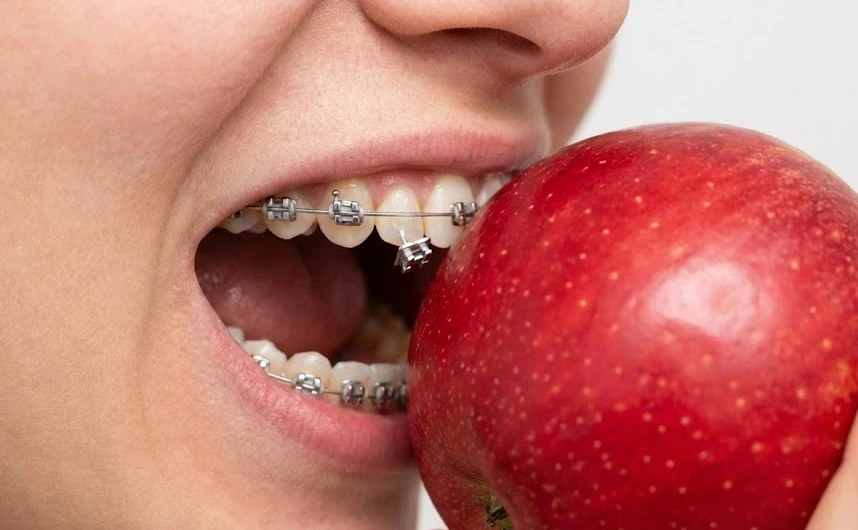
Actually, in most cases, brackets popping off isn’t due to the failure of the adhesive. It’s that the shear force generated by the food was more than the bond strength of the adhesive.
Try to picture your bracket as a climber who’s hanging on a rock face (your tooth) by the strength of his fingers only. The wire here represents the safety rope that connects all the climbers. If that climber is suddenly hit (a hard almond) or pulled (caramel), he will inevitably lose his hold.
The majority of broken appliance cases that Lema Dental Clinic have to deal with are caused by dietary mistakes. Dentist Polen Akkılıç and her team continually emphasize this point as they understand that you are more likely to enjoy your stay in Istanbul than being in the repair chair.
Foods That Destroy the Bond
The biggest enemy of orthodontics is hard and crunchy foods. They are so dangerous that even if you don’t risk popping a bracket, a crunch could permanently bend the archwire. In fact, a bent wire means that your teeth won’t be able to move or will even move the wrong way until the wire gets replaced.
Here are the things we are strictly against:
- Ice: The main culprit. By chewing on ice, you unleash a force wave.
- Nuts: Almonds, cashews, and peanuts are well-known to be extremely dangerous for braces.
- Popcorn: The popcorn fluff is not the problem; the unpopped kernels are. One bite on a “maid” (unpopped kernel) can shear a bracket instantly.
- Hard Candies: Lollipops or Jolly Ranchers are like a double whammy—sugar for decay and hardness for breakage.
The “Sticky” Trap: Foods That Pull and Tangle
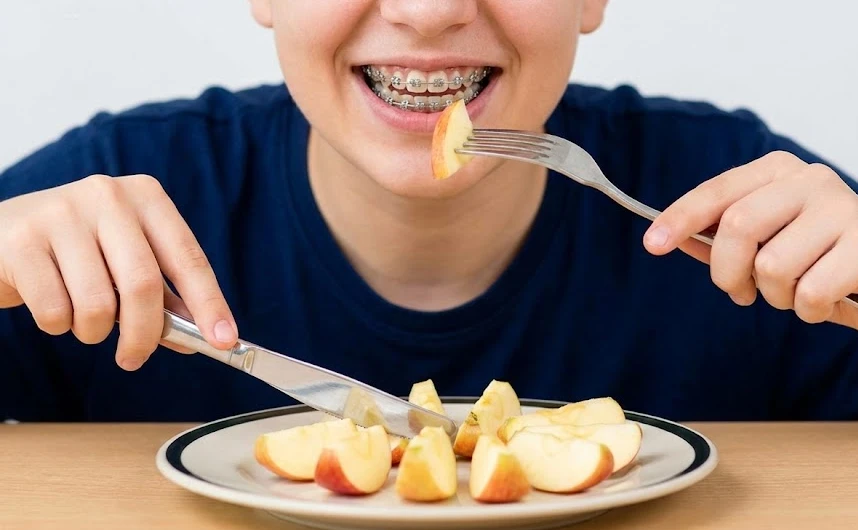
If hard foods are the hammer, then sticky foods have to be the glue trap. These foods get wrapped around the intricate wires and hooks, creating a nightmare for hygiene and at the same time the pulling force weakens the adhesive gradually.
We have witnessed patients contemplating the consumption of chewing gum or taffy, after which the wire was pulled completely out of the molar tube.
- Chewing Gum: Yes, even sugar-free. It’s just too cohesive.
- Caramel and Toffee: They behave like cement once they cool in your mouth.
- Gummy Bears/Worms: They not only demand a great deal of chewing power but also get stuck in places where your toothbrush does not reach.
The “Safe vs. Sorry” Food Matrix
Just to make it easier for you to understand (pun intended), here is a chart on how you can change your cravings into orthodontic-friendly choices.
| Food Category | FORBIDDEN (The Danger Zone) | The Risk | THE LEMA SAFE ALTERNATIVE |
| Fruits & Veggies | Whole Apples, Raw Carrots, Corn on the Cob | Shearing off front brackets | Steamed carrots, Apple slices, Corn cut off the cob |
| Breads | Hard Pizza Crust, Bagels, French Baguettes | Bending wires while tearing | Soft tortillas, Muffins, Pancakes, Soft-crust pizza |
| Meats | Beef Jerky, Steak on the bone, Ribs | High chewing force required | Meatballs, Tender chicken, Fish, Burgers |
| Snacks | Popcorn, Nuts, Pretzels | Wedging between wire and tooth | Hull-less popcorn (risky but better), Yogurt, Soft cheese |
| Sweets | Caramel, Taffy, Licorice | Pulling brackets off | Ice cream, Smoothies, Chocolate (without nuts) |
The Silent Saboteur: Sugar and Acids
However, structural damage is the main concern, Dentist Polen Akkılıç points out less obvious danger: decalcification.
In addition to wearing braces, you have provided bacteria with dozens of new hiding places. Sugary and acidic foods (like soda, energy drinks, and excessive fruit juice) can cause “white spot lesions.” These are the permanent white scars left on your teeth after the removal of your braces.
It is indeed very sad to unveil a well-aligned smile only to have it flanked by discoloration squares. Our advice to patients is to cut down on sugar and, if they have to, to rinse their mouths with water immediately after eating.
Adapting Your Lifestyle in Turkey
While in Turkey, you will be tempted by not only our delicious food but also several other attractive things. The good news is that a lot of Turkish food can be eaten even during orthodontic treatment. Köfte (meatballs), Dolma (stuffed vegetables), and Çorba (soup) are all great, soft dishes that won’t harm your treatment.
Nevertheless, you should be careful with Lokum (Turkish Delight). If it is not the extremely soft, freshly made, nut-free type, its sticky texture can be very harmful to metal wires.
FAQ: Direct Insights from Our Doctors
You absolutely can, but you have to change how you eat it. The soft inner part is fine. The danger lies in the hard, crispy crust. We recommend leaving the crusts on the plate or dipping them in sauce until they are completely soft.
Do not panic. It happens more often than you think. In the vast majority of cases, the bracket will pass through your digestive system harmlessly. However, please call us at Lema Dental Clinic immediately so we can schedule a repair to keep your treatment moving.
Technically, it won’t cause cavities, but mechanically, it is still a risk. It can bend the wires at the back of your mouth without you realizing it. We generally advise patients to simply give up gum for the duration of the treatment. It’s not worth the extra month in braces.
A soft burger is usually safe, but big, thick gourmet burgers can be tricky. Biting into them forces your front teeth to do heavy lifting they aren’t designed for right now. It is safer to cut the burger in half or use a knife and fork.
Many patients do report losing a few kilos in the first month, simply because they stop mindless snacking on chips and nuts! But rest assured, there are plenty of delicious soft foods (like pasta and ice cream) that will keep you well-fed.
- Proffit, W. R., Fields, H. W., & Sarver, D. M. (2018). Contemporary Orthodontics. Elsevier Health Sciences.
- Bishara, S. E., & Trulove, T. S. (1990). Comparisons of different debonding techniques for ceramic brackets: An in vitro study. American Journal of Orthodontics and Dentofacial Orthopedics, 98(3), 145-153.
- Hammad, S. M., et al. (2013). Effects of chewing gum on the force degradation of some orthodontic elastomeric chains. Journal of Orthodontic Science, 2(3), 95.
- Sondhi, A., & Schrudt, J. (2001). Dietary habits and their effect on orthodontic bracket bond failure. Journal of Clinical Orthodontics, 35(12), 723-726.
- Kula, K. S., & Ghoneima, A. A. (2016). Impact of Diet on Orthodontic Treatment Outcomes. Wiley-Blackwell.

