


Dental crowns are customized replacements for teeth that have undergone damage, are very weak, are filled with many fillings, or are unattractive. These dental restorations restore the original appearance and functionality of the tooth as well as enhance its physical strength.
Crowns can also cover dental implants or form dental bridges. The choice of the ideal material for a crown depends on many factors like the position of the tooth in the mouth, how well the person bites, their desire for aesthetic qualities, how much of the tooth is left, and their financial capacity.
Various Types of Dental Crowns in Turkey
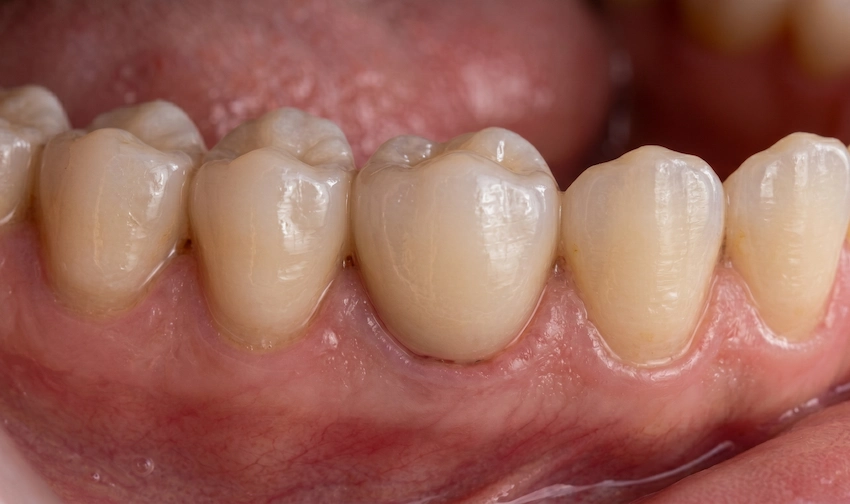
Besides, dental crowns are available in different materials. The strength, durability, natural aspect, and cost of each material are in a different combination.
Popular dental crown types are:
- Single-layer zirconia crown
- Two-layer/ Multi-layer zirconia crown
- Pure porcelain/glass crowns
- Porcelain-fused-to-metal crowns
- Gold crowns
- Resin or plastic crowns
- Temporary/provisional crowns
No crown material would be a good choice for every individual. One would want a tooth-colored ceramic restoration for a front tooth, while a molar crown with high resistance might be better made of zirconia if it’s constantly getting the heavy chew action.
First, the dentist should be the one to take into account the remaining teeth, gum health, bite line, whether the patient suffers from bruxism, and what the patient desires.
A few considerations when planning a ceramic crown are where the crown is going in the mouth, which tooth is being used,d as well as what part of the teeth the patient would show. The tooth that is being used to restore should be strong enough. The color of metal used in the crown needs to match the patient’s natural tooth color to have the best effect.
Porcelain Crowns vs. Metal Crowns in Turkey
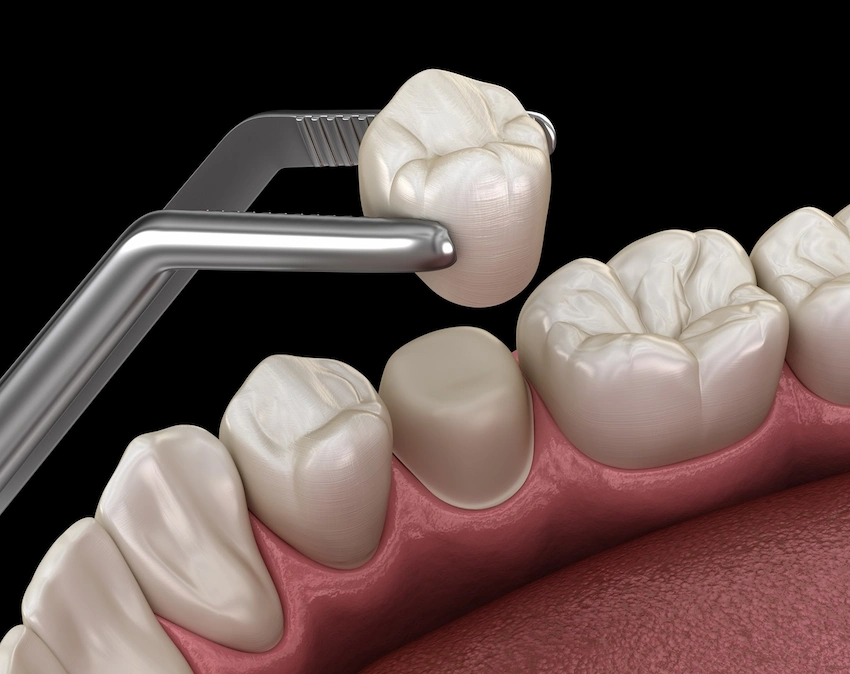
The porcelain material is the one that offers an aesthetic appearance, which is the main reason people go for this kind of crown. It can blend perfectly with the teeth next to it by changing the color to a different shade. So, they are an ideal option if someone looks at the area for the biggest portion of the time.
Nevertheless, the type of old-time-style porcelain might be more brittle and prone to fracturing. If the person’s chewing forces are strong and they do not control their teeth biting and grinding, it might be wise to select another kind of durable material.
Metal crowns have proved to be quite resistant to the bite force; thus, they break or bend very rarely, if ever. They have been traditionally used in crowns made of gold, palladium, or other alloys. Metal crowns, however, have the drawback of not being aesthetic but having a metallic color instead.
Crowns made of porcelain-fused-to-metal contain both a metal sub-structure and a porcelain covering in different colors for different teeth. Even though these are tough and pretty enough, the porcelain might get chipped, and in some cases, one sees the metal line darkly behind the gum.
It’s not surprising that zirconia and ceramic crowns are now widely preferred due to the fact that these two are tooth-colored and completely without metal.
Ceramic Crowns in Turkey: An Aesthetically Enhancing and Long-Lasting Alternative
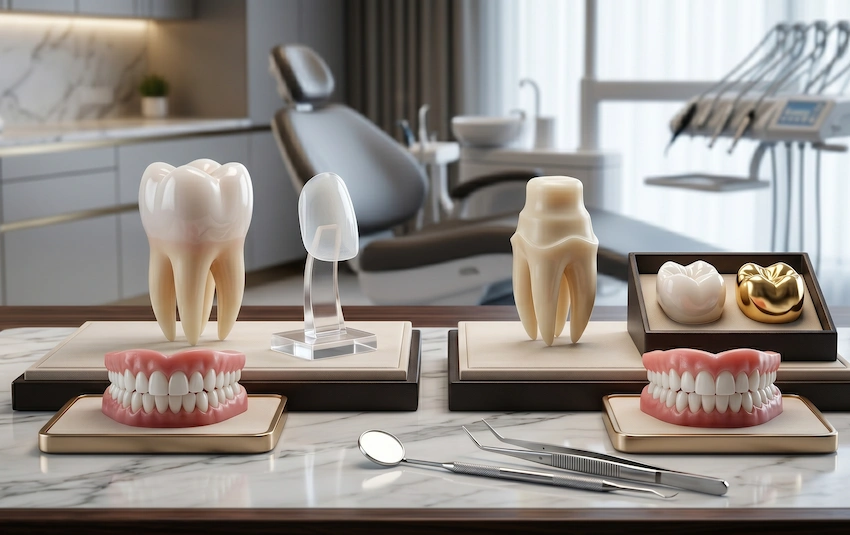
Ceramic crowns are restorations devoid of metal, which are mainly made to have a very similar look to natural teeth in coloration. These are the main types of crowns chosen for the visible front areas.
Different ways of making ceramics include:
- Fieldspathic porcelain system
- Bonded lithium disilicate system
- Pressed or injection ceramic
- Two-layered zirconia and more
Among ceramic materials used in a clinical setting, those of disilic lithium, such as E-max, are a popular choice for the provision of an esthetically pleasing dental service. These have good translucency and result in lifelike restorations.
Major benefits of a ceramic crown are:
- Perfect color of the real tooth
- The edge of the metal is hidden
- Very little discolouration
- Metal free
- Dental technology compatibility
Whether the tooth preparation is good, the quality of lab work, the shade of the color the technician selects for the restoration, the method of bonding, and finally, the bite are important factors in determining the outcome of dental treatment with ceramic crowns.
A Detailed Look at Expenses in Turkey
The price for a dental crown mainly varies with the material, the level of aesthetics, the type of manufacturing, the time and skills required in the dental laboratory and the dental clinic, and the degree of treatment needed. Based on the present unit cost, the expected price intervals are:
| Restoration Type | Main Features | Approximate Price Range per Tooth |
|---|---|---|
| Ivoclar ZirCAD Zirconia Crown | Durable, metal-free, and suitable for both front and back teeth | €160–€190 |
| Ivoclar Prime Aesthetics Crown | Premium-looking zirconia with natural color transitions and high translucency | €220–€260 |
| E.max Veneer | Thin, highly aesthetic lithium disilicate restoration mainly used for visible front teeth | €240–€280 |
Please note that dental crown prices may vary slightly over time due to economic factors such as market conditions, foreign exchange rates, laboratory costs, and changes in the production or pricing policies of material manufacturers. The cost may also differ depending on the crown material selected and the individual requirements of your treatment. We recommend contacting our patient coordination team directly to request the latest personalized quotation based on your treatment plan and intended travel dates.
E-max ceramics are also listed as a cosmetic option, despite being technically different from standard dental crowns.
Patient-specific variables might influence final treatment cost, such as:
- Root canal procedure
- Infection cleaning
- Gum disease management
- Extraction of teeth
- Core buildup
- Temporarily covering
- Prothesis
- Scaffolding of soft tissue
- Somatic bone grafting
- New diagnostic imaging
After an individual diagnosis and dental imaging, a patient should obtain a personal treatment proposal; clinics such as Lema Dental Clinic of Istanbul can carry out the dental survey and advise about appropriate material according to both the clinical and aesthetic needs of the patient.
Zirconia Crowns in Turkey: Combination of Strength, Durability, and Realistic Look
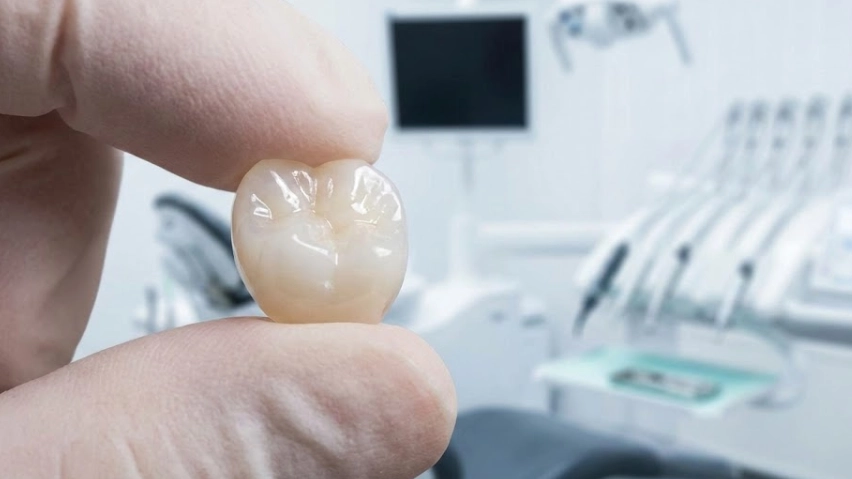
Zirconia crowns are made of a strong and tooth-colored ceramic material named zirconium dioxide. Zirconia crowns are mostly recommended for molars, incisors, dental implants, and dental bridges.
Ivoclar ZirCAD zirconia crowns combine strength, a lifespan, and a look that is very close to natural teeth and is suitable especially in cases involving large occlusal forces and patients who prefer restorations without the use of metals.
Different kinds of zirconia crowns exist.
A solid zirconia block is the base for monolithic zirconia crowns. When the major problem is the crown strength, the dentist would commonly refer to this type.
Layered or multi-layered zirconia crowns give a tooth-like surface and color gradient through their depth. If appearance plays the main role, particularly on front teeth, they may be considered the best.
Compared to standard opaque zirconia, Ivoclar Prime Aesthetics crowns are translucent enough and very natural-looking. As it is a multi-layered structure, the differences in the color of the crown in the cervix, middle, and incisal portions mimic the real tooth.
Although zirconia is very strong, there may still be some problems, e.g., crown loosening, cement bond failure, porcelain chipping. Incorrect adjustment of bite and opposing tooth wear are also possible.
Gold Crowns in Turkey: Durable and Budget-friendly
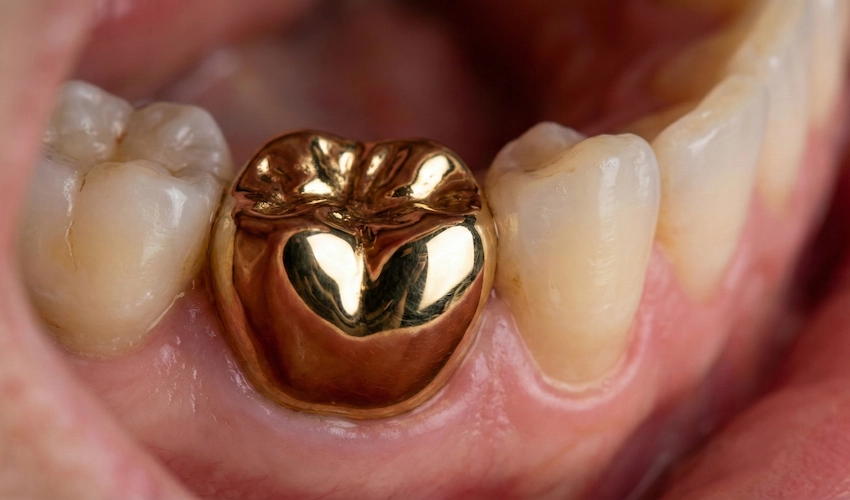
High-performance gold metal alloys that are mainly used by many gold crown manufacturers can be of great help to patients who are in urgent need of a restoration that should withstand heavy and frequent occlusion without getting broken or worn out for a long time. They also exhibit great resistance to corrosion and have the durability of metals.
The fact that gold is not a brittle metal means that, unlike porcelain, it does not chip. On the other side, the gold crown, in many cases, may be less damaging to the underlying tooth tissue compared with certain ceramic restoration methods and less invasive overall.
One of their primary drawbacks is the metal-like color. Consequently, gold crowns are usually selected to cover posterior teeth rather than anterior teeth where the restorations are highly visible.
On the other hand, due to the expense of the materials used, such as alloy containing gold, a gold crown may carry a higher price tag at the outset, but it might be economical in the long run since its longevity is greater and the maintenance and replacement needs are reduced.
Gold crowns are a viable solution mainly for people who:
- Have a strong bite
- Are prone to grinding their teeth
- Have had ceramic crowns fracture repeatedly
- Need tooth restoration on the back molar
The dentist needs to examine the patient before recommending the metal type because it must be taken into account that the patient may have a metal allergy, different occluding forces, and dental aesthetics requirements.
Temporary Crowns in Turkey: Reasons and Technique
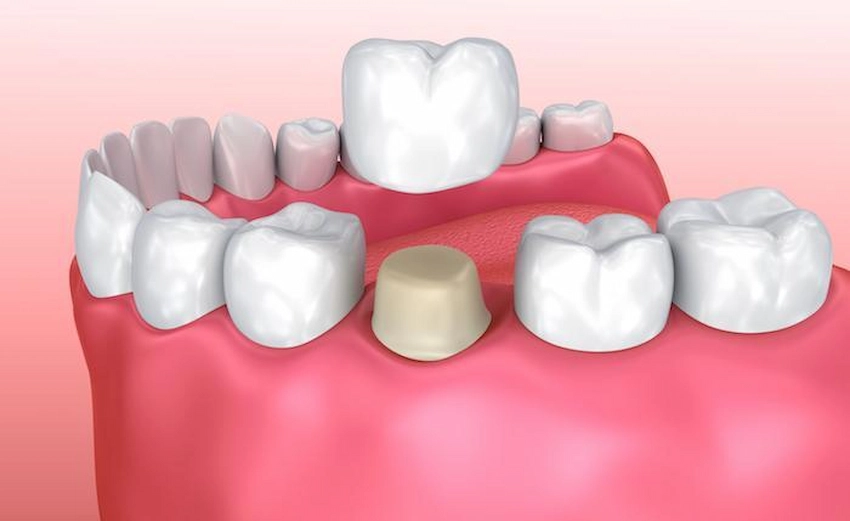
A temporary crown is put on a prepared tooth to protect it during the production of the definitive crown.
Advantages of temporary crowns include the fact that they:
- Reduce tooth sensitivity
- Protect the tooth from further damage
- Ensure the appearance of the tooth is maintained during treatment
- Inhibit nearby teeth from shifting
- Facilitate chewing
- Minimize gum problems around the prepared tooth area.
Acrylic, composite resin, bis-acril, PMMA, or digitally printed resins are used in the fabrication of temporary crowns.
They are secured to the tooth with temporary cement, which enables the dentist to remove the temporary crown for placing the permanent one.
During the first weeks after receiving a new permanent crown, a patient is strongly advised not to eat hard or sticky foods, as these could break or pop out the temporary crown. Examples of items to avoid include ice cubes, shelled nuts, chewing gum, taffy, or any other sweet that has a very sticky texture.
When flossing, instead of lifting upward, it should be pulled out from the side. In this way, the chance of the temporary crown coming out will be significantly reduced.
A temporary crown is not meant to withstand the same level of strength and time-to-time durability as a zirconia or ceramic permanent crown.
FAQ: Types Of Dental Crowns And Their Costs in Turkey
What is the cheapest option?
Ivoclar ZirCAD zirconia restoration is a very popular choice in this particular area, as it is the cheapest crown type in the comparison list. Its base price is about €170; however, the final cost could be modified with other procedures performed.
How much does an Ivoclar Prime Aesthetics crown cost?
An Ivoclar Prime Aesthetics crown has a unit price of approximately €240 per crown. It is usually priced between €220 and €260.
What is the cost of one E-max veneer?
A single E-max veneer costs around €260, and the cost can be between €240 and €280 based on the complexity of the treatment.
Which dental restoration looks more natural?
Ivoclar Prime Aesthetics zirconia and E-max laminates offer the best results in terms of both light transmission and the appearance of natural tooth shade gradients and blending in with adjacent teeth. Which option to choose will depend on whether it is a dental restoration with full coverage (e.g., crown) or a more conservative option like a dental veneer.
Which dental restoration is the weakest?
A dental crown made of pure zircon (monolithic zircon crown) is among the toughest tooth-colored dental crown materials. It has been shown from clinical experience and studies that it is often a gold standard recommendation, e.g., in the case of molars, implants, and the presence of very strong chewing force.
Are E-max veneers the same thing as dental crowns?
Not quite. A veneer is a thin cover placed over only one side (front) of the tooth, while a dental crown encases the largest part of visible tooth structure.
Should I get myself a zirconium dental crown for my front tooth?
Yes. The front teeth can be restored with translucent and multi-colored zirconium. Prime Aesthesia Zirconium crowns offer the most natural appearance for the parts of the smile where the teeth are highly displayed.
Would the price of the crown include any other restorative work?
Treatment that involves additional dental work such as canal cleaning, gum disease treatment, infection cleaning, extraction, implant surgery, temporary restorations, etc. is likely to be billed separately. The treatment plan should outline each item either as included or as an additional fee item.
Academic References
- Sailer I, Makarov NA, Thoma DS, Zwahlen M, Pjetursson BE. All-ceramic or metal-ceramic tooth-supported fixed dental prostheses? A systematic review of survival and complication rates. Part I: Single crowns. Dental Materials. 2015;31(6):603–623.
- Sailer I, Pjetursson BE, Zwahlen M, Hämmerle CHF. A systematic review of the survival and complication rates of all-ceramic and metal-ceramic reconstructions. Clinical Oral Implants Research. 2007;18(Suppl 3):86–96.
- Chen H, Li T, Ng JPZ, Almeheni L, Li KY, Burrow MF. Clinical performance of zirconia-based tooth-supported fixed dental prostheses: A systematic review and meta-analysis. Journal of Dentistry. 2024;151:105382.
- Zarone F, Di Mauro MI, Ausiello P, Ruggiero G, Sorrentino R. Current status on lithium disilicate and zirconia: A narrative review. BMC Oral Health. 2019;19:134.
- Alzahrani SJ, Hajjaj MS, Azhari AA, Ahmed WM, Yeslam HE, Carvalho RM. Mechanical properties of three-dimensional printed provisional resin materials for crowns and fixed dental prostheses: A systematic review. Bioengineering. 2023;10(6):663.

