


First things first, it’s not breaking news that teeth are not only meant for bubblegum chewing or taking a perfect selfie. In fact, behind each and every shining tooth is a world of sensitivity evoked by the presence of something hardly anybody thinks of: the tooth nerves.
These small dynamites are really the cause of your sensing, reacting, and sometimes even occurring to protect your mouth from bigger dental problems. But when they malfunction, nature will put you through intense pain. If you’ve ever felt a sharp sting from ice cream or had a severe throb lingering all night long, then you have met your tooth nerve in a quite cruel way.
Quality dental treatment is the right of anyone who comes to Lema Dental Clinic in Istanbul, Turkey. To diagnose nerve problems, we use the latest technology, such as digital X-rays and 3D imaging. Additionally, the expertise of our staff and our minimally invasive techniques allow us to select the least painful, most efficient, and long-lasting alternatives to achieve a Hollywood Smile for you.
What Are Dental Nerves and Where Are They Located?
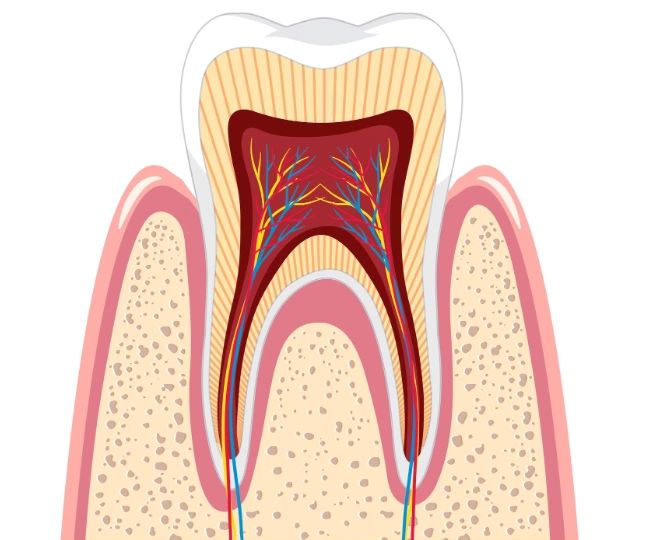
Let’s do a brief exploration of your tooth from the interior to the exterior. Each tooth comprises three main parts:
- Enamel – the hard outer covering (like a helmet).
- Dentin – the yellowish middle layer, rich in nerves and blood vessels.
- Pulp – the inside of the tooth, home to the nerves, blood vessels, and connective tissue.
The soft pulp is where the main trigger of the senses is. This pulp spreads down through long, thin channels called root canals, connecting the tooth to the jawbone. Look at the dental pulp as the brain of your tooth; it always functions and adapts to its surroundings.
What Tooth Nerves Teach Us About Oral Health
The reasons why tooth nerves are important are as follows:
- Protection: Nerves alert you to a damaged or infected tooth, preventing minor issues from becoming major ones.
- Sensation: Nerves allow us to feel textures, which is important for precise chewing and speaking.
- Circulation: The pulp sustains the tooth with necessary nutrients and blood supply, especially during development.
Your tooth nerves are part of your body’s alarm system. Without them, problems like cavities or cracks could go undetected until the tooth breaks.
The Most Common Causes of Tooth Nerve Pain

1. Tooth Decay (Cavities)
The acidic environment created by plaque erodes the enamel. Once decay reaches the dentin and then the pulp, the nerve is exposed, resulting in severe pain.
2. Infection (Abscess)
If bacteria invade the pulp, it becomes infected. The infection can become so painful that it necessitates a root canal.
3. Trauma or Fracture
A cracked or broken tooth, no matter how minimal, can directly expose or irritate the nerve. Sometimes, the nerve dies slowly, leading to tooth discoloration.
4. Grinding (Bruxism)
Grinding your teeth wears down enamel, exposing the dentin and increasing tooth sensitivity. This pressure can lead to pulp inflammation over time.
5. Gum Recession
Receding gums can expose the tooth root, which does not have enamel. As a result, the nerves can be easily angered by heat or cold.
Treatments for Tooth Nerve Pain

Dental Fillings
When the cavity is minor and not affecting the root, a filling can heal the tooth and leave you infection-free.
Root Canal Treatment
This involves removing the damaged pulp, cleaning the root canal, and sealing the tooth. It’s a painless procedure that allows you to keep your natural tooth.
Tooth Extraction
If the tooth is too severely damaged to be saved, it will have to be pulled. A dental implant or a bridge can then fill the void.
FAQ: Frequently Asked Questions About Tooth Nerves
Are tooth nerves connected to the brain?
Yes! Through the trigeminal nerve, tooth nerves send pain and pressure signals directly to your brain.
What causes nerve pain in teeth?
Common causes include deep cavities, dental infections, trauma, grinding, or even gum recession exposing the sensitive root.
Can a damaged tooth nerve heal on its own?
In mild cases, inflammation may calm down. But once the nerve is seriously infected or dead, professional dental treatment is needed.
What are the symptoms of an inflamed tooth nerve?
Sharp, throbbing pain, sensitivity to hot and cold, swelling, or pain when chewing are all signs that your tooth nerve may be inflamed.
How is tooth nerve damage treated by a dentist?
Treatment may involve a filling, crown, root canal, or extraction, depending on the severity. Antibiotics might also be prescribed if there’s an infection.

