


Pterygoid implants use strong back-jaw bone, so sinus lifts are often avoided.
Maxillary atrophy can be truly heartbreaking! The posterior maxillary bone gets so severely resorbed that it stops full-arch implants dead in their tracks. It’s so disheartening to witness the patients’ defeated expressions every week. They really expect the osseointegration and a new life when they come in, but what they get is a major clinical barrier due to their atrophic jawbone.
In the past, the only dental industry solution to this problem was traditional sinus lift surgery. The conventional clinical protocol involved sinus floor elevation. So, they would have to surgically implant the bone graft material into the maxillary sinus cavity, wait about one year, and hope that the healing process would result in dense enough bone to support the titanium fixture.
But what does the anatomy say? If you try to build a permanent dentition on a resorbed alveolar ridge, you are basically trying to fix steel into loose sand. It is impossible to secure a dental prosthetic into weak, hollowed-out bone.
Actually, maxillofacial surgery has been modernized. By going after the extremely dense, permanent cortical bone located deeper within your skull, we can bypass the vulnerable sinus cavity altogether.
This is where pterygoid dental implants come in.
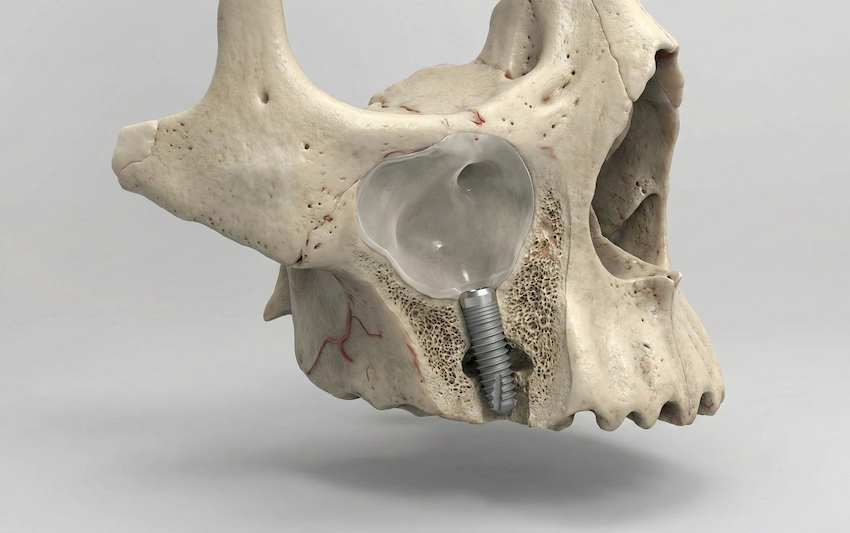
What Are Pterygoid Dental Implants?
Pterygoid dental implants are quite different from common implants. They are long and made of titanium. What makes them special is that they have been designed to specifically overcome cases of extreme maxillary bone loss without bone grafting.
So, instead of putting normal implants vertically into the bad alveolar bone, we place them backward, at an angle. They are directly fixed into the pterygomaxillary complex, which is a very dense pillar of cortical bone located at the upper jaw and the sphenoid bone introduction point.
If we equate the atrophic maxilla to a weak drywall sheet, then the pterygoid plate would be the load-bearing steel beam just behind the drywall. Mechanically speaking, once surgical anchoring of prosthetic teeth is done on this dense anatomical “steel beam,” immediate stability is achieved.
The Clinical Problem(s) with Traditional Sinus Lifts
The whole point of a sinus lift is to create some bone to put an implant in, but the procedure is very invasive and requires the skill of a maxillofacial surgeon. And the result after all is that the patient is waiting for the graft to solidify into bone,- 6, 7, or 9 months wearing loose temporary dentures.
The big issues in the clinic come down to:
- Patients are waiting for 6 to 9 months to have a solid bone graft while still wearing loose temporary dentures.
- The surgical complications are membrane perforation and acute sinus infection, which are moderate to high risks in clinical settings.
- Multiple phases of surgical intervention – first, the bone grafting is done,e and then several months after the actual implant placement.
One has to wonder why go through a year of invasive grafting when there is a direct biomechanical bypass available?
The Lema Protocol: Advanced Maxillofacial Precision
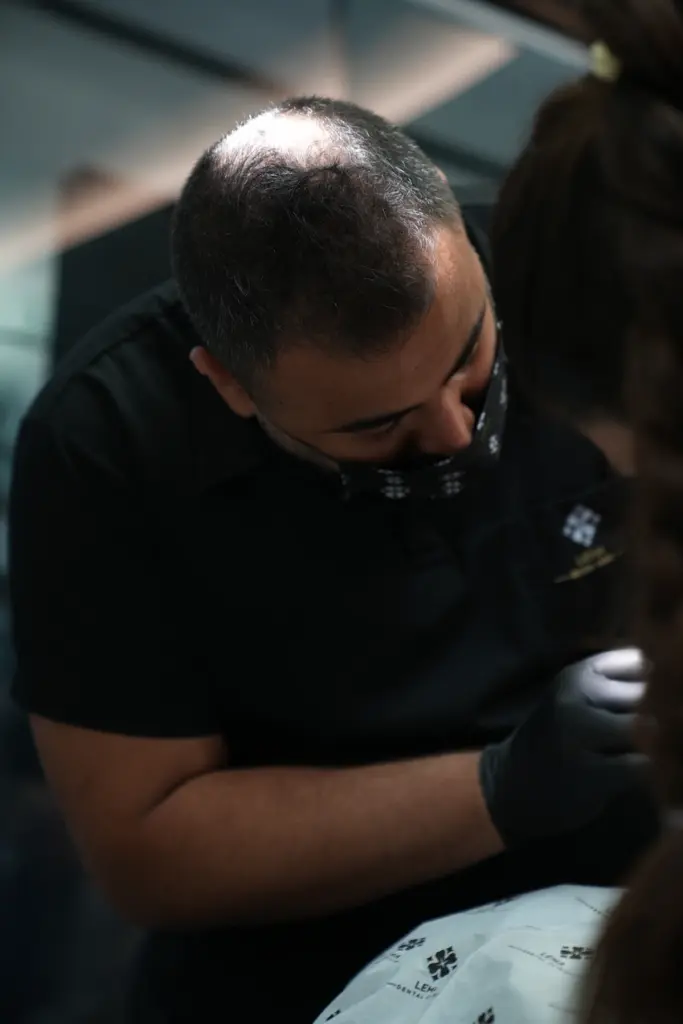
At Lema Dental Clinic, we have become a reference point for treating even the most severe cases of atrophy, as evidenced by hundreds of our patients being rehabilitated every year. One of the things that makes our clinic special is the use of an advanced 3D volumetric tomograph,y along with Professor Doctor Coşkun Yıldız and Dentist Polen Akkılıç. This specific diagnostic imaging maps the exact safe surgical trajectory to your pterygomaxillary suture even before the surgical procedure begins.
Cortical bone in the pterygoid region is virtually resistant to resorption (shrinkage) over time, which means that your long-term clinical prognosis will be exceptionally secure.
For our international patients in dental tourism, immediate functional restoration is the point. Our clinical team, by performing immediate loading protocols, can be sure that pterygoid dental implants grip the cortical bone so well. After your oral surgery, you will come out of our clinic that same afternoon with fixed, temporary acrylic prosthetics.
Clinical Comparison: Sinus Floor Elevation vs. Pterygoid Implants
| Clinical-feature | Traditional Implants + Sinus Lift | Pterygoid Dental Implants |
| Treatment Timeline | 8 to 12 months (Delayed Osseointegration) | 3 to 7 days (Immediate Loading) |
| Surgical Interventions | Multiple (Bone Grafting, Healing, Implant Placement) | Single Surgical Phase |
| Bone Graft Required? | Yes, extensive synthetic or autogenous graft | No |
| Maxillary Sinus Risk | Moderate to High (Membrane tears, infection) | Zero (Bypasses the sinus cavity entirely) |
| Bone Density Achieved | Variable (Depends on graft success) | Excellent (Type 1 or 2 dense cortical bone) |
Frequently Asked Questions
It is only natural to fear elongated implants as a patient. In fact, the pain after the operation is usually less than that of a traditional sinus lift. We totally avoid the very innervated Schneiderian membrane, which is the main cause of pain in sinus lifts. The deep cortical bone chosen for the implant site has very few pain receptors.
Certainly. Indeed, a severely resorbed posterior maxilla is the very reason for which this surgery is done. The alveolar bone melts after decades of denture use due to the absence of masticatory stimulation. Nevertheless, the pterygoid bone is able to resist this atrophy. It is like your body’s permanent, structural anchor point.
Pterygoid dental implants require very advanced surgical skills, and maxillofacial surgery training is needed. It is the least known part of the standard dental school curriculum. Furthermore, most local clinics are not used to doing these surgeries in terms of the anatomical complexity and risk that navigation of the vascular structures entails. So, they go with the older sinus floor elevation technique as their default.
Your initial surgical phase will last for only a few days at Lema Dental Clinic.
We install titanium fixtures and fixed, temporary prosthetics for you, so that you have an immediate aesthetic restoration. After that, a few months later, you come back to Turkey for a very short final appointment for placing your permanent, customized zirconia restoration. After that, your soft tissue heals.
Definitely. Consider the pterygoid plates as the load-bearing walls of your skull. These structures naturally take up the huge mechanical forces that your masseter muscles generate during chewing. Therefore, having dental prosthetics attached to these implants restores your bite force to that of a healthy, natural dentition.
- Tulasne, J. F. (1989). Osseointegrated fixtures in the pterygoid region. In: Advanced Osseointegration Surgery: Applications in the Maxillofacial Region, 182-193.
- Candel, E., Peñarrocha, D., Peñarrocha, M., & Peñarrocha, M. (2012). Rehabilitation of the atrophic posterior maxilla with pterygoid implants: a review. Journal of Oral Implantology, 38(S1), 461-466.
- Bidra, A. S., & Huynh-Ba, G. (2011). Implants in the pterygoid region: a systematic review of the literature. International Journal of Oral & Maxillofacial Surgery, 40(8), 773-781.
- Graves, S., Mahler, B. A., Javid, B., & Armellini, D. (2015). Maxillary all-on-four therapy using angled implants: a 16-month clinical study of 1110 implants in 276 jaws. Dental Clinics of North America, 59(2), 299-314.
- Rodriguez, X., Vela, X., Mendez, V., Segura-Mori, L., Calvo-Guirado, J. L., & Tarnow, D. P. (2016). The effect of abutment dis/reconnections on peri-implant bone resorption: a radiologic study of neutrally inserted implants. Clinical Oral Implants Research, 27(1), 1-6.

