


They are suitable for patients with severe bone loss who cannot receive traditional implants.
The world of dental restoration often seems a binary one where you either have enough bone for implants or you don’t. Patients who fell into the “don’t” category for years were either ignored or given a set of loose and ill-fitting dentures.
But things are different now.
In our dental practice in Turkey, we encounter patients each week from abroad who had been told their case was “hopeless” because of the severely atrophied alveolar bone. They come to us fully convinced that the fixed dental prosthesis is a thing of the past. And it definitely isn’t. This is exactly what subperiosteal implants are for ‑ a highly advanced, precisely tailored, and custom-made implant that makes it possible to implant the prosthesis without having to rely on the existing bone at all.
We can discuss the details of this treatment, including who the ideal candidates are, the reasons why it is different from a standard treatment and the expertise of Professor Doctor Coşkun Yıldız who is highly experienced in complex cases like these.
The Foundation Problem
Imagine the jawbone as garden soil. Trees need deep, compact soil (bone) in which they can have their roots. If the soil has washed away by erosion, you just cannot plant a tree. It will fall over.
Simply put, the jawbone shrinks (resorbs) over time after you lose teeth. If you have been using dentures for many years or have suffered from poor gum condition, that “soil” might just have disappeared.
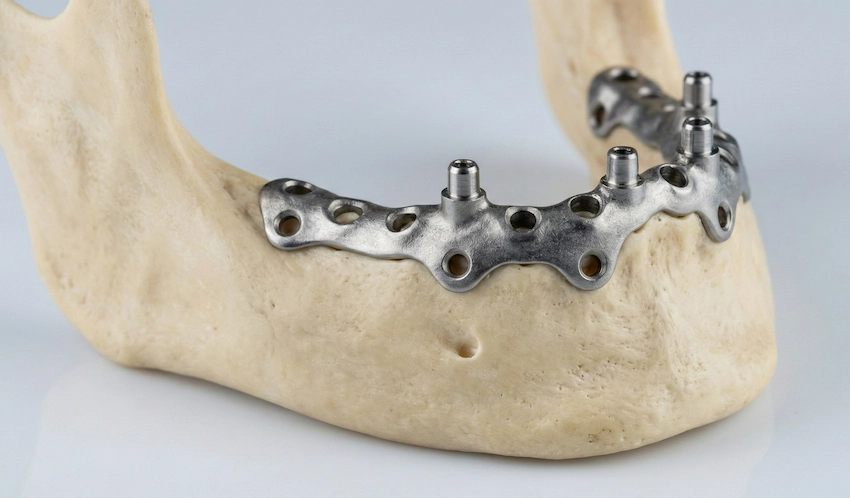
The subperiosteal implant technique is a change of game. We do not insert a root into the bone; instead, a tailor-made metal framework is placed on the top of the bone beneath the gum. It’s like a custom saddle fitting the curve of your jaw giving the new teeth a very stable base without having to screw into the bone deep below.
Perfect Candidate
Not everyone requires such an intervention. To tell you the truth, most patients at Lema Dental Clinic get satisfactory results from the conventional All-on-4 or All-on-6 treatments. Subperiosteal implants are for use as a last resort only.
You may be a good candidate if:
- You Have Severe Bone Loss: There is not enough bone height/width in your jaw for regular implants, and your ridges, especially your lower jaw (mandible), are practically “flat.”
- Bone Grafting Not Possible or Has Failed: You might have attempted bone grafting and it failed or your health condition precludes the long healing duration and therefore the risk and uncertainties of bone grafting.
- Inability to Wear Dentures: Many of our patients simply cannot tolerate removable dentures either because of their sensitive gag reflex or chronic rubbing which causes sores because the prosthesis keeps moving on a flat jawbone.
- Need for Instant Functionality: In contrast with complicated grafting treatments requiring from 6 to 12 months of healing, subperiosteal frameworks are custom-designed and often allow for much quicker restoration of function.
A Clinical Perspective from Lema Dental Clinic
Dentist Polen Akkılıç and team frequently look into panoramic X-rays of international patients even before they come to Turkey for treatment. We find and evaluate different anatomical landmarks. For instance, if the inferior alveolar nerve (in the lower jaw) is very close to the bone crest due to atrophy, drilling is risky.
In such fragile cases, a subperiosteal implant is a safer option because it is placed over the safe layer rather than inside it. It is in harmony with your anatomy instead of forcing your anatomical features to be ‘drilled’ and ‘screwed’.
Comparing Your Options: Standard vs. Subperiosteal
Below is a list of important differences between the regular treatment and this more advanced treatment designed to help you picture the difference clearly.
| Feature | Standard Dental Implants | Subperiosteal Implants |
| Placement | Inserted into the jawbone like a screw | Placed on top of the bone, under the gum |
| Bone Requirement | Requires adequate bone height and width | Requires minimal bone or none |
| Treatment Time | 3–6 months (longer if bone grafting is needed) | Generally shorter; custom framework prepared in advance |
| Invasiveness | Medium; involves drilling into the bone | Medium to high; requires gum flap reflection |
| Best For | Patients with healthy or moderately resorbed bone | Patients with severely atrophied (resorbed) jaws |
The Procedure: Precision Engineering
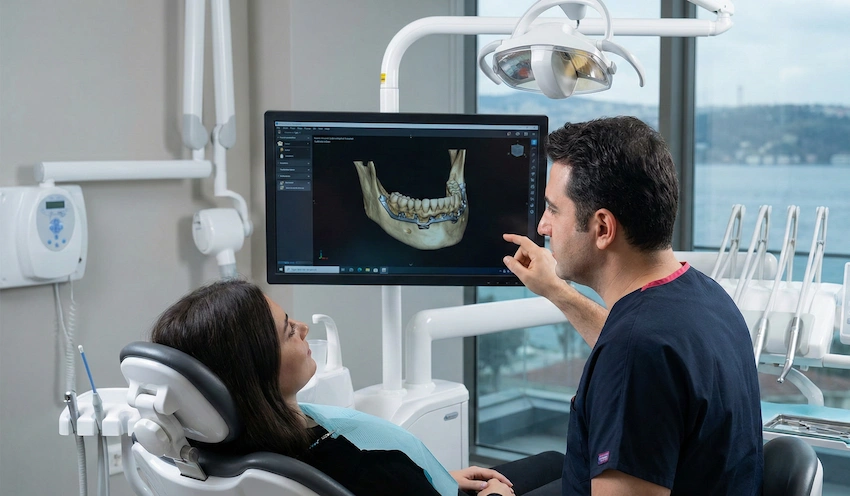
We heavily rely on digital technology in the method we employ. Engineering, not guesswork, is what we are talking about here.
- CBCT Scan: A 3D scan of the jawbone that you have been left with is taken for us.
- 3D Modeling: Your digital jaw is produced through a computer.
- Custom Fabrication: The implant framework is created by 3D printing (usually by the method of Direct Metal Laser Sintering) out of medical-grade titanium so that it perfectly fits the bone surface.
- Placement: The surgeon incises the gum, places the device directly on the bone and sutures the cut to cover the implant. The abutments are left out for the attachment of the crowns.
It’s a highly skilled surgical procedure. This is not a “regular” treatment you find in every dental institution. Only the skillful maxillofacial surgeon like Prof. Dr. Coşkun Yıldız, who fully knows the exceedingly fine biology of the periosteum (connective tissue that covers the bone) can deliver this.
Frequently Asked Questions
A large number of patients marvel at how little pain they experience. Since the drill is not perpendicularly penetrating the bone marrow, the post-surgical deep bone pain is normally less with subperiosteal implants than with the conventional ones. You will be tender and swollen in the soft parts because we have to raise the gums to place the framework, but we take good care of you with medications.
It mainly features hygiene that determines whether one has a very long life span or not. Since titanium implants themselves cannot corrode, it is essential to maintain a healthy gum environment around them. With suitable care and check-ups regularly, the implants can be expected to last for a very long time providing a stable solution in a situation where no other alternatives exist.
It’s a combination of technical skill and equipment. Turkey is a leading country in the world in advanced dentistry. You can find the same high-quality German or Swiss materials at Lema Dental Clinic as in the UK or US; however, since we have more complex cases, the experience of our surgeons in performing ‘impossible’ restorations is limitless.
Many times, yes. The tissue-supported framework effectively spreads the chewing forces immediately after implant placement due to the fact that it covers a large area of the bone surface. We, at times, attach a set of fixed temporary teeth so that you leave our clinic with a smile on your face.
Since it is a personalized and complicated operation, it usually costs more than a single standard implant but often less than a full mouth restoration involving the extensive bone grafts and sinus lifts. We offer you a complete breakdown of expenses before the trip.
- Cerea, G., & Dolcini, G. A. (2018). Custom-made direct metal laser sintering titanium subperiosteal implants: A retrospective clinical study on 70 patients. BioMed Research International, 2018, 5420591.
- Mommaerts, M. Y. (2017). Additively manufactured sub-periosteal jaw implants. International Journal of Oral and Maxillofacial Surgery, 46(7), 938–940.
- Gellrich, N. C., et al. (2017). Individualized CAD/CAM-produced titanium subperiosteal implants for the reconstruction of severe alveolar ridge atrophy. Journal of Cranio-Maxillofacial Surgery, 45(7), 1069-1076.
- Nordquist, W. D., & Krutchkoff, D. J. (2014). The Custom Endosteal Implant: Histologic Evaluation of a Retrieval Case. Journal of Oral Implantology, 40(2), 189-195.
- Van der Meirsch, W., et al. (2021). Patient-specific subperiosteal implants: A 2-year prospective study. Journal of Stomatology, Oral and Maxillofacial Surgery, 122(6), 578-583.

