


Full-mouth restoration usually needs 4–8 implants per jaw.
People associate the removal of their teeth with losing a part of their very being. Some patients just sitting in our chairs are so lost that we may not have time to tell them how nice their new smile will be when we finish the job.
One of the main questions we face almost daily is: “Doctor, if I make up my mind to have a mouthful of teeth, how many implants do I really need? Can I just have the 32 teeth replaced by 32 implants?“
Replacing every single missing tooth with its own titanium root may appear logically sound at first. Modern dentistry, however, is not such a simple matter. Even attempting to put 32 implants is nearly infeasible. Besides, it goes against nature.
What we witness in the clinic, the scientific basis for implant limits, and how we do full-mouth restorations in Lema Dental Clinic, Turkey, is presented here.
The Smile’s Structure: Less Can Be More

Firstly, to figure out the dental implant limit, imagine your jawbone as a building’s foundation.
When constructing a bridge, no support pillar is positioned every few inches. Rather, a few heavy-duty, load-bearing pillars are set at well-chosen intervals. Overloading the foundation with pillars will only lead to the weakening of the soil underneath them.
Your jawbone is no different. Besides that, every titanium implant must be surrounded by sufficient healthy bone so that it can be integrated well. This usually means that about 1.5 to 2 millimeters of bone along each post are needed. This is for the healing method that is known as osseointegration.
If implants are placed too close to each other, the bone between them loses the blood supply that is vital for it. The bone literally starves. It shrinks, and, finally, the implants fail.
Professor Doctor Coşkun Yıldız regularly points out, “The aim is never to place the highest number of implants. It is, instead, to place the least number possible to get the maximum stability and aesthetic harmony.”
Addition by Subtraction: Single Arch vs. Full Mouth
Still, the question is: how many is the limit?
In case you have lost all your teeth in a single jaw, our goal is to provide you with 12 to 14 functional teeth approximately.
Still, the actual surgery should be considered here. Several 14 independent implants in a single jaw are never even considered. As a matter of fact, the very biological maximum that a single jaw can hold comfortably is 8 implants (16 for both jaws). Besides this, 8 is, in fact, a very rare number needed.
Thanks to the state-of-the-art biomechanics, we can support an entire dental set with a much smaller number of implants:
- The All-on-4 Technique: 4 implants per jaw. We implant 2 directly in the front. The other 2 are angled so that they safely avoid the sinus cavities and nerve canals.
- The All-on-6 Technique: 6 implants per jaw. It is often our first choice if you have a heavier bite or slightly less bone density. It is better at spreading the chewing forces.
- The All-on-8 Technique: 8 implants. This is the utmost number for a full-arch restoration. We only resort to it when the patient has a huge bone volume and needs maximum support.
Getting Full-Mouth Rehabilitation in Turkey, Lema Dental Clinic
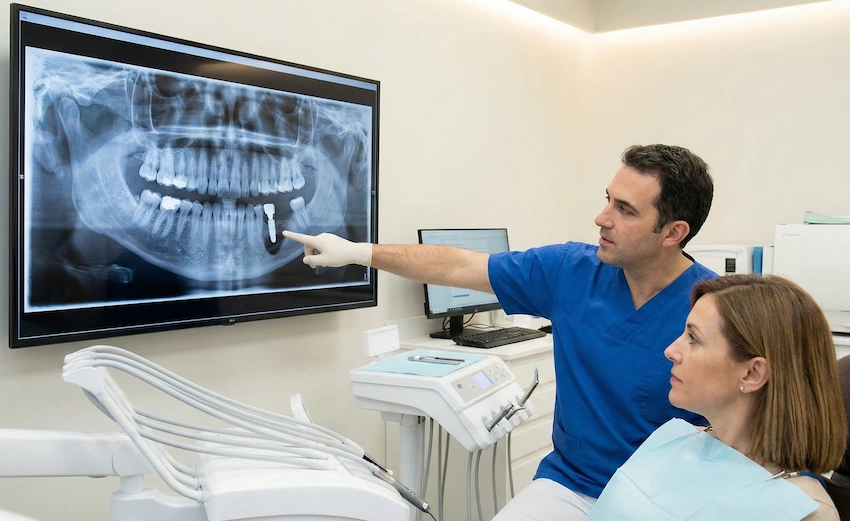
Through our work at Lema Dental Clinic, we have observed that each mouth is unique. Dentist Polen Akkılıç with her team only after many hours studying 3D CBCT scans would perform the smallest surgical operation.
The reason why Turkey is a worldwide center for these highly specialized surgeries is that we combine top digital technology with a very high degree of clinical experience.
Hence, we do not presume the place where your bone is the strongest; we chart it digitally. In case you suffer severe bone loss in the upper jaw, we will never be able to place the six implants that will lead to your death. Rather, we may decide to go with four implants that are placed in a way that they can’t be dislodged. We may even go with zygomatic implants, which are anchored to the cheekbones safely.
Summary of Full-Arch Implant Methods, Comparison
| Method | Implants per Arch | What is it best for | Bone Grafting Needed? |
| All-on-4 | 4 | Patients with moderate to severe bone loss, when the avoidance of sinus is required. | Rarely |
| All-on-6 | 6 | Individuals with good bone volume, heavy grinders (bruxism). | Occasionally |
| All-on-8 | 8 | People with exceptional bone volume need maximum load distribution. | Frequently |
| 1-to-1 Replacement | 12-14 | Not possible or recommended. Biological risks for full-arch implantation. | Always |
FAQs Section
That is a very reasonable point to raise. You should, however, remember that the All-on-4 method is a kind of cooperation between your 4 implants and the prosthetic bridge fixed to them. If one of your implants fails, the prosthetic bridge will need adjustment, and the failed implant will most likely have to be replaced. This is the reason why we very often decide to go for the All-on-6,6 whicprovidesng the patient with a safety net in case of an implant failure.
Titanium is exceedingly biocompatible. First of all, it should be noted that your body would not recognize it as a foreign object (like a splinter of wood). Therefore, real “rejection” is rarely observed. Implant failure cases are very rare given the number of implants. Poor quality implantation site, smoking heavily, and infection are the major causative factors.
An important point I would like to bring up is the fact that your jaw is one of the parts of the mouth with the least number of nerve endings present. So, the main reasons for your after-surgery discomfort will be the healing of the soft tissue (gums). Adding two more implants to four implants will increase the duration of the surgery only by a few minutes. Besides, the recovery timeline is barely affected at all.
Every doctor may indeed have a different approach to this. On the other hand, worldwide, there is a trend toward efficiency and safety. The big thing about placing 8 implants is that it demands the availability of a huge amount of pristine bone. Otherwise, the surgeon needs to resort to heavy grafting. We, on the other hand, prefer to invest 6 implants in your strong natural bone rather than locate 8 implants in weak artificial bone.
Most of the time, fixing a temporary fixed bridge to your implants will be possible within the same day as your surgery, which means that you will have a fully functional, beautiful new set of teeth by the time you leave our clinic in Turkey. These temporary teeth are normally worn for three to six months to allow the implants to fully integrate with your bone. After this, your permanent and durable zirconia teeth will be made for you.
- Maló, P., de Araújo Nobre, M., Lopes, A., Macrovassilis, A., & Borges, J. (2019). A longitudinal study of the survival of All-on-4 implants in the mandible with up to 10 years of follow-up. Journal of the American Dental Association, 142(3), 310-320.
- Buser, D., Sennerby, L., & De Bruyn, H. (2017). Modern implant dentistry based on osseointegration: 50 years of progress, current trends and open questions. Periodontology 2000, 73(1), 7-21.
- Branemark, P. I., Hansson, B. O., Adell, R., Breine, U., Lindstrom, J., Hallen, O., & Ohman, A. (1977). Osseointegrated implants in the treatment of the edentulous jaw. Experience from 10 years. Scandinavian Journal of Plastic and Reconstructive Surgery. Supplementum, 16, 1-132.
- Gallucci, G. O., Hamilton, A., Zhou, J., Buser, D., & Chen, S. (2018). Implant placement and loading protocols in partially edentulous patients: A systematic review. Clinical Oral Implants Research, 29(S16), 106-134.
- Pjetursson, B. E., Thoma, D., Jung, R., Zwahlen, M., & Zitzmann, N. U. (2012). A systematic review of the survival and complication rates of implant-supported fixed dental prostheses (FDPs) after a mean observation period of at least 5 years. Clinical Oral Implants Research, 23(S6), 22-38.

