


Gold is usually better for bruxism due to its durability and enamel-friendly wear.
Gold vs. Porcelain Crowns for Heavy Bruxism
Bruxism is no secret if you repeatedly wake up with a tight jaw or a headache that feels like a band wrapping around your temples. A silent battle at night, your teeth suffer the damage in a war you don’t even know you’re fighting.
Such is the case we witness daily at Lema Dental Clinic in Turkey. Patients are not only coming to us to have a “Hollywood Smile,” but also to repair the damage that years of grinding have caused. Restoring the appearance of teeth is truly a matter of choice and during consultations, we face the question: “Can I have the beauty of porcelain or should I go for the industrial strength of gold?“
It is not a matter of a straightforward yes or no. It is more of balancing the laws of physics with beauty.
The Physics Behind the Teeth Grinding
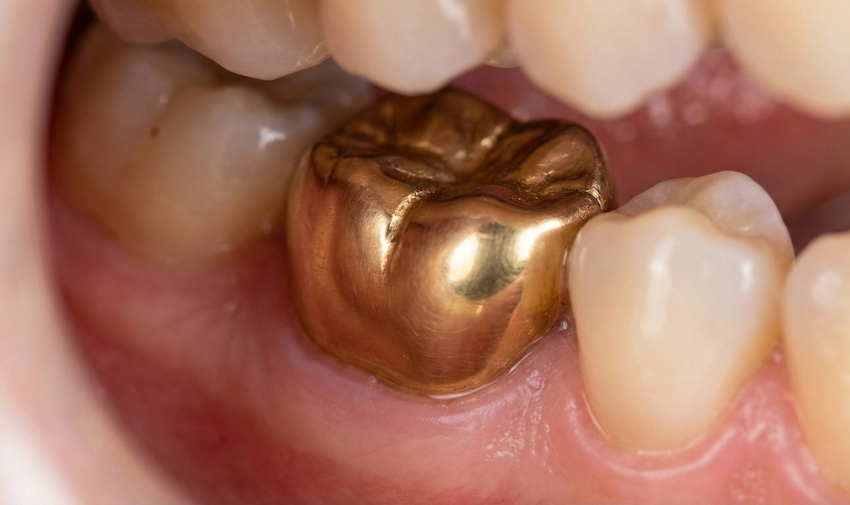
A human jaw is powerful enough to help break down food so material selection truly matters. During regular chewing, the force works out to be around 20 to 40 pounds. On the other hand, if you are a teeth grinder at night (which is normally an unconscious and uncontrolled act), that force can easily exceed 250 pounds.
You can imagine a hydraulic press working inside your mouth. The moment you put a material between this press that is too brittle, it will break into pieces. On the other hand, if the material is too hard, it may tolerate the press, but it can also harm the natural tooth that is going to beitss antagonist. These are things that Professor Doctor Coşkun Yıldız contemplates while making a surgical plan.
Gold: The Case for the Ugly Duckling (That Lasts Forever)
In the age of Instagram, gold has become less trendy; however, many still refer to it as the “gold standard” and for good reasons.
Gold alloys fall under the category of “biocompatible” even from a mechanical standpoint. On the one hand, the metal resists the tremendous force of bruxism and on the other hand, it is so soft that it can be easily adapted. In this sense, it serves as a shock absorber. Your enamel wears down as you grind against gold at a speed that is very similar to natural enamel. This material is neither prone to chips nor fractures and the tooth that confronts the gold is treated very kindly.
The only disadvantage, naturally, is that it resembles metal. Most of our patients in Istanbul don’t want to get their molars turned into shiny accessories, so they generally prefer their teeth to look natural instead of metal.
Porcelain: A Beauty that Comes with a Risk
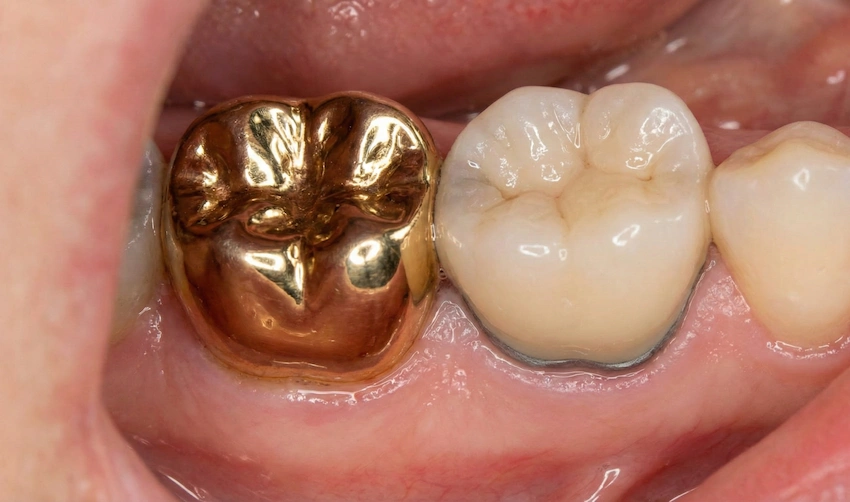
People have been relying on traditional porcelain (especially Porcelain Fused to Metal or PFM) for decades because it has the translucency of natural teeth. It’s a very attractive thing. However, if you grind your teeth heavily, traditional porcelain will be just like glass.
Bruxism can exert such a great force that porcelain, if not sufficiently supported, tends to chip or shear off. This phenomenon is known as “veneer failure.” What is worse is that unpolished or low-grade porcelain is abrasive. It behaves like sandpaper against your opposing natural teeth so that over the years of grinding, these teeth get worn down slowly through filing.
Dentist Polen Akkılıç and her team regularly caution patients that if you decide to use traditional porcelain for your back molars and you are a heavy grinder, then you are basically risking the longevity of your teeth unless you make the use of a night guard a priority.
Contemporary Choice: Monolithic Zirconia
We are noticing this change at our clinic. The dilemma between “ugly but strong” (gold) and “pretty but brittle” (porcelain) rarely happens now.
Introducing Monolithic Zirconia
Zirconia is a crystal, not a metal yet it has metal-like strength. “Monolithic” refers to the fact that it is totally made from a single block; therefore, there is no layer of porcelain that can be detached. It is extremely resistant to fracture—even for the most powerful bruxers among us. Although it is not as gentle as gold, if highly polished, zirconia is much less abrasive than traditional porcelain. For visitors to Turkey who want both longevity and a bright smile, it has become our main recommendation for posterior (back) teeth.
Face-to-Face: Material Comparison for Bruxers
| Feature | Gold Alloy | Traditional Porcelain (PFM) | Monolithic Zirconia |
| Fracture Resistance | Very good; resists cracking | Low to moderate; prone to chipping | Very good; difficult to break |
| Aesthetics | Poor (metallic yellow or silver) | Excellent natural translucency | Good; opaque white, improving |
| Wear on Opposing Teeth | Gentle; wears similar to enamel | Abrasive; may wear natural enamel | Low when highly polished |
| Tissue Response | Excellent biocompatibility | Generally good; metal may show with gum recession | Excellent tissue fit |
| Best For | Molars where function outweighs aesthetics | Front teeth without grinding | Molars for grinders who prefer white teeth |
Frequently Asked Questions
No, absolutely not. The gold utilized in dental work is a high-noble alloy that is not magnetic at all. You’re definitely going to go through the security check without triggering the alarms—though you might attract a few of them through the envy of your teeth!
For all we know, the answer is yes. Zirconia’s flexural strength is over 1000 MPa (megapascals) while the natural enamel’s strength is only about 380 MPa. Simply put, it is the “diamond” among dental crowns. Of course, nothing lasts forever, but still, monolithic zirconia can be ranked as the most fracture-resistant tooth-colored material on the market.
Totally. It is a must. The crown may tolerate the grind if it is, say, gold, porcelain, or zirconia but the roots of your teeth and your jaw joint (TMJ) will still be the ones that absorb the pressure. Professor Doctor Coşkun Yıldız is constantly reminding us that the night guard shields the entire system including the bone, the muscles, and the restoration.
It is really just a matter of doing a lot of work and getting very good at it. At Lema Dental Clinic, the number of international patients is so huge that our lab partners have actually become very skilled in working with the latest materials like Zirconia and E.max. We can offer exquisite, precision-milled restorations at such a reasonable price that a full-mouth rehabilitation becomes a feasible option which is why we don’t compromise on the quality of the materials.
Definitely not. High-noble gold alloys are chemically stable. They will not corrode or rust and they will not leave you with a metallic taste in your mouth. If you do get a metallic taste, it usually is from old, non-precious metal crowns not from gold crowns.
- Magne, P., & Belser, U. (2022). Bonded Porcelain Restorations in the Anterior Dentition: A Biomimetic Approach. Quintessence Publishing.
- Guess, P. C., Schultheis, S., Bonfante, E. A., & Coelho, P. G. (2011). All-ceramic systems: Laboratory and clinical performance. Dental Clinics of North America, 55(1), 33-52.
- Johansson, C., Kmet, G., Rivera, J., & Larsson, C. (2014). Fracture strength of monolithic all-ceramic crowns made of high translucent yttria-stabilized zirconia. Acta Odontologica Scandinavica, 72(2), 145-153.
- Miyazaki, T., Nakamura, T., Matsumura, H., Ban, S., & Kobayashi, T. (2013). Current status of zirconia restoration. Journal of Prosthodontic Research, 57(4), 236-261.
- Donovan, T., &arc; Chee, W. W. (2004). A review of contemporary restorative materials. Dental Clinics of North America, 48(2), v-vi.

