


Jawbone atrophy is caused by tooth loss and treated with implants or bone grafts.
Understanding and Treating Jawbone Atrophy
Looking at yourself in the mirror, you find a slight change. Maybe your face has become a bit shorter or the skin of the mouth is looser and it is caving in. These are not only the signs of aging but also what is happening under the surface.
Here at Lema Dental Clinic in Turkey, besides the clinical experience, we try to explain the jawbone to our patients as the floor of a house. And, when you get rid of the supporting beams (teeth) the floor would not just stand there; it will start to decay. That is the process of jawbone atrophy or resorption. The term itself is a bit scary but nowadays with surgery, what used to be a permanent disability can be restored very well.
Let’s first understand the underlying cause and, more importantly, how Professor Doctor Coşkun Yıldız and our surgical team will be able to give the house a brand-new foundation.
Why Does the Bone “Melt” Away?
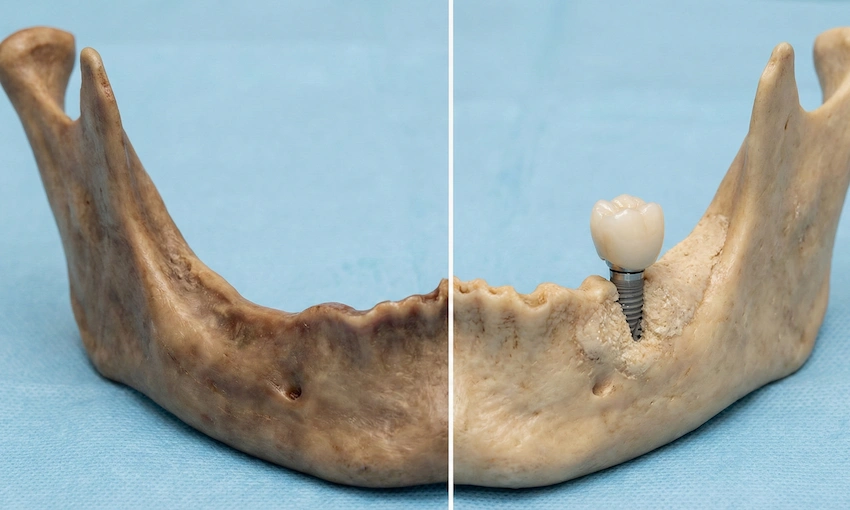
Our body is extremely efficient and it can sometimes be a problem. It strictly follows the policy of “use it or lose it”. Your jawbone’s main job is to hold your teeth. When you chew, the roots of your teeth press your jawbones which sends a signal to your body that this area needs to be maintained.
But if a tooth is extracted and never replaced, the stimulation by the root will not be there anymore. The body, which is an excellent economy manager, decides that it no longer has to expend energy in maintaining that particular portion of bone. So, it starts reabsorbing the minerals thus the bone is getting smaller in height, width, and density.
The Primary Culprits
Besides the most common cause (missing teeth), our Istanbul clinic also sees other contributing factors:
- Periodontitis (Gum Disease): If you think about it, it is like having termites in the wood. The bacteria are destroying the ligaments and the bone that serve as a support system for the teeth.
- Long-term Denture Use: Conventional dentures rest on the gums. They do not provide any stimulation to the bone underneath; rather the constant friction of rubbing is likely to cause faster bone loss.
- Trauma: A sudden direct impact to the jaw might result in the interruption of the blood supply which thus leads to atrophy.
Rebuilding the Foundation: Treatment Options
Well, here is the question: If the floor has gone, can we build a new house? And the answer is yes for sure. But the way depends completely on how much “ground” we have left to work with.
1. Bone Grafting (The Standard Repair)
When the loss is minimal or moderate, bone grafting is the technique we opt for. It is as if you are fixing a little hole in the wall before you put on the paint. We fill the defect with bone material which can be from your own body, a donor, or a synthetic source. In a few months, your body accepts this new material and is capable of converting it into living, vascularized bone.
2. Sinus Lifting
Bone loss in the upper jaw, especially where the back molars are, poses a rather unusual problem: the sinus cavity moves down. The explanation Professor Doctor Coşkun Yıldız gives to his patients is the “eggshell” problem. The sinus membrane is very thin essentially an eggshell and so we have to be extra careful when we lift it up to put bone under it that will serve as a safe cushion for an implant.
3. Zygomatic & Pterygoid Implants (The Heavy Lifters)
Here is where Lema Dental Clinic significantly stands out from the crowd. It might be that previous dentists have turned the patient away by saying he/she has no jawbone left.
Under such circumstances, the usual grafting may take many years or may fail. Instead, we decide not to use the jawbone at all. In fact, we fix long, specialized implants in the Zygoma (cheekbone) or the Pterygoid plate—bones which are very dense, permanent, and unlike the jawbone, they do not atrophy. It is as if you are fixing your tent to a huge rock when the soil on the surface is too loose.
4. The Aesthetic Finish
Upon the surgical team’s success with raising the floor strong enough, Dentist Polen Akkılıç and her team take over. Their work is like that of an architect. They craft prosthetics (crowns or bridges) that not only fit in the hand well but also replenish the facial volume that has gone due to atrophy hence the dental facelift effect.
Comparison: Choosing the Right Path
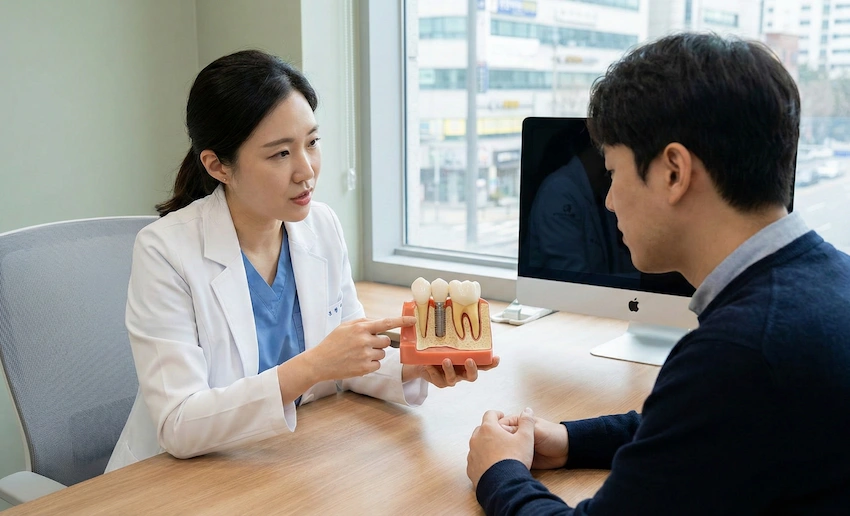
Each mouth is unique. Here is first our approach to making the right choice for an international patient coming to us in Turkey.
| Treatment Option | Best For | Healing Timeline | Complexity |
| Standard Implant + Minor Graft | Just extracted a tooth with mild bone loss | 3–4 months | Low |
| Sinus Lift | Posterior upper jaw with insufficient bone height | 4–6 months | Moderate |
| Block Bone Graft | Severe horizontal or vertical bone defects | 6–9 months | High |
| Zygomatic Implants | Severe end-stage bone loss in the upper jaw | Immediate loading possible | Very High (Requires maxillofacial surgeon) |
Frequently Asked Questions
This question pops up as the greatest concern. The truth is that the intervention is carried out under local anesthesia or sedation, so you will not experience any pain during the operation. After a tooth extraction, the wound is very often more painful than the bone graft because that surface is open to the air while in the case of the graft there is no electric socket exposure. Generally, patients are fine with the use of common analgesics for a couple of days.
It is all about how stable the implant will be. If we resort to Zygomatic implants, then we can usually put on teeth the same day (Immediate Loading). If it is a normal graft, then we have to be biologically respectful by waiting 3 to 6 months for the graft to unite (osseointegration) prior to putting the heavy load of a tooth on it.
Besides the fact that you will have a cheaper treatment, it is a question of quantity and quality of treatment services. At Lema Dental Clinic, we are used to facing complex atrophy cases on a daily basis whereas a general dentist may see that kind of case once a year. Our surgical team has special training for high-complexity rehabilitation.
If you ignore it, the situation will worsen. The nerve inside the jaw may become exposed and even wearing dentures would cause pain. Besides, the facial collapse may deprive you of up to 15 years of your real age. So, you should look at treatment as a health investment that will benefit you in the long run and not merely as a means for a beautiful smile.
Definitely. We only use highly purified, sterilized, and biocompatible materials. Regardless of whether it is bovine-derived (cow) or synthetic, the material is just a framework. Your body gradually does the job of substituting this scaffold with your own bone.
- Hansson, S., & Halldin, A. (2012). Alveolar ridge resorption after tooth extraction: A consequence of a fundamental principle of bone physiology. Journal of Dental Biomechanics, 3, 1758736012456543.
- Esposito, M., Grusovin, M. G., & Felice, P. (2009). Interventions for replacing missing teeth: Horizontal and vertical bone augmentation techniques for dental implant treatment. Cochrane Database of Systematic Reviews, (4).
- Aparicio, C., Manresa, C., Francisco, K., et al. (2014). Zygomatic implants: indications, techniques and outcomes, and the zygomatic success code. Periodontology 2000, 66(1), 41-58.
- Chappuis, V., Araujo, M. G., & Buser, D. (2017). Clinical relevance of dimensional bone and soft tissue alterations post-extraction in esthetic sites. Periodontology 2000, 73(1), 73-83.
- Testori, T., Weinstein, T., & Scutellà, F. (2019). Implant placement in the esthetic zone: biologic rationale, soft tissue management, and restorative options. The International Journal of Periodontics & Restorative Dentistry, 39(2), 189-197.

