


Yes, dental implants are possible without bone using advanced implants.
One of the most painful moments for a patient is not tooth loss but when a dentist says,”Sorry, you just don’t have enough bone for implants.”
At Lema Dental Clinic in Istanbul, we deal with such a situation almost daily. Patients previously feeling hopeless walk through our door, feeling like they have to suffer insecure and irritating dentures for the rest of their lives. The truth is, a conventional dental practice meets its limits when there is a severe bone loss. But let’s see what the latest surgical techniques really allow us to do. In fact, dental implants can still be a reality even after extensive bone loss.
However, the answer lies not in general dentistry but in advanced surgical rehabilitation. At a point in time when the “bathtub” of your jaw is gone, instead of giving up, we find new anchors.
Bone Loss Analogy: “Ice Cube Melting”
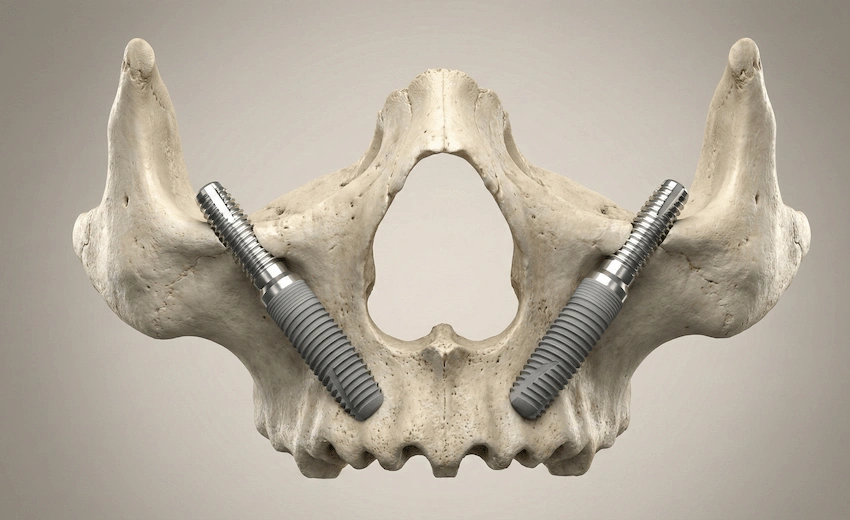
Before looking for the answer, it is necessary to understand the question first. Your jawbone is similar to a muscle in that when you use it, it grows bigger and stronger; conversely, if you don’t use it, it becomes smaller and weaker. Roots of teeth usually help the bone by sending it signals, which the bone responds to by getting denser and stronger. When a tooth is taken out from the socket, the bone around that area will not get any signal to remodel from the tooth and therefore, it will start to resorb.
One of the best ways to get a clear picture of the situation is through an analogy. Just think the jawbone is the soil in the flower pot in your garden. When the plant is there, its roots will grab hold of the soil very tightly. However, if there is no plant, the soil will be gradually washed away, and the level will drop. The above explanation shouldhelp understandg the loss of bone in the upper jaw. However, besides this destruction there is a little cavity, the maxillary sinus, which is an air space that is located just above the teeth. Therefore, as the bone shrinks, the sinus floor also goes down and the bone thickness left along the sinus will not be enough to place a titanium screw.
The Surgery Path: Bypassing the Bone Deficiency
Imagine a scenario where you want to hang a very heavy framed picture on a wall that is made out of only one dry layer; the picture would simply fall. So, you can either make the dry layer stronger or you can go for the stud that is behind the wall. The same analogy holds true for implant dentistry.
Basically, we come up with our implant plans based on two main strategies. Our maxillofacial surgeon in Turkey, Professor Doctor Coşkun Yıldız is among the top experts in the world of non-conventional implant cases.
1. Reconstructing The Base (Grafting and Sinus Lifts)
This is just the “strengthen the wall” method. To physically enlarge and lengthen the ridge, bone graft substances, sometimes a blend of synthetic bone and your biological material, are utilized. In sinus lift surgery, the fragile sinus membrane is lifted (imagine opening an eggshell without breaking it) and bone is placed underneath.
2. Finding “the Studs” (Zygomatic & Pterygoid Implants)
This is the part where a “no bone” patient finds the biggest relief. When the jawbone is not present at all, we simply eliminate it from the equation.
- Zygomatic Implants: These implants are longer than normal ones and therefore can get a firm hold of the zygoma (cheekbone) directly. The cheekbone is a dense cortical bone and unlike jaw bone, is hardly ever resorbed. Hence, it provides an instant, highly stable support base.
- Pterygoid Implants: These implants derive their anchor from the pterygoid plate, which is a piece of hard bone deep in the back part of the upper jaw; therefore, there is no need for a sinus lift.
Why Is Turkey Still the Place to Be for Dental Implants?
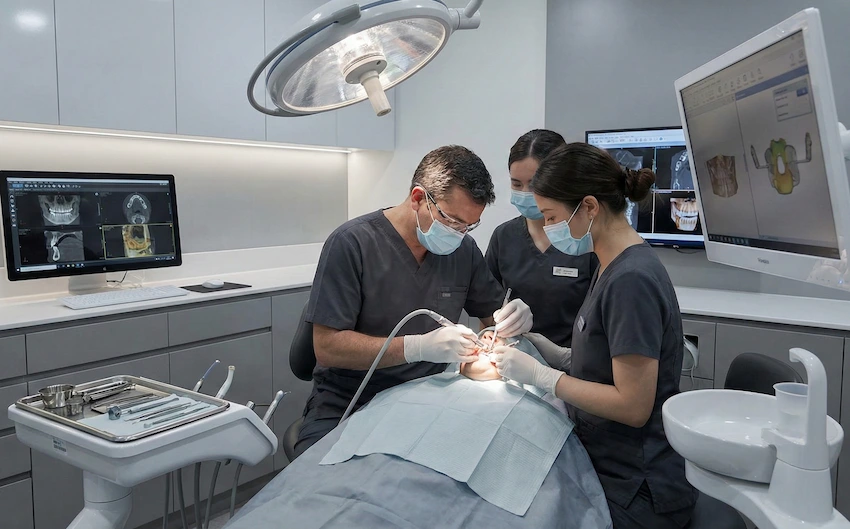
Year on year, thousands of individuals come to Istanbul for this treatment. Experience and skill set are what count. At a lot of small local clinics, Zygomatic implant surgery is an event that happens “once a year”. On the other hand, Dentist Polen Akkılıç and her team perform complex full-mouth reconstruction surgeries as part of their normal routine.
We combine these complex surgical approaches with digital smile designs. In other words, no matter how difficult the surgery is, the output—the smile—is a perfect one, and very natural. Not only do we restore the functions of the mouth, but we also re-establish the facial anatomy that had collapsed due to a lack of bone supporting it.
Knowing the Decisions: a Clinical Dissection
Deciding requires a look at the pros and cons first. According to our clinical experts, these are the situations of the different methods.
| Feature | Standard Implants | Bone Grafting / Sinus Lift | Zygomatic Implants |
| Ideal Candidate | Good bone density and height | Moderate bone loss | Severe or extreme bone loss (“no bone”) |
| Treatment Time | 3–6 months | 6–12 months (healing required) | Immediate loading (often 3–5 days) |
| Invasiveness | Low | Moderate to high | High (requires maxillofacial surgeon) |
| Success Rate | 95–98% | 90–95% (depends on graft integration) | 96–98% (high primary stability) |
| Main Advantage | Routine and predictable procedure | Preserves natural jaw anatomy | Immediate teeth without bone grafting |
Q&A: We Answer Your Questions
Pain is usually what concerns people the most. However, here is a little secret for you: Zygomatic implants are sometimes even less painful postoperatively than bone grafts of large surfaces. The main reason is that the implants are set in quite dense bone and soft, healing gum tissue is less impacted than by a graft. Hence, the recovery is really very easy. To be totally pain-free, we administer high-dose sedation and have very precise medication protocols in place.
Basically, yes. We call it ‘primary stability’ when the bone is extremely dense, and hence the cheekbone will provide that. So, a fixed temporary prosthesis can be set within merely 24 to 48 hours postoperatively, and there is no need to fly from Turkey with a ‘no smile’.
Most of the time, it is not your age but your general health that prevents you from having an operation. We have treated elderly people in their 70s and even 80s successfully. The driving factor in this is actually whether the heart, lungs, and the rest of the body are healthy enough to get through any type of surgery safely. The good news is that we always conduct a full medical workup before starting the treatment.
Obviously, general practitioners excel at the restorative side of things but surgery of the maxillofacial area is a different story. Zygomatic and Pterygoid implants are only available to those who have a very narrow and specific training in the field. Most of the general dental practitioners do not have that knowledge. In other words, they are not cheating you; they just are giving you an answer based on what they can do and know.
If you keep up with good oral hygiene and visit your dentist regularly, dental implants can easily be a lifetime investment. The reason for this is that the cheekbone is not subject to resorption, as opposed to the jawbone, making these implants very durable.
- Aparicio, C., Manresa, C., & Francisco, K. (2014). Zygomatic implants: indications, techniques and outcomes, and the Zygomatic Success Code. Periodontology 2000, 66(1), 41-58.
- Chrcanovic, B. R., Albrektsson, T., & Wennerberg, A. (2016). Survival and technical complications of zygomatic implants: An updated systematic review. Journal of Oral Maxillofacial Surgery, 74(10), 1949-1964.
- Davó, R., & Pons, O. (2013). Prostheses supported by four immediately loaded zygomatic implants: a 3-year prospective study. European Journal of Oral Implantology, 6(3), 263-269.
- Tuminelli, F. J., Walter, L. R., Neugarten, J., & Bedrossian, E. (2017). Immediate loading of zygomatic implants: A systematic review of existing clinical studies. Journal of Oral and Maxillofacial Surgery, 75(10), 2267-2276.
- Maló, P., de Araújo Nobre, M., Lopes, A., & Ferro, A. (2015). The All-on-4 treatment concept for the rehabilitation of the completely edentulous mandible: A longitudinal study with 10 to 18 years of follow-up. Clinical Implant Dentistry and Related Research, 21(4), 565-577.

