


Don’t bite, cut it up.
It’s Saturday, you are wandering the colorful food scene in Turkey, and suddenly, you get a craving. You want a burger. Not just any burger, but a huge one piled high with all the extras. But then, your tongue runs over the metal brackets of your braces, and you hesitate.
The real question is not “can” you—besides physically, sure, your jaw still works—but should you?
At Lema Dental Clinic, we see thousands of international patients every year, and this has to be one of the lifestyle-related questions that come up most frequently. The fact is that while your desire is the same, the parts of your mouth involved in that desire have changed. A direct bite into a burger while wearing braces is like putting a bet on a high-stakes game.
The “Shear” Force Problem
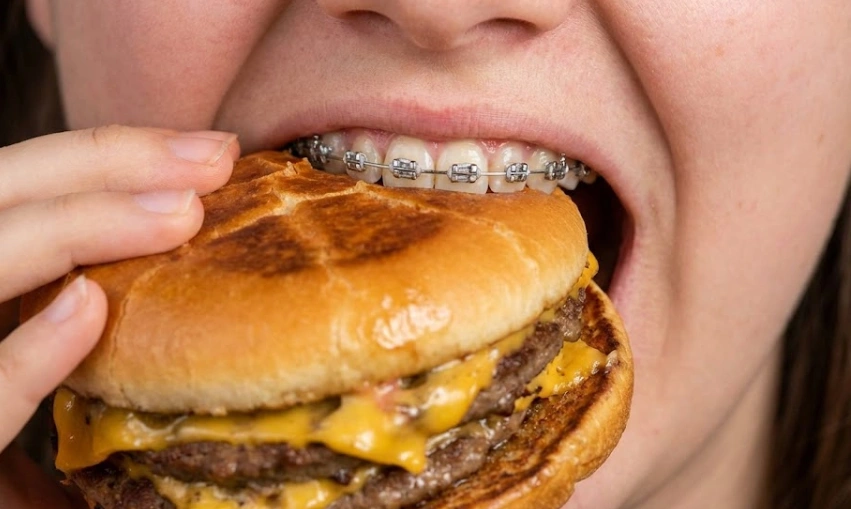
Let’s just rewind to the physics of your mouth for a second. When your front teeth (incisors) are pressed down on a big burger bun, you are basically throwing what we call “shearing force.”
Imagine your brackets to be like anchor points in rock climbing that are put in place on a rock face. They are meant to hold up against the steady, horizontal pull of the archwire (the rope). However, it turns out that they are quite vulnerable to vertical, peeling forces. That movement, where you separate a piece of bread or meat with your teeth by dragging it off, acts like a crowbar prying the bracket off the enamel.
Professor Doctor Coşkun Yıldız is probably always telling our patients that the bond between the bracket and the tooth is only temporary – eventually, it has to be removed. It’s a very strong bond, but it’s not invincible. That same strength will be broken if you give one piece of a crusty slider a very enthusiastic bite.
The Lema Protocol: How to Eat a Burger Safely
So, are you going to be sipping on soup only for the next 12 to 18 months? No way.
Dentist Polen Akkılıç and her team propose changing the way of doing things only slightly, not completely restricting the diet. You may have a burger as well, but you just won’t be able to eat it the way you did before.
Here is the first thing to remember, what we always say, at our clinic: Don’t use your front teeth as tools.
1. The Knife and Fork Method
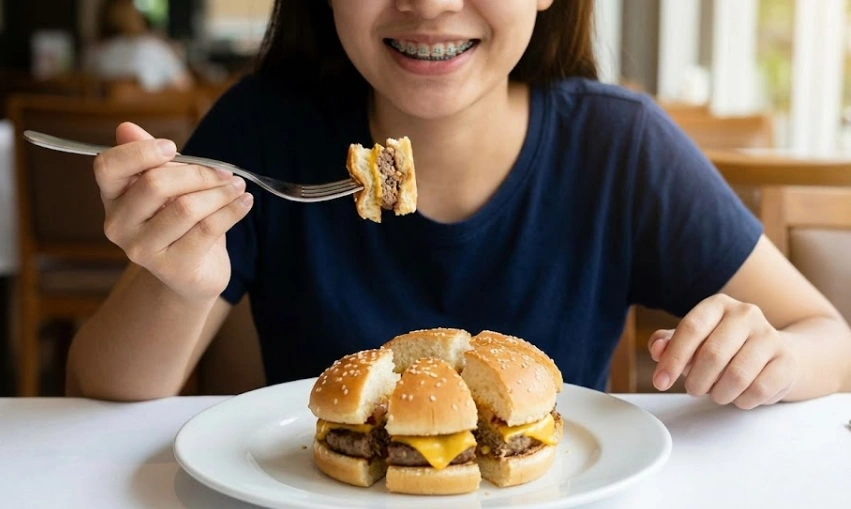
It may culminate in you feeling less “cool,” but slicing your burger into pieces will be the move that saves your teeth (and braces). Making use of a fork to do the placement of the food directly on your back molars (your chewing teeth) will get you completely away from the dangerous front brackets.
2. The “Deconstruction” Technique
Have it on the move? Then break down your burger. The patty first, then the bread. In fact, the combination of the different textures that comes off so well in the burger—the soft bread, the meat chewy, the pickles crunchy—is an absolute nightmare for your wires.
3. Watch the “Hidden” Dangers
Usually, it is not the patty that causes the bracket to come off. It is the extras.
- Bacon Crispy: That can even be harder than glass and can twist wires.
- Buns Crusty: Sourdough or baguette-style buns require a lot of tearing force.
- Veggies Raw: A thick slice of raw onion or a hard pickle brings in quite some opposition.
Risk Assessment: The Old Way vs. The Safe Way
Here is a detailed explanation of what goes on in your mouth if you choose one or the other eating mode.
| Eating Method | Stress on Front Brackets | Risk of Emergency Visit | Clean-Up Difficulty |
| Direct Biting (Traditional) | Critical. High leverage applied to brackets. | High. 30-40% of broken brackets come from similar foods. | Difficult. Bread creates a “mush” that gets stuck everywhere. |
| The “Squish” (Flattening the burger) | Moderate. Reduces thickness but increases density. | Medium. Still requires tearing motion. | Moderate. Dense food packs around wires. |
| Knife & Fork (Lema Recommended) | Zero. Front teeth are bypassed entirely. | Minimal. Risk is near zero if chewed carefully. | Easy. Smaller pieces mean less debris trapped. |
FAQ: Your Questions Answered by Our Doctors
Yes, that “pop” is the sound of the adhesive bond failing. Even if the bracket looks like it’s still on the tooth, it might be sliding on the wire. This means that tooth is no longer being moved correctly. You need to contact us or your local orthodontist immediately to prevent your treatment time from extending.
Soft buns are certainly safer than gourmet brioche or sourdough, but the risk isn’t zero. The “tearing” motion is what does the damage. If you must eat it without cutlery, tear off small pieces with your fingers and pop them in your mouth. Do not bite into it.
This is the one major advantage of aligners. Since you remove them to eat, you can bite into a burger just like you did before treatment! However, Dentist Polen Akkılıç warns that you must brush immediately after. Trapping burger grease and sugars inside your aligners is a recipe for rapid tooth decay.
It happens more than you think. Every time a bracket breaks, we often have to step back a wire size to re-engage the tooth. In our clinical experience at Lema Dental Clinic, chronic bracket breakers can add 3 to 6 months to their total treatment time. It’s not worth the risk for one meal.
Those little seeds are a nuisance. They don’t usually break brackets, but they love to lodge themselves between your gums and the metal band. They can be incredibly difficult to floss out and can cause gum irritation. We recommend rinsing your mouth vigorously with water immediately after eating.
- Proffit, W. R., Fields, H. W., & Sarver, D. M. (2018). Contemporary Orthodontics. Elsevier Health Sciences.
- Keim, R. G., Gottlieb, E. L., Nelson, A. H., & Vogels, D. S. (2019). JCO study of orthodontic diagnosis and treatment procedures, part 1: results and trends. Journal of Clinical Orthodontics, 53(10), 581-590.
- Bishara, S. E., & Trulove, T. S. (1990). Comparisons of different debonding techniques for ceramic brackets: an in vitro study. American Journal of Orthodontics and Dentofacial Orthopedics, 98(3), 145-153.
- Al-Moghrabi, D., Pandis, N., & Fleming, P. S. (2016). The effects of bonded orthodontic appliances on the diet and eating habits of patients: A systematic review. Journal of Orthodontics, 43(2), 115-124.
- Hammad, S. M., & Al-Wakeel, E. E. (2011). Shear bond strength of metal brackets bonded to porcelain surfaces using different surface conditioning protocols. European Journal of Orthodontics, 33(6), 615-620.

