


They are needed when extreme jawbone loss makes traditional implants impossible.
You’re sitting in the dental chair. The reception of unnerving news is always tough, right? Your dentist informs you that there isn’t enough bone left in your mouth to support dental implants. It’s very depressing news. All you want is to be able to smile and eat confidently again.
We often see in the clinic a lot of patients coming to us from different parts of the world. Most of the time, they bring us their X-rays showing their jawbones are very thin. They hardly believe a removable denture is the only option for them. Of course, they desire to have comfortable implant teeth. Regrettably, standard implants are limited while it is a fact that advanced surgery goes further to the very point where ordinary methods stop.
To help visualize how your jawbone functions, consider it like the foundation of a house. Conventional dental implants are similar to steel posts driven deep into thick concrete. However, what if that concrete was taken away? Then obviously one doesn’t attempt to put posts into thin air. Instead, a new way of holding the structure is built. This is exactly the principle behind trans-nasal & subperiosteal implants.
As per our experience in the clinic at Lema Dental Clinic, Turkey, we do not consider a thin bone as a dead-end. Rather, we look at it as a structural challenge requiring a custom solution.
The Drawbacks of Usual Bone Grafts
You all know that when you lose teeth, your jawbone, which upholds the teeth, starts becoming thinner gradually. At the end of many years, this bone diminution becomes quite severe. Hence, regular methods try to build up bone again by carrying out bone grafts or sinus lifts.
On the other hand, let’s evaluate things more deeply. Bone grafts are sometimes ineffective. There can be a health issue with the patient. Or, the sinus lining is so thin that it is just like a sheet of wet paper. This results in the surgery being very dangerous. The pain and stress caused by bone graft failures are enormous. It is at the moment when Dentist Polen Akkılıç and her team go for graft-less, advanced implant systems.
Subperiosteal Implants: Another Platform
Thinning down of the lower and/or upper jaw has reached such an extreme level that if you insert a screw there, it will come out of the other side.
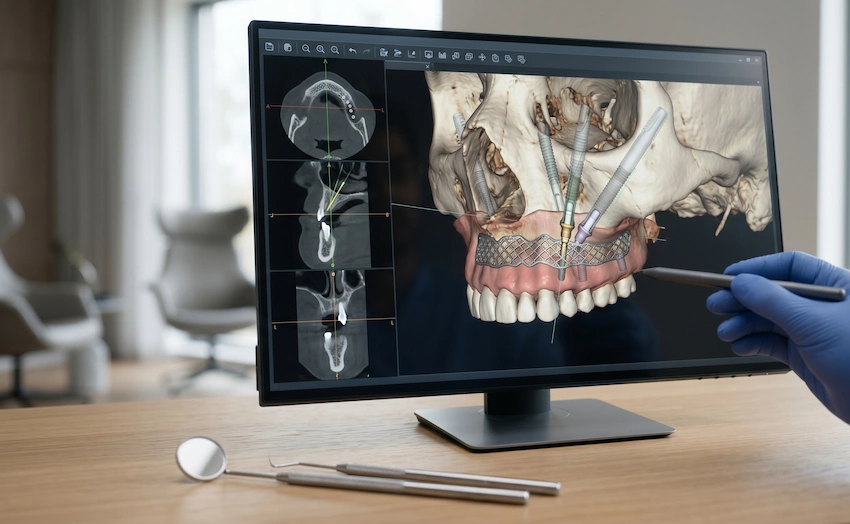
Changing the game entirely, subperiosteal implants are no longer fixed & entered in the jawbone. Custom-made titanium frameworks are used to support the bone, in a manner covering the bone surface only, below the gum tissues.
Subperiosteal implants are compared to a custom saddle by Professor Doctor Coşkun Yıldız. That is how we make them – by using very detailed 3D images of the bone. This way, they help distribute the forces generated by chewing evenly across the remaining good bone. Stability does not require deep bone.
Benefits of Subperiosteal Implant:
- Complete Bone Loss: Bone level reduced to the point of almost no visible bone.
- Bone Graft Failures: Failure of the previous surgeries to create new bone.
- Immediate Delivery: With subperiosteal implants, you can sometimes have teeth on the same day as the surgery because the custom frame supports the prosthesis. No waiting for graft healing!
Trans-nasal Implants: Normal Facial Pillars

We are left with the question: what if the whole upper jaw is totally missing, not to mention the front part?
At the back of the mouth, it is the cheekbones where regular zygomatic implants get fixed. However, as for the front, in such cases, we sometimes use trans-nasal implants.
These implants skip a sinus area that happens to be a dead space, and safely get fixed in a very hard bone that lies between the nose and the mouth. To go back to our house example, trans-nasal implants give you a direct anchorage for your new teeth to the strong pillars of your face, thus offering the stability much needed for anterior teeth. Most importantly, they do not require any artificial bone grafts.
Implant Options Comparison
Here is a very simple table we have drawn out to briefly illustrate these advanced choices in comparison to normal implants.
| Implant Category | Most Suitable For | Procedure | Is Bone Graft Required? |
| Traditional Implants | Healthy, dense jawbone | The implant is directly inserted into the jawbone | Occasionally |
| Subperiosteal Implants | Severe bone loss top to bottom | Custom skeletal frame over the bone | No |
| Trans-nasal Implants | Severe bone resorption in the front upper jaw | The implant is inserted into the hard bone near the nose | No |
FAQs
However, you think that a larger frame means more pain. On the other hand, as we do not use heavy bone grafts, the swelling is relatively easy to cope with. We make the frame digitally so that it fits perfectly the first time. This reduces the trauma to your mouth.
As is standard for regular implants, they are titanium and safe. However, with good oral hygiene and dental check-up visits, they can be a long-term solution to your smile problem.
Never. The frame is extremely thin—usually about one or two millimeters. Besides, after your gums heal over it, it is perfectly invisible to the eye. The only change that you will see in your face is a complete and beautiful smile.
Most dentists stick to standard implants only. Trans-nasal and subperiosteal implant surgeries are very advanced procedures. They require special 3D machines and a surgical team that has been trained in extreme bone loss. It is just a whole different level of medical engineering.
Since we skip slow bone-graft procedures, it is quite often possible for us to scan, place, and give you the new teeth all in one visit. Generally, it is only 7 to 10 days. Every step of your trip is planned so that you do not waste any time.
- Abreu, A., & Bönecker, M. (2021). The resurgence of customized subperiosteal implants in severe maxillary atrophy: A 3D continuous evolution. Journal of Maxillofacial and Oral Surgery, 20(3), 412-419.
- Chiapasco, M., & Casentini, P. (2018). Narrow implants and advanced surgical techniques for the rehabilitation of the severely atrophic maxilla. International Journal of Oral & Maxillofacial Implants, 33(5), 1069-1078.
- Gellrich, N. C., & Rahlf, B. (2019). Custom-made titanium subperiosteal implants for the rehabilitation of severe mandibular atrophy. Journal of Cranio-Maxillofacial Surgery, 47(12), 1871-1877.
- Pellegrino, G., & Lizio, G. (2020). Trans-nasal and pterygoid implants for the management of the severely resorbed maxilla: A retrospective clinical study. Clinical Implant Dentistry and Related Research, 22(4), 521-529.
- Wang, F., & Monje, A. (2022). Alternative to bone grafting: The role of extra-maxillary anchorage in full-arch rehabilitation. Periodontology 2000, 88(1), 154-173.

