


Bad breath after implants may indicate peri-implantitis infection.
Whether you invested locally or went out of your way to Turkey just to get that perfect smile, you must have done it for your confidence. Slowly, however, an uneasy feeling creeps in. At first, it might have only been the metallic taste you wake up to or your partner having to move away a couple of times when you get too close to talking to them.
Implants are primarily made out of titanium, which is a rust-resistant metal; hence implants cannot be termed natural. However the compatible tissues of the body that are living around the implant location can still get infected.
In fact, at Lema Dental Clinic, many patients have panicked in the past when they first saw that their implant site was giving out a foul smell upon cleaning their implants. Is the implant failing? Was the surgery performed wrongly? No, definitely not. Nevertheless, halitosis, that is bad breath, which keeps coming back is the #1 indication of Peri-Implantitis.
Think of a dental implant as a fence post that is installed in the ground. Now if the soil that was tightly packed around the post is gradually washed away or infiltrated by the rain the post will go unstable. This “soft” bacterial broth that your nose is detecting is exactly what is happening.
Why the “Seal” Is So Important: How Bacteria Get In
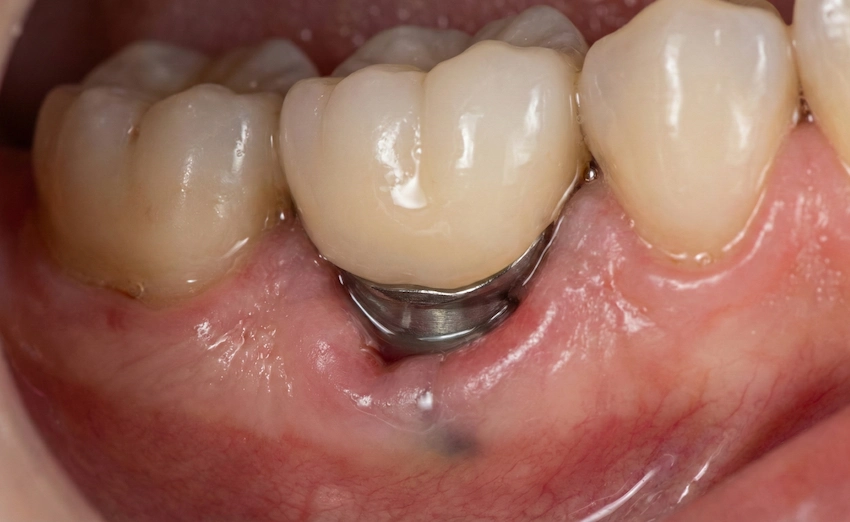
It is a very broad explanation that is necessary so you know why in medicine detailed treatment plans are always a good idea. Teeth are biologically sealed. That biological seal is a very close fibrous one, which does not allow bacteria to penetrate to the bone. However, the gum around implants only has mechanical sealing at the crown and gum junction.
The dentist Polen Akkılıç and her team explained the term “pocketing” to designate when the seal is broken or the first fixture was not quite perfect.
With an implant, it is your gum that either wraps very tightly around it like a turtleneck sweater or not at all. A perfectly fitting turtleneck is a great analogy to the part of the neck that should be very close to your neck. But if the tissue is not as tight, again just as crumbs get inside the shirt if it is loose, then in the mouth food particles and bacteria will be “invited” to the loose “collar” around the titanium. Since the pocket is not reached with a toothbrush, bacteria will ferment, and the resulting odor will be the consequence.
Rigorous continuation of the problem under discussion will eventually lead to implant loss caused by the progressive bone loss.
Peri-Implant Mucositis Vs Peri-Implantitis
Coming down to their practical applications, both of these problems can be considered a fire alarm and a fire respectively. The alarm is a signal warning, whereas the fire is an actual attack.
- Peri-Implant Mucositis: This is the inflammation of the mucosa around the implant; no loss of bone is involved. The dyed gingival tissues are visually red, swollen, and clinically verifiable. Bleeding is observed on gentle probing or after tooth brushing, and in this case, odor is also sensed. The disease stage management is a completely reversible situation.
- Peri-Implantitis: It is also used to refer to an infection that is accompanied by bone loss that goes beyond the level of the crest, which is due to the initial bone remodeling around the implant. In the photo below, a human patient with peri-implantitis is demonstrated, and a surgical flap has been raised. It is very clear how implant bone loss is quite extensive. Without treatment, the implants will lose their stability and become mobile not only slightly but also clinically.
Signs You Cannot Ignore
At Lema Dental Clinic, we found that the first signs of a problem with the dental implant failure might be patient discomfort that is minor or none at all.
This is because an implant differs from natural teeth in that implants have no nerves, so they cannot feel pain or sensitivity as natural teeth do. Hence, you need to watch out for other indications:
- Rotten Taste: If after brushing you are still experiencing a sour and maybe metallic taste in your mouth, then it is a sign that you should definitely not ignore.
- Bleeding on Probing: If lately, you feel like you’ve been washing your face scoring and seeing pink in the sink, it may be pointing out that the gum is very red, there is a lot of blood, and the tissues are very active.
- Pus or Exudate: You’d better not try to handle this on your own, but rather find help at a dental clinic that will properly diagnose and treat you.
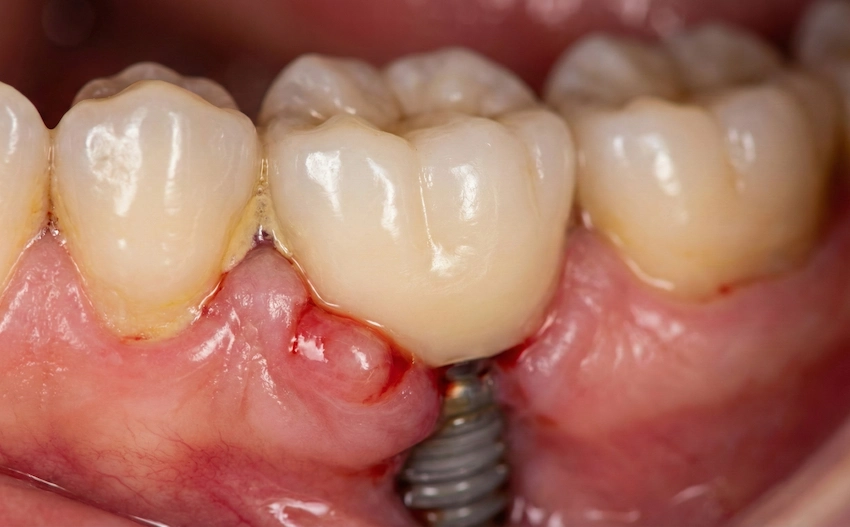
- Thread Exposure: It may shock you to find that the metal threads of the screw that was once covered are now visible even without a dental mirror. You are witnessing bone loss.
View of a Surgeon: Prevention and Treatment
For example, in the hands of a well-trained and experienced surgeon like Professor Doctor Coşkun Yıldız, the decision to preserve or lose an implant can rely on that one person.
We attract patients from all over the world to our Turkey clinic. In case of pain after the implantation or implant failure, we become their second opinion. To keep the teeth healthy and maintain the stability of the bone, it is of paramount importance to keep the neighboring tissues healthy. A thorough diagnosis cannot be achieved from managing at-home care alone. “Cement Sepsis” is a term used to describe a situation where an excessive amount of cement is left by a dentist under the gumline during the crown placement. That leftover cement behaves like a foreign body and results in chronic inflammation, thus tissue destruction and infection.
Most importantly, at Lema, we usually choose screw-retained implants because, with these, cement problems are totally excluded—but what if it is already too late and you are infected?”
Treatment Priority
| Condition | Severity | Symptoms | Treatment | Outcome |
| Healthy Implant | None | Healthy gums, no bleeding, no odor | Proper brushing, water flossing, regular hygiene visits | Excellent |
| Mucositis (Early) | Mild | Bleeding, redness, mild bad odor | Professional cleaning, antiseptic rinses | Reversible (High success) |
| Peri-Implantitis (Moderate) | Moderate | 4–6 mm pockets, unpleasant taste, slight bone loss | Antibiotics, laser therapy, surface decontamination | Controllable with compliance |
| Peri-Implantitis (Severe) | Severe | Visible implant threads, pus, pain | Bone graft, flap surgery, possible implant removal | Guarded (May need replacement) |
Our Approach at Lema Dental Clinic
You should not wait for the symptoms to worsen before deciding to take action. In this regard, you have to get the fissured tissue checked and accurately diagnosed as well as the antimicrobial therapy which is involved in the earliest stage after the signs and symptoms have appeared and it should stop the further deterioration or loss of the implant.
When a peri-implantitis patient comes to our clinic in Turkey, the first thing we do is to take a CBCT scan, which allows us to see the bone loss more accurately. In cases where bone is still there, dentist Polen Akkılıç may consider deep scaling and root planing, which includes laser treatment to kill bacteria that are very difficult to reach on the titanium implant surface.
Nevertheless, if bone loss is extensive, Professor Doctor Coşkun Yıldız might be able to help through a regenerative surgery paradigm. To the very unstable fence post analogy, if we can add more soil to hold it, then implant bone regeneration through thorough removal of infection, followed by bone graft material is quite possible.
FAQs
The metallic taste or odor you may notice in your mouth during the first week or two after surgery is, without a doubt, caused by the presence of blood clots and the subsequent healing process.
Short answer – no! Mouthwash only hides the smell and does not get rid of the bacteria that are left in the gum pocket around the implant. It is akin to deodorizing the entire room while the carpet remains stained. A dentist’s professional cleaning is the only sure way to get rid of it.
Not exactly. Actually, bad breath indicates the problem. Usually, if you visit a clinic when the problem is at the “Mucositis” stage, then the implant can be saved. The odds of saving it at that time are close to 100%. On the other hand, you cannot expect very high savings once the implant gets loose.
Of course. It has been decided that almost half of the cases considered by us are “rescues.” Regardless of where you had your implants done, whether it’s here, the UK, the US, or somewhere else, the team in Turkey is ready to perform diagnostics and treatments, surgical or nonsurgical.
The water flosser is the dental patient’s best friend. Incidentally, conventional floss can snag and even tear fibers from the rough area of the implant. With a water flosser, you can wash away bacteria clinging to the collar of the implant – the source of bad odor.
- Schwarz, F., Derks, J., Monje, A., & Wang, H. L. (2018). Peri-implantitis. Journal of Periodontology, 89(S1), S267-S290.
- Renvert, S., & Polyzois, I. (2018). Risk factors for peri-implant mucositis: a systematic review. Journal of Clinical Periodontology, 45, S59-S71.
- Mombelli, A., & Decaillet, F. (2011). The characteristics of biofilms in peri-implant disease. Journal of Clinical Periodontology, 38, 203-213.
- Heitz-Mayfield, L. J., & Salvi, G. E. (2018). Peri-implant mucositis. Journal of Clinical Periodontology, 45, S237-S245.
- Koldsland, O. C., Scheie, A. A., & Aass, A. M. (2010). Prevalence of peri-implantitis related to the severity of the disease with different degrees of bone loss. Journal of Periodontology, 81(2), 231-238.

