


Extraction is needed if a wisdom tooth causes pain, infection, or damage.
It is a common scenario, I would say for almost all of us. You are probably in your late teens or early twenties, maybe concentrating on the university or your first job, and out of nowhere, you sense it – a dull ache possibly with swelling at the back of your jaw. It is that dreaded dental rite of passage: the appearance of the third molars, or wisdom teeth, as they are still fondly called.
The truth is, these teeth are nothing but remnants from an earlier stage of human evolution. Our forefathers had a tougher diet with roots and raw meat which required more chewing force, hence the necessity for more teeth. Modern humans? We have made life easier for ourselves by eating softer food and as a result, our jaws have become smaller.
Such a case is what the team at Lema Dental Clinic in Turkey deals with every day. Patients come to Istanbul mainly flying just asking the same question: “If they do not hurt now, do I really have to remove them?”
The answer cannot be strictly either one as it depends completely on the layout of your mouth.
The “Parking Lot” Problem: What is an Impacted Tooth
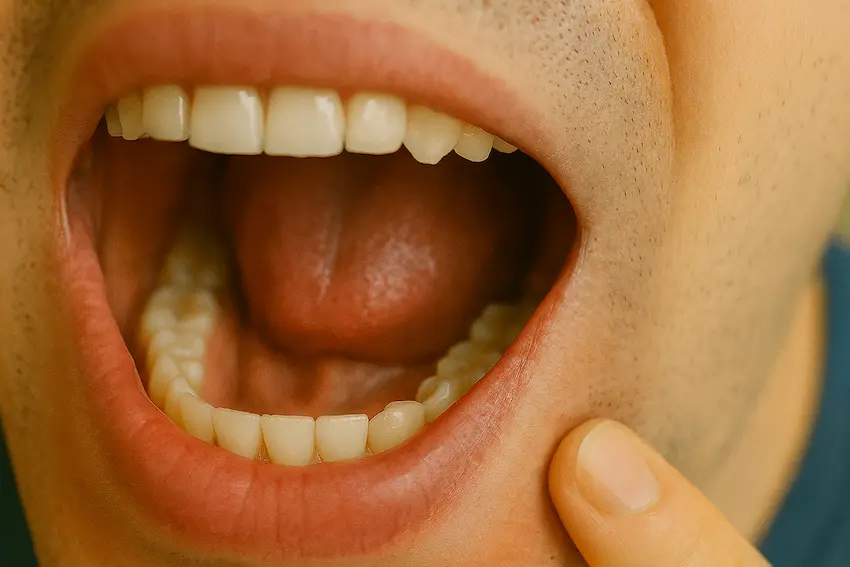
Just think of your jawbone as a parking lot that has exactly 28 spaces. Your 28 teeth are already perfectly ‘parked’. After that, four big SUVs (wisdom teeth) come and try to squeeze into the lot forcefully.
So, what is the result? The lot is in a mess.
They may hit the already parked cars (crowding), park sideways (horizontal impaction), or be half-stuck in the gate (partial eruption). This is what we refer to as impaction.
One of our chief maxillofacial surgeons, Prof. Dr. Coşkun Yıldız, often refers to this analogy to help people understand why just “waiting it out” is not a good plan at all for impacted teeth. A tooth ‘locked’ under the gum doesn’t just quietly wait. It can also harm the root of the healthy molar next to it, in the same way that a tree root breaks a house’s foundation.
Red Flags: Need for Surgery
Most people would say that pain is the clearest indication of something being wrong, but in fact, it is usually the last one to appear. By the time you are really hurting, the problem has already been there for some time. Here is what we find clinically:
- Pericoronitis: This is when the gum tissue around a tooth that is only partially erupted becomes infected. It’s sort of a flap of swollen skin that collects food and bacteria.
- Cysts and Tumors: A fluid-filled sac sometimes develops in the jaw where the tooth is still under the gum. If it remains untreated, the jawbone gets hollowed out.
- Sinus Problems: What most people don’t believe is that the upper wisdom teeth can push the sinus cavity, thus leading to sinus pain, pressure and congestion.
- Orthodontic Relapse: You spent a great deal of time with braces. These molars when pressing against the front teeth, can undo all the work you did to straighten your teeth.
Clinical Note: Just because the problem is not visible does not mean it does not exist. Many times, we get patients presenting a “silent” impaction which means that the damage is only visible with a panoramic X-ray.
The Lema Method: Precision in Turkey
Surgery scares a lot of people, and we totally get that. But really, nowadays removing a tooth is a totally different story compared to yesteryears. One of the major things that sets our clinic in Turkey apart is that we are on 3D technology, so we can see exactly where the nerve is even before we make the first cut.
The Dentistry Polen Akkılıç team puts a lot of effort into preserving the tissue. The objective of the procedure is not just the removal of the tooth; it is done so precisely that the bone will quickly regenerate, and you will be back to enjoying your trip to Istanbul in no time.
Keeping or Removing?
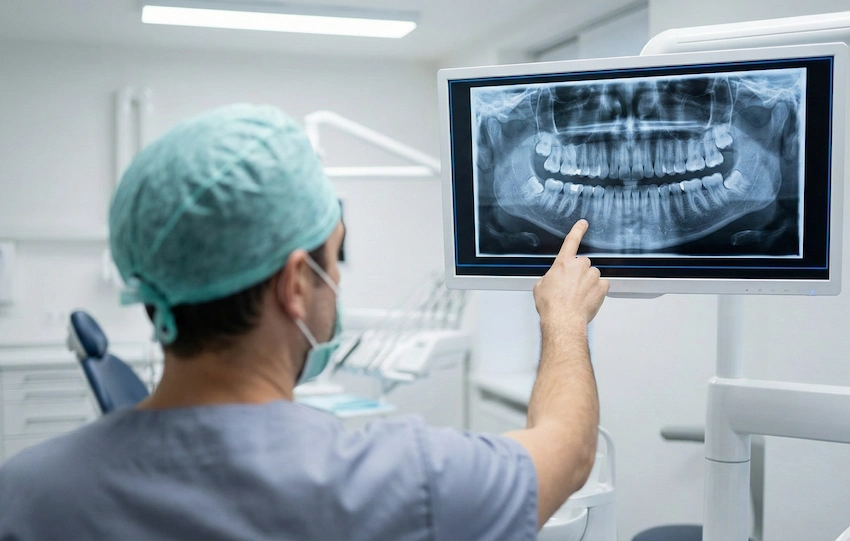
As much as wisdom teeth have a bad reputation, they are not always the enemy. Which is extremely rare though – but is one of the possibilities – if the jaw is sufficiently big and the tooth grows straight, functional and free of caries, it is alright to keep it.
On the other hand, there is a hygiene problem. These types of teeth are located so far back that getting them with a toothbrush is like trying to clean an area behind a heavy fridge. And, if you can’t clean it, it is going to get worse.
Let me show you how we determine the urgency of the situation:
| Scenario | Status | Recommended Action | Urgency Level |
| Fully Erupted & Straight | Functional | Keep under observation with regular X-rays. | Low |
| Soft Tissue Impaction | Tooth covered by gum | Removal is usually recommended to prevent infection. | Medium |
| Horizontal Impaction | Tooth pushing adjacent tooth | Immediate extraction due to risk of root resorption. | High |
| Infection Present | Swelling / Pus | Antibiotic therapy followed by urgent surgical removal. | Critical |
FAQs
It is not really the ‘time’ but more the ‘difficulty’ that matters. When you get older, the roots of your teeth grow fully and become firmly fixed in the jawbone, and the bone also becomes denser. Therefore, a45-year-old’sd recovery will be slower than that of a 17-year-old. Nevertheless, if they are hurting you, they must be removed regardless of your age.
This is surely a myth. The removal of your wisdom teeth will not change the shape of your jaw or the bone under your cheeks. The bones that form your face will stay the same. Of course, you might have some swelling for a couple of days, but nobody will be able to tell you had an operation after it goes away.
Antibiotics only mask the symptoms and are not a cure for the problem. They could temporarily eliminate the infection, but since the root of the problem (impacted tooth and trapped bacteria) is still there, the infection will recur eventually – and probably be stronger.
Besides the considerable money-saving aspect, it comes down to the number and skill of surgeons. At Lema Dental Clinic, our oral surgeons perform thousands of such surgeries annually. We’ve encountered every type of complication and eccentric case. Essentially, you get the same high-end, specialist treatment that you won’t be able to afford or would have to wait a very long time for, if you’re coming from the UK or the US.
Most patients’ symptoms have completely disappeared within 3 to 4 days. Meanwhile, a soft diet (yogurt, soup, mashed potatoes) is advised just for a short period. We offer a detailed aftercare package to assist you in coping with any pain and to make your recovery process as safe and rapid as possible.
- American Association of Oral and Maxillofacial Surgeons (AAOMS). (2020). Management of Third Molar Teeth. AAOMS White Paper.
- Ghaeminia, H., et al. (2016). Surgical removal versus retention for the management of asymptomatic disease-free impacted wisdom teeth. Cochrane Database of Systematic Reviews, (8).
- Marciani, R. D. (2012). Third molar removal: an overview of indications, imaging, evaluation, and assessment of risk. Oral and Maxillofacial Surgery Clinics, 19(1), 1-13.
- Phillips, C., et al. (2003). Risk factors associated with prolonged recovery and delayed healing after third molar surgery. Journal of Oral and Maxillofacial Surgery, 61(12), 1436-1448.
- Pogrel, M. A. (2012). What is the effect of the timing of removal on the incidence and severity of complications? Journal of Oral and Maxillofacial Surgery, 70(9), S15-S24.

