


No, well-fitted high-karat gold veneers do not cause bad breath.
Gold dental work has a certain old-school charm to it. It’s a statement. A style. But for a lot of the patients who come for a consultation here in Turkey, the beauty of it is somehow accompanied by a small but persistent worry: Could this somehow change the way my breath smells?
Pondering that is indeed fair. Nobody would want to invest in a gorgeous smile only for it to ruin their hygiene.
It really comes down to no — gold itself isn’t the culprit of bad breath. It is a noble metal, chemically inert and remarkably compatible with the human body. Nevertheless, the truth of oral health is rarely that straightforward. Although the material is not blameworthy, the situation surrounding it might be.
At Lema Dental Clinic, we see thousands of international patients and quite often we have to explain to our patients that halitosis (chronic bad breath) extremely rarely results from the material, but it is always a failure of engineering that leads to this problem.
The Chemistry of the Mouth: Why Gold is Actually “Clean”
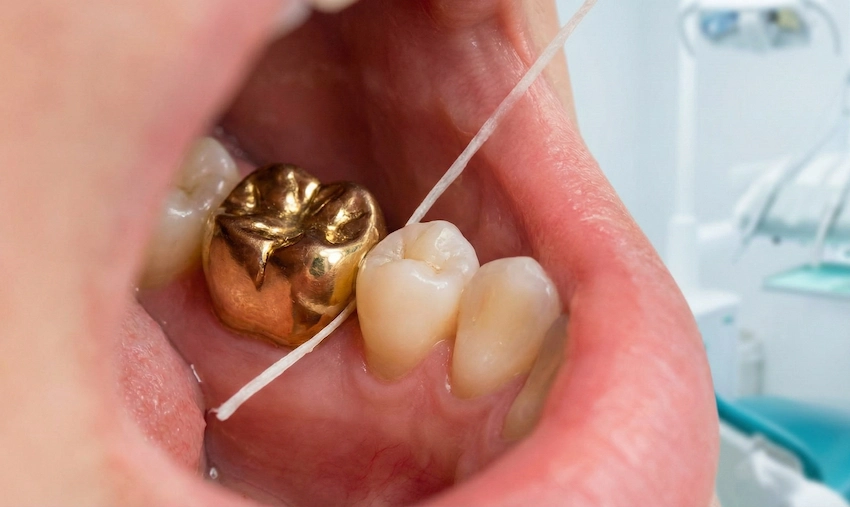
Let’s dig a bit deeper into the reasons that gold has stayed the gold standard (pun intended) in dentistry for years and years. In contrast to composite resins or less expensive alloys, high-karat gold simply is not corroded. It does not rust. It does not disintegrate in the wet, acidic environment of your mouth.
If you think about the lower-quality dental materials just like a wooden fence left out in the rain then eventually, they become permeable and thus can harbor bacteria and foul odor. Gold is not like that. Gold resembles a sheet of glass more. It remains smooth and without pores. Rather than bacteria digging into, they simply roll off.
Professor Doctor Coşkun Yıldız mentions very frequently in his consultations that the high-quality gold is biologically met with an extremely passive response. Your gums don’t resist it. So that if you smell something, we must consider the possibility that, rather than looking at the metal portion, the problem points toward the margins—the exact area where the gold fits on the natural tooth.
The Real Culprit: The “Micro-Gap” Trap
The truth is that most times the problem is with the fit, not the material. If a porcelain veneer or a crown is not properly seated, it results in what we call an “open margin” or a “micro-gap.”
Imagine trying to close a Tupperware container but the lid is slightly bent. Whatever you do, soup will always leak, and air will enter. A poorly fitted veneer creates a similar situation. It essentially becomes a microscopic ledge where food and plaque get trapped, and toothbrushing is less effective in that spot.
Eventually, the food residue rots, and that is what gives off the smell. So, do not blame the gold—this is just the biological decay happening underneath an improperly fitted restoration.
This is why Dentist Polen Akkılıç and her team are so obsessed with the digital scanning phase. We only work with precision in our clinic. Marginal fit is something we measure in microns and as such we can assure that the transition from the tooth to the gold will be flawless. If your fingernail can catch the edge of the veneer, then bacteria will be able to, too.
Gold vs. The Alternatives: A Hygiene Showdown
When making your smile makeover decision in Turkey, a comparison of different materials under the “hygiene test” can certainly be very useful.
| Material | Surface Porosity | Bacteria Adhesion | Durability (in Mouth) | “Bad Breath” Potential |
| High-Karat Gold | Almost zero (non-porous) | Very Low | Superb (20+ years) | Minimal (if fitted properly) |
| Porcelain / Zirconia | Very Low | Low | High (10–15 years) | Low |
| Composite Resin | Moderate (can degrade over time) | Moderate to High | Moderate (5–7 years) | Medium (may absorb odors) |
| Cheap Base Metal Alloys | Low to Moderate | High (may corrode) | Variable | High (metallic taste or smell possible) |
The Importance of “The Wash”
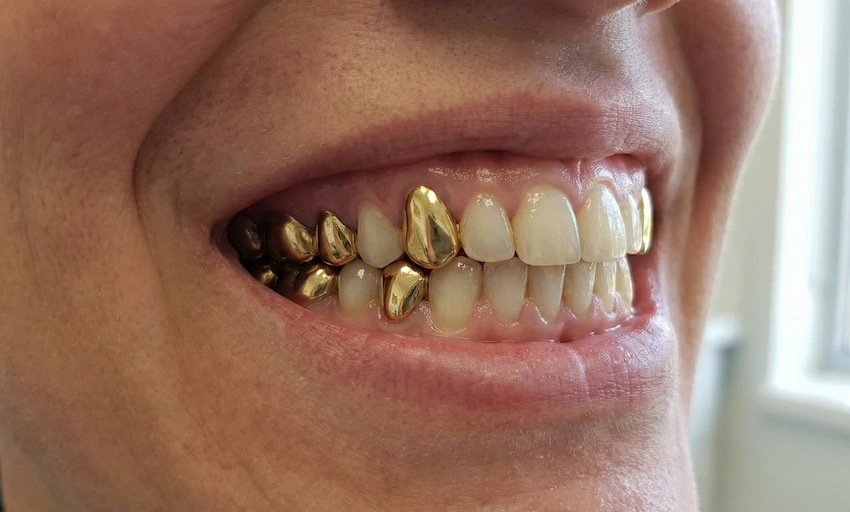
We often address one more aspect here and it is saliva. Saliva-wise, the story is quite interesting as gold surfaces are hydrophobic – they don’t like water – but they are smooth. Saliva neutralizes acids and washes away bacteria producing sulfur compounds, but it needs to bathe the teeth for this to happen.
If the veneers are too thick or “over-contoured”, then this can cause a break in the natural saliva flow around the gums. This is, for instance, the same effect as throwing a rock in the water where you create a non-flowing spot which gets filled with the floating matter.
Here at Lema Dental Clinic, we plan our gold restorations to be just like the natural demand profile of your tooth. Each time you talk or swallow, your tongue and cheek should be able to naturally clean the gold surface.
FAQ: Straight Answers from the Clinic
There is no doubt about that. However, I would always recommend my patients to stay away from strongly abrasive “whitening” toothpastes having charcoal or baking soda as a component because they lead to microscopic cracks which ddullthe surface and also give the plaque a place to stick even though the gold would not be damaged itself. Use a soft, non-abrasive gel.
Most of the time it is a phobia. “If we decide to use high-karat gold, there is no reason that you should see the dark ‘tattoo’ on the gum as it happens with the use of cheap base metals (like nickel). The dark color that you may sometimes see is due to gum recession or it is a kind of reaction to the non-precious metal mixture. Needless to say, we don’t use such alloys of lower quality and grade.”
Regular maintenance of your veneers should be done just in the same way as that of natural teeth. For everybody, a dental cleaning and professional examination interval of six months is suitable. Having a local dentist would be a good idea as well in case you are out of Turkey, and then he or she can take an X-ray of your mouth so that it is possible to detect decay formation at the edges. Even though the gold is strong, the tooth underneath continues to be vulnerable.
Anyhow, you would need an examination very soon. It might be gingivitis which only requires a deep cleaning. Once, the decay is such that there is a “leak” or gap in the veneer, then replacing the veneer would be necessary (for the sake of both the breath and the tooth that is a living organism) in order to have a seal that is perfect again.
The point is the same, but it might feel more slippery! Flossing is a must. One patient, I always say this: “Only floss the teeth that you want to hold on to.” To put it in dental terms, the contact between the gold and the next tooth should be tight enough to let the floss snap, but at the same time, it should be sufficiently smooth so as not to cause shredding. In case, your floss gets shredded, this means that the rough dental surface needs re-finishing.”
- Anusavice, K. J., Shen, C., & Rawls, H. R. (2013). Phillips’ Science of Dental Materials. Elsevier Health Sciences.
- Donovan, T., & Chee, W. W. (2014). A review of current dental adhesives and the interface. Journal of Esthetic and Restorative Dentistry, 26(1), 31–42.
- Goodson, J. M. (2017). Gingival crevice fluid flow and periodontal health. Periodontology 2000, 31(1), 43–54.
- Marsh, P. D. (2018). Dental plaque as a biofilm and a microbial community—implications for health and disease. BMC Oral Health, 6(Suppl 1), S14.
- Roberts, H. W., & Berzins, D. W. (2019). Corrosion behavior of dental alloys: A review. Journal of Prosthodontics, 18(1), 32–41.

