


Best denture adhesive depends on denture fit and daily comfort.
Using dentures doesn’t have to be synonymous with worrying about your teeth. You are having a meal. You are sharing laughter with family. The very last thing you’d expect is to worry about your dentures falling off.
At our dental center, Lema Dental Clinic, located in Turkey, this concern is probably the top one we hear every day in our dental practice. People not only come from various parts of the world to our clinic, but also desire the highest levels of comfort and a completely natural appearance. Undoubtedly, our main focus is on luxury dentistry and dental implants. Yet, we completely understand that many of our patients are dependent on full or partial dentures. For them, selecting the perfect denture paste is indeed an everyday essential requirement.
Here we go through the basics. We reveal the best approach for the upper jaw, which is generally easier,r and also for the difficult lower jaw. Besides that, we tell you about the absolute best choices in general for obtaining a firm, secure grip.
Why Do Dentures Slip?
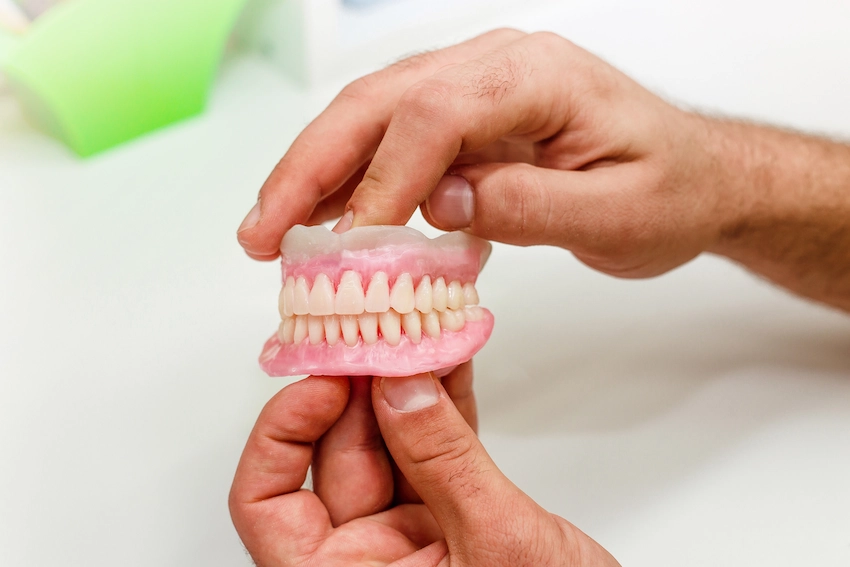
The fact is, your mouth is a challenging setting for false teeth. It is moist and warm. Besides, it is changing all the time. Whenever you speak, swallow, or chew, your oral muscles are pushing quite hard against your acrylic plates.
Professor Doctor Coşkun Yıldız has emphasized many times that the mouth’s morphology is critical. Thus, identifying your mouth’s natural shape is the very first and foremost step in product selection.
Upper Dentures: The Suction Cup Effect
By the way, the top part of your mouth is like a smooth, curved ceiling. Then an upper denture takes advantage of this large area to establish a tight seal similar to a heavy-duty suction cup that is being pressed against a wet glass window. As the area is so large, upper dentures generally have a very good hold even without the use of any adhesive.
Occasionally, one does not need a heavy paste for fastening the teeth to the gums at this point. Rather, the paste is employed to enhance the suction. Besides, this prevents the seeds of small and irritating foods from being trapped under the plastic.
Lower Dentures: The Balancing Act
Here is a scenario that comes the closest to what happens at the dental office while Dentist Polen Akkılıç and her team are assisting a patient. Unlike the upper jaw,w which has a broad, flat surface, the lower jaw is more like a slim horseshoe. To make matters worse, your tongue is located right next to it. Since the tongue is the strongest muscle in the body, it is also the one that most frequently pushes the lower teeth out of place.
Getting an implant-free lower denture that stays in place is equivalent to attempting to keep a heavy bridge balanced on loose sand. High-quality adhesives are just like superheroes in these cases.
Comparing Your Choices
However, let’s analyze the products you can actually purchase. Most of the adhesives come down to just three simple categories. Each one performs a different role. Thus, the decision is dependent on the jawbone structure, the quantity of saliva production, and which one is pleasing to you.
| Adhesive Type | Best Used For | How to Apply | Hold Strength | Pros & Cons |
| Creams / Pastes | All-around daily use. | Put in small, tiny dots. | High |
|
| Powders | Upper dentures. | Sprinkle lightly over wet teeth. | Medium |
|
| Adhesive Strips | Narrow lower jaws. | Cut to fit, lay over dry teeth. | Medium-High |
|
Finding the Best All-Around Grip
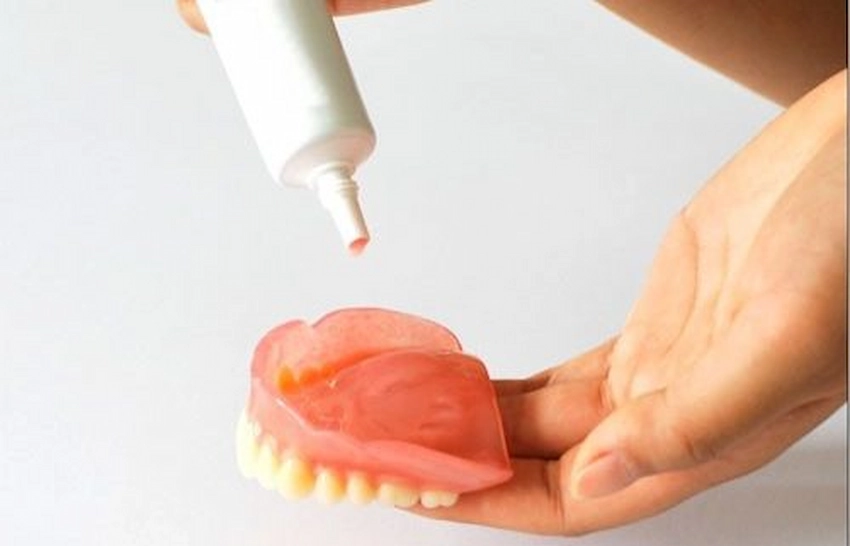
What about is there one product that wins for everyone as an adhesive?
Among the adhesives that work everywhere, those zinc-free creams are at the top of our clinical picks. In fact, to make the paste adhere better, many brands add a mineral called zinc. However, long-term exposure to high zinc levels may lead to nerve damage. On the contrary, a zinc-free paste not only provides a strong and safe hold during the entire day but also eliminates the risk of health problems.
A cream is better when you use a minimal amount. Just three tiny dots on the upper denture should be enough. Likewise, three small dabs on the bottom are fine. However, if after biting down you get the paste’s taste in your throat, that means you have used an excessive amount.
More patients who belong to our clinic like the powder rather than the ream when it comes to the upper denture. Since the upper mouth already has a natural suction, the powder just makes the seal even tighter. Besides, it does not cause a thick and messy layer between the plastic and your soft gums, which sometimes happens with cream or paste.
On the other hand, the adhesive strips (also called wafers) give great results in keeping the lower denture in place. They are very soft and thick, and grip the bone of the lower jaw, which is thin. By also acting as shock absorbers when you are eating, they prevent your tongue from pushing the teeth out of place.
Frequently Asked Questions (FAQ)
How much adhesive should I actually use?
Doctor’s Advice: Use the least amount possible at first. Apply just a couple of dots about the size of a match head. In case the teeth continue to feel unstable, add a bit more the next day. A thick layer of paste actually destroys the natural suction and makes it slippery.
Why does my lower denture always come loose, even with the strongest glue?
Doctor’s Advice: As discussed above, the lower jawbone is very narrow. Also, your tongue is continuously pushing it. If over the years, your bone has become thinner, not even glue will hold it perfectly. At that point, we usually recommend checking out snap-on dental implants.
Is it safe to swallow a little bit of the denture glue?
Doctor’s Advice: Sure. It is completely normal and safe to swallow small amounts of the goo during eating. However, this is exactly why we advise our daily users to opt for zinc-free brands.
How do I clean the sticky paste off my gums at night?
Doctor’s Advice: Never scrub your gums strongly. Take a sip of warm water. Swish it around there for thirty seconds so that the paste melts. Then, take a very soft toothbrush or a warm washcloth and gently wipe the gums.
When is it time to stop using adhesive?
Doctor’s Advice: Adhesives are a helping hand, not a permanent solution. When you have to apply paste thrice a day, just to be able to eat soft foods, your dentures are not fitting anymore. Jawbone shrinks with time. When even paste is a failure, the time has come for you to come to Lema Dental Clinic to get a refitting or a permanent implant upgrade.
Academic References
- Bartlett, D. W., & Carter, N. E. (2017). Denture adhesives: A critical review of the literature. The Journal of Prosthetic Dentistry, 118(2), 143-148.
- Felton, D., Cooper, L., Duqum, I., Minsley, G., Guckes, A., Haug, S., … & Sweitzer, T. (2011). Evidence-based guidelines for the care and maintenance of complete dentures: A publication of the American College of Prosthodontists. Journal of Prosthodontics, 20(s1), S1-S12.
- Grasso, J. E. (2004). Denture adhesives: Changing attitudes. The Journal of the American Dental Association, 135(1), 81-86.
- Kulak, Y., Arikan, A., & Kazazoglu, E. (1997). Existence of Candida albicans and microorganisms in denture stomatitis patients. Journal of Oral Rehabilitation, 24(10), 788-790.
- Zhao, K., Cheng, X. R., Chao, Y. L., & Li, Z. B. (2004). Effect of a denture adhesive on the retention and stability of maxillary dentures. Chinese Medical Journal, 117(3), 415-418.

