


Avoid sticky; choose xylitol.
It is a pretty simple habit: after coffee, one puts a piece of mint gum in the mouth, or one chews gum to help relieve stress during a commute. However, a dental bridge gets cemented in place one day, and that mindless habit becomes something you have to hesitate about and even take a risk assessment.
Maybe you think: Will the gum pull out my new teeth? Will it stick underneath and cause infection?
In our clinical experience at Lema Dental Clinic, we always answer these questions that way: the answer is negative only in very few cases; on the other hand, the answer is definitely a yes, but be cautious at the same time. A dental bridge is something that is very well engineered ergo it makes a bridge between two ends and thus, it is held firmly by natural teeth (abutments) on either side of the gap. The enable it to withstand immense biting pressure; however, it has one particular weakness: vertical pulling forces.
The “Muddy Boot” Effect: Why Gum is Dangerous

If you want to figure out the risk, then you have to take a look at the physics of your mouth first
Professor Doctor Coşkun Yıldız very often uses this approach to explaining retention: “if you picture that you are walking through a deep sticky mud while you have only the loose rain boots on. You can imagine that each step you take is fine. However, when you lift your foot, the mud clings to the boot and tries to pull it off continuously.”
Sticky, sugary bubble gum behaves in the same way as mud does.
- Compression (Biting Down): This is something that your bridge really likes. A bridge is extremely strong, and it is able to withstand the crushing force of one’s mouth.
- Tension (Lifting): This is the last thing that your bridge wants. When the gum is stuck on the porcelain of the bridge and your open your mouth, the tensile force created by the gum results in the move of the bridge opposite to the gum.
Such constant “pulling” over the long term can actually lead to the weakening of the cement that holds your natural tooth and the bridge together. The process is not going to be visible from one day to another, but the micro-movements caused by this bonding can be destroyed, which then means that bacteria may get inside and cause an infection.
Material Matters: Zirconia vs. The Rest
Bridges are different and this determines your liberty to chew or not to chew.
At our clinic in Turkey, Dentist Polen Akkılıç and her team primarily use high-grade Zirconia for bridges. Zirconia is exceptionally smooth and non-porous on a microscopic level. It is like a non-stick frying pan; gum struggles to adhere to it.
Whilst bridges of the old styles, especially those with metal margins or acrylic temporary, are more textured. Gum attaches to them very tightly. If you are a patient who is currently undergoing the stage of the temporary bridge treatment in Turkey, then you absolutely should not chew gum. The temporary cement is made to be weak (so that it is possible to remove the temporary); and gum will get that bridge off in one or two seconds.
The Safe Zone: Xylitol is Your Friend
In the case when chewing is a must, the kind of gum is more important than the fact that you are chewing at all.
Sugarless gum that uses Xylitol as a sweetener is usually considered safe for zirconia bridges that are permanent. The gum is less adhesive, it is easier to break down, and it also stimulates saliva production, which in turn promotes the cleaning of the area under the pontic (the artificial tooth). Actually, the classic sugary pink pieces that you used to blow the bubbles with when you were a kid? Those are like kryptonite for dental work.
Comparison of Chewing Risks
What you can afford to eat is summarized here, so you don’t have to get a panic attack emergency flight back to Istanbul.
| Gum Type | Stickiness Factor | Pulling Force on Cement | Risk Level |
| Sugar-Free (Xylitol) | Low. Does not adhere strongly to porcelain. | Minimal. Safe for well-cemented bridges. | Safe (In moderation). |
| Nicotine Gum | High. Very dense and tacky texture. | High. Can rock the bridge loose. | Risky. Avoid if possible. |
| Sugary Bubble Gum | Extreme. Acts like adhesive. | Severe. Creates strong suction/lift. | Dangerous. Do not use. |
| Breath Strips/Mints | None. Dissolves instantly. | Zero. No mechanical stress. | Best Option. |
Top Queries on Sticky Habits and Prosthetics
You can try, but it is rarely effective. Chewing is a complex neuromuscular cycle. Even if you consciously start on the left, your tongue naturally moves the bolus of gum across the arch to the right side to balance the muscle work. You might accidentally bite down on the bridge with the gum in between, creating that dangerous “pulling” effect we want to avoid.
This is the real annoyance. If a piece of gum gets lodged between the gum tissue and the pontic (the suspended tooth), it creates a trap for bacteria. It can cause immediate irritation and inflammation. If this happens, do not use a toothpick. Use a floss threader or a water flosser to gently dislodge it.
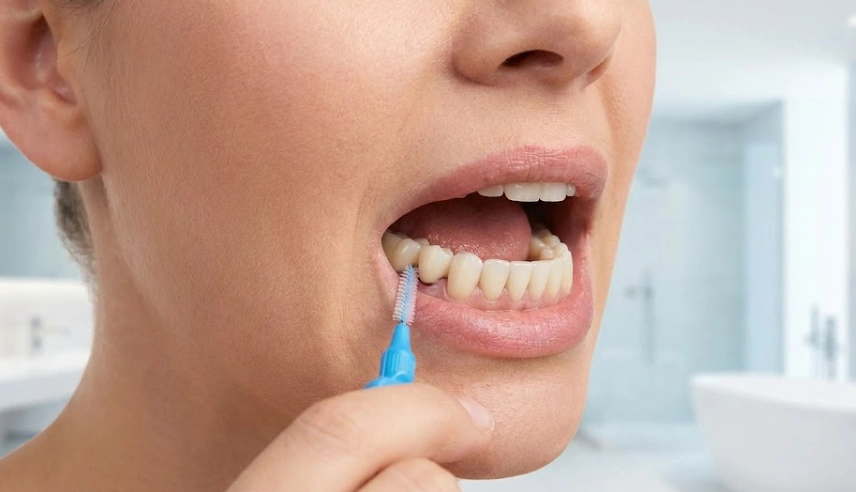
There is a misconception that gum acts like a toothbrush. While Xylitol gum does stimulate saliva (nature’s mouthwash), it does not physically “scrub” the bridge clean. In fact, if you have a bridge, plaque accumulates mostly underneath it, where gum cannot reach. Nothing replaces Interdental brushes.
Standard chewing won’t scratch Zirconia, but the texture of nicotine gum is often harder and more fibrous. The bigger issue is the “park and chew” method used with nicotine gum, where you wedge the gum between your cheek and teeth. Wedging a sticky substance against a bridge for 30 minutes places constant lateral pressure on the abutments, which can be damaging over time.
Professor Doctor Coşkun Yıldız recommends a strict “gum ban” for 48 to 72 hours after your final fitting. The permanent cement needs time to reach its full cure strength. Introducing pulling forces while the chemical bond is still maturing is the fastest way to compromise your new smile.
- Cagidiaco, E. F., et al. (2019). Clinical performance of lithium disilicate versus zirconia fixed partial dentures: a 5-year retrospective study. Journal of Dentistry, 83, 1-10.
- Pjetursson, B. E., et al. (2007). A systematic review of the survival and complication rates of all-ceramic and metal-ceramic fixed dental prostheses (bridges). Clinical Oral Implants Research, 18(s3), 73-85.
- Wassell, R. W., et al. (2002). Crowns and other extra-coronal restorations: Try-in and cementation of crowns. British Dental Journal, 193(1), 17-28.
- Al-Wahadni, A. M., et al. (2018). The effect of chewing gum on the stability of fixed prosthodontics: An in-vitro study. Journal of Prosthodontic Research, 62(1), 58-63.
- Murchison, D. F., et al. (1998). Retention of crowns cemented on teeth with different surface preparations. Journal of Dental Research, 77(Special Issue B), 654.

