


Medical-grade titanium or zirconia.
Looking at a dental implant diagram, it is almost too simple—a screw, a connector, and the crown. However, when you are in the dentist’s chair, about to have a foreign object permanently implanted in your jawbone, simple is nowhere to be seen. You want to be sure of everything regarding the material, its origin, and whether your body will accept it.
At Lema Dental Clinic, we think it is really great when people want to learn more. Actually, Professor Doctor Coşkun Yıldız frequently explains to his patients that a well-informed patient not only recovers faster but also has more faith in the science that works inside their mouth.
Typically, titanium is used.
However, just saying “titanium” is like saying a Ferrari is made of “steel.” It fails to acknowledge the engineering marvel that makes modern dentistry possible. The screw is more than just a piece of metal; it is a bioactive component that is able to integrate with your body.
Titanium: Grades 4 and 5, the Giants in Implant Dentistry
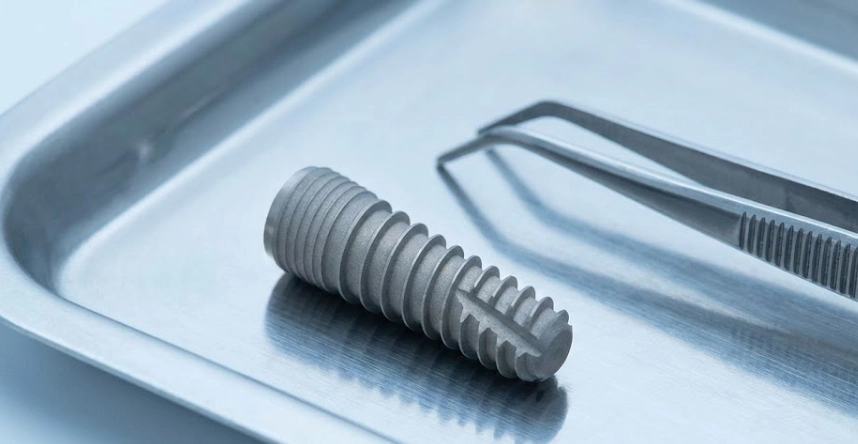
Better than anything else, commercially pure titanium (Grade 4) or a certain titanium alloy (Grade 5) have been considered the standard of implantology for the last 40 years.
Just to rule out the matter of strength, we will tell you that it is not the reason why titanium was chosen. The major reason is that it has a very special property called biocompatibility. The immune system does not react to titanium as a foreign body once it is implanted in a human body. Your osteoblasts (bone-forming cells) even increase in number and attach themselves to the titanium’s surface. This is called osseointegration.
Do not think of the implant as a nail. Rather, think of the trellis that the plants are growing on. The bone cells are like the vines that not only wrap themselves around the microscopic titanium rough surface, thus locking it steadily but also go through it.
We have mainly two different types here in Turkey:
- Grade 4 Titanium (CP Ti): Where titanium is pure, Grade 4 is that very titanium which is also biocompatible. A consequence of the same is it is always recommended to patients with high bone density as case where flexibility is less important than the integration speed.
- Grade 5 Titanium (Ti-6Al-4V): This is a Titanium/Aluminum/Vanadium 6%/4% alloy that is added to it. The tensile strength of the screw is considerably increased. Dr. Polen Akkılıç points out that the use of this for back teeth may be thought of as the most suitable, given the fact that there is a colossal bite force which is as high as 70 kg/cm2 thus the molar area is more exposed to the force where the pressure is immense.
Metal-free material mentioned: Zirconia
There is no doubt that titanium is the best, but there has recently been a great demand for “metal-free” dentistry and the result is Zirconia–based implants.
Although zirconia is basically nothing more than a ceramic (zirconium dioxide), it still has the strength of a metal. It is a great aesthetic advantage as a white material for patients with thin gum tissues. A titanium implant may sometimes show a gray shadow through the gum due to some discoloration but this is not a phenomenon with zirconia that can eliminate it. Nevertheless, it is more prone to breakage than titanium, and the use of it requires very careful surgery.
A “Screw within a Screw”
This is a distinction that often confuses patients. There are actually two screws involved in the process:
- The Fixture: This is the large screw implanted into the jawbone.
- The Abutment Screw: This is a tiny, microscopic screw that connects the visible tooth (crown) to the fixture.
One can hardly imagine using a gold or titanium alloy for a small cap screw. Gold can be somewhat soft and thus, more malleable, so it is able to be used here. A few gold threads are allowed to be tightened (torqued) so that they wear (individually create) the perfect bacteria-proof seal between parts, almost like a gasket.
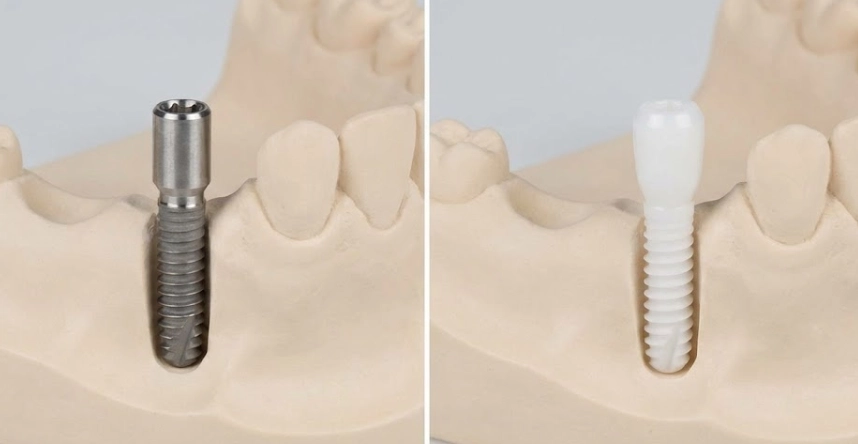
Finished Titanium vs. Zirconia Reveal
To help you understand which material might be right for your biological profile, we’ve broken down the clinical specs below.
| Feature | Titanium Grade 4 (Pure) | Titanium Grade 5 (Alloy) | Zirconia (Ceramic) |
| Primary Component | >99% Titanium | Ti, Aluminum, Vanadium | Zirconium Dioxide |
| Strength | High | Very High | High (but brittle) |
| Biocompatibility | Excellent | Excellent | Excellent (Hypoallergenic) |
| Aesthetics | Dark grey (risk of gum shadow) | Dark grey | White (Superior aesthetics) |
| Cost | Standard | Standard | Premium |
| Allergy Risk | Extremely Rare | Very Rare | Virtually Zero |
Top Queries on Implant Materials and Safety
This is the number one question we get! The answer is no. Dental implants are non-magnetic and too small to trigger standard metal detectors at airports. You can walk through security without having to explain your dental history to the TSA agents.
Yes, absolutely. Titanium is paramagnetic, meaning it is not magnetic like iron or steel. It will not rip out of your jaw or heat up during an MRI scan. However, it can create a “starburst” artifact on the image in the immediate area of the mouth, which might obscure visibility for the radiologist. Always inform your technician you have implants, but rest assured, it is safe.
True “rejection” (like an organ transplant rejection) is virtually impossible with titanium because it has no biological proteins for your immune system to target. Failures, when they happen, are usually due to bacteria (peri-implantitis) or overloading the bone, not an allergy to the metal itself.
The oral environment is harsh—wet, acidic, and full of enzymes. However, titanium forms a passive oxide layer the instant it touches oxygen. This invisible layer makes the screw corrosion-resistant. We have seen implants placed 30 years ago that look as pristine as the day they were put in.
Not all titanium is created equal. The purity of the manufacturing process matters. We partner with top-tier global manufacturers (like Straumann or Nobel Biocare) because their surface treatments—how the titanium is sandblasted and acid-etched—are patented and proven to accelerate bone healing. We do not use generic or “white-label” implants.
- Sidambe, A. T. (2014). Biocompatibility of advanced manufactured titanium implants—A review. Materials, 7(12), 8168–8188.
- Osman, R. B., & Swain, M. V. (2015). A critical review of dental implant materials with an emphasis on titanium versus zirconia. Materials, 8(3), 932–958.
- Elias, C. N., Lima, J. H. C., Valiev, R., & Meyers, M. A. (2008). Biomedical applications of titanium and its alloys. JOM, 60(3), 46–49.
- Cionca, N., Hashim, D., & Mombelli, A. (2017). Zirconia dental implants: where are we now, and where are we heading? Periodontology 2000, 73(1), 241–258.
- Brånemark, P. I. (1983). Osseointegration and its experimental background. Journal of Prosthetic Dentistry, 50(3), 399–410.

