


Throbbing pain, swelling, bad taste.
We frequently explain to patients that the mouth is the body’s most sensitive alarm system. It doesn’t murmur; it shouts. However, when patients talk about their wisdom teeth (third molars), quite a few try to ignore the alarm. They simply “teething” their teeth is the cause of the discomfort and the pain is nothing more than a temporary irritation.
But this is the harsh truth we at Lema Dental Clinic have to face: pain is hardly ever just pain. It is, more often than not, a biological distress signal.
It is not just a toothache when a wisdom tooth gets infected. It’s also a part of the battle that your immune system has to fight. Professor Doctor Coşkun Yıldız always tells our international patients that if you disregard such symptoms, what should have been a simple extraction might end up being a complicated emergency surgery. Whether you are in London planning a trip to Turkey or already here in Istanbul, recognizing these signs early is the difference between a quick recovery and a hospital stay.
The “Trap Door” Phenomenon: The Root Cause of the Infections
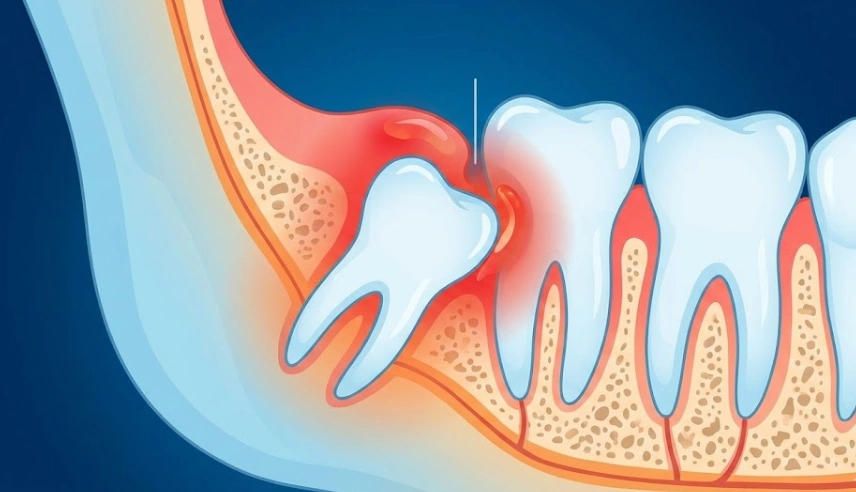
Before one can understand why an infection occurs, one should first get a mental picture of the anatomy.
Visualize a flower that is trying to open its leaves whereas, however, instead of soil, the flower is pressing against a piece of concrete. An impacted wisdom tooth is just like that. Most of the time, the tooth only emerges halfway through the gum tissue. This, in turn, produces a flap of gum skin—the operculum in clinical terms—that is just as a trap door.
Food particles and bacteria get under this trap door. However, your toothbrush cannot come to the rescue as the bristles are unable to get inside and remove them. It therefore becomes a perfect environment for the bacteria to multiply. According to our clinical experience, the infection of this kind, which is referred to as pericoronitis, is the main reason for patients to come rushing to our clinic in Istanbul.
Warning Signs We Pay Attention to
Most people mistake an infection for being readily visible, but the modes of infection can really be very deceptive. Usually, when it does make itself audible, it has already been long.
1. The Radiating Ache
The initial pain is located at the very back of the mouth, behind the last molar. Yet, a cavity pain comes when the tooth is exposed to cold water, as you know, this pain does not behave any such way. It is throbbing pain to be exact. The pain spreading in different directions is called radiating pain. Sometimes it may be felt in the ear, the neck, or even as a headache behind the eyes. This is caused by the inflammation that is impinging on the main nerve lines in the jaw.
2. The “Rotten” Taste
The one that really scares patients the most is the sign. With good reason, the patients will be the ones to first notice a continual metallic or salty taste in their mouth or a smell that even the strongest mouthwash will not be able to cover up. Most likely, pus is slowly leaking out from that “trap door” gum flap. It is very unpleasant to hear because that is what it really is – the active decay of the tissue and the metabolic byproducts of the bacteria.
3. Trismus
Have you ever felt that your jaw is sore when you woke up in the morning? You can hardly open your mouth wide enough to eat a burger or even brush your teeth. That is trismus. When the infection leaves the tooth and goes to the mastication muscles (chewing muscles), they suddenly start to spasm and get tighter.
4. The Visible Swelling
Dentist Polen Akkılıç and her beauty team are often capable of making such a diagnosis even before the patient opens his/her mouth because only from the outward appearance is it obvious. The lymph nodes underneath the jaw start to become painful and swollen. To the point where the swelling becomes such a degree that it causes a visible lump on the cheek, making the patient look like a “chipmunk.”
Distinguishing Normal Healing Process from Infection
It can be very difficult to determine the source of trouble if you recently underwent oral surgery or if you are just dealing with a few attack symptoms. Use this table to see which signal your body is sending.
| Symptom | Normal Eruption / Healing | Dry Socket (Alveolar Osteitis) | Active Infection |
| Pain Level | Mild to moderate soreness | Sharp, excruciating, radiating pain | Throbbing, continuous ache |
| Timing | Comes and goes for days | Starts 3-4 days after extraction | Persists and worsens over time |
| Swelling | Minimal gum swelling | None usually | Visible facial or neck swelling |
| Taste/Smell | None | Bad taste from food debris | Foul taste of pus; fever |
| Mouth Opening | Slightly stiff | Normal range of motion | Limited opening (Trismus) |
| Response to Meds | Ibuprofen helps significantly | Painkillers provide little relief | Antibiotics required to reduce symptoms |
Critical Queries on Wisdom Tooth Flare-Ups
The short answer is no. Antibiotics are a cease-fire, not a peace treaty. They can temporarily knock down the bacterial count and reduce swelling, which is often necessary before we can safely operate. However, they cannot remove the source of the problem (the impacted tooth and the debris trapped under the gum). Once you stop the medication, the infection will return, often with a vengeance. Surgical removal is the only permanent cure.
It can become one very quickly. If you experience difficulty swallowing, difficulty breathing, or if the swelling spreads toward your eye or down your neck, you need immediate emergency care. This could indicate that the infection is spreading to deeper neck spaces, a condition that can obstruct your airway.
We see this often. If you have a flare-up right before your trip, we recommend seeing a local dentist to start a course of antibiotics before you fly. This calms the acute inflammation, making the flight more comfortable and the anesthesia more effective once you arrive at Lema Dental Clinic. We can then perform the extraction safely upon your arrival.
A fever (usually over 38°C or 100.4°F) is a systemic sign that your body is losing the battle to contain the bacteria locally. It means the infection has entered your bloodstream. This is a clear signal that professional intervention is needed immediately.
Actually, keeping the infected tooth is what endangers your other teeth. An impacted wisdom tooth pushes against the healthy second molar in front of it. This pressure can cause resorption (dissolving) of the healthy tooth’s root or create a cavity on the back of that tooth that is impossible to fill. Removing the wisdom tooth protects the structural integrity of your entire arch.
- Venta, I., & Ylipaavalniemi, P. (2020). Clinical signs and symptoms of acute pericoronitis of lower third molars. Oral Surgery, Oral Medicine, Oral Pathology, Oral Radiology, 130(6), 609-615.
- Marciani, R. D. (2012). Third molar removal: An overview of indications, imaging, evaluation, and assessment of risk. Oral and Maxillofacial Surgery Clinics, 24(1), 1-19.
- Piesold, J. U., Al-Nawas, B., & Klein, M. O. (2018). Antimicrobial treatment of pericoronitis: A retrospective analysis. Journal of Cranio-Maxillofacial Surgery, 46(6), 936-940.
- Guralnick, W., & Laskin, D. M. (2019). NIH Consensus Development Conference for Removal of Third Molars. Journal of Oral and Maxillofacial Surgery, 38, 235-236.
- Renton, T. (2021). The diagnosis and management of pericoronitis. Dental Update, 48(4), 274-284.

