


By pain, looseness, gum infection, and bone loss on X-rays.
Let’s be honest –dental implants can really change your life and are a big decision at that. Apart from being a boost to your self-esteem, they also let you enjoy a meal with steak and keep you healthy. Despitedental implants showing an outstanding success rate of something between 95% and 98%, the anxiety of being among that tiny minority of ‘failures’ is justified.
Meanwhile, here at Lema Dental Clinic, patients keep coming in every day from every corner of the globe either to Turkey to undo the damage of a bad oral treatment or simply to have the first treatment done right. Implants, indeed, cannot be considered as something you ‘put and forget’. In fact, they are biological anchors.
It seems you have landed here because perhaps, you are experiencing a little discomfort or you think there is something wrong with your body. That is how we, at the clinic, digest and decode the failure signs for our patients in simple language without mixing them up with complicated medical jargon.
Osseointegration Explained: The Biological Key to Implant Success
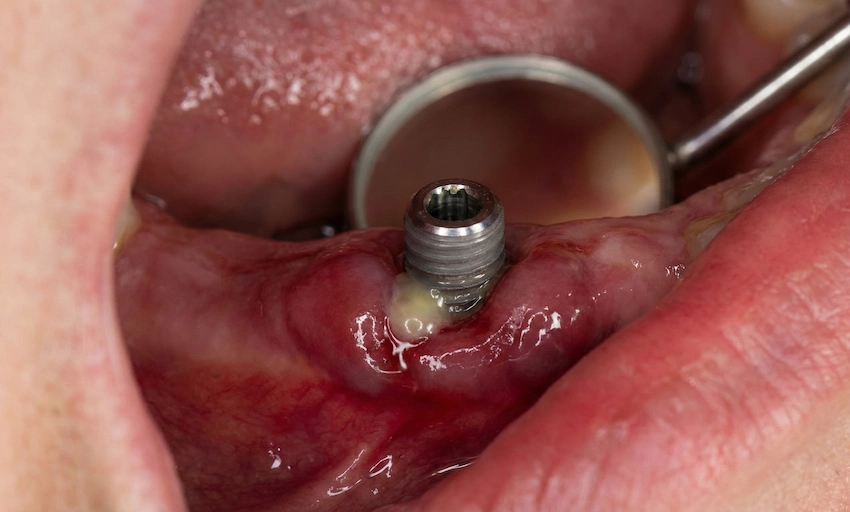
Failure and success are two mutually exclusive facets that cannot exist without the other.
Professor Doctor Coşkun Yıldız frequently cites a construction metaphor when he explains the idea to his patients. He says: ‘Imagine a scenario when a steel column is placed in fresh concrete. The column can only bear the load of the building once the concrete sets and gets so hardened that it adheres tightly to the steel surface.’
The term which is technically used in dentistry here is osseointegration. In simpler terms, your jawbone (concrete) has become so intimately entwined with the titanium implant (pillar) that the two have literally turned into one entity.
- Success: The bone cells merge tightly into the implant’s microchannels thus ensuring firm fixation.
- Failure: The implant is enveloped with soft tissue, or bacteria find their way between the bone and the implant. A pillar standing in mud, not in concrete, is what you get. The pillar may remain standing for a little while, but it will eventually start to shake and fall down.
Early vs. Late Failure: It Depends on When
Failures are not necessarily instantaneous. We, at Lema Dental Clinic, are, based on our experience, able to distinguish between these problems in terms of two different time intervals.
1. Early Failure (3 – 4 Months After Surgery)
That is when the bone is not completely healed yet. Most of the time, these cases are a biological rejection or a surgical error.
- “The Spinner“: During the recovery time, if the implant is displaced even to a minimal extent, it becomes physiologically impossible for the bone to develop. It is akin to trying to glue two things together while your hands are trembling.
- Infection: Caused by bad hygiene or the presence of bacteria that are antagonistic to healing.
2. Late Failure (Many Years Later)
If you have been enjoying your new tooth for several years and then suddenly it starts causing you problems, it is most likely due to Peri-implantitis— a destructive inflammatory disease of the tissues around dental implants. If you want, you can think of it as a more aggressive form of gum disease.
5 Warning Signs You Shouldn’t Overlook
Dentist Polen Akkılıç and her assistants reveal to us how they carry out a check-up on a patient with suspicious symptoms.
1. Pain Or Discomfort Following The Nerve
Pain is essentially an alarm mechanism of the body. It might be that there is some soreness that you can feel right after the surgery, but what do you think will be the case if months go by? Pain is an alarm signal. Biting pain functionally means that the implant is unable to bear the force, or the bone is getting resorbed which is the explanation of pain.
2. Mobility (The Devil’s Kiss)
Implants, as opposed to natural teeth, never move or wiggle. Tees have ligaments that give them a tiny bit of “give,” but implants are firmly stuck in the bone. So, if in your trial and error to move it with your tongue or finger it actually moves, then probably the fibrosis happened instead of the bone deposition during the integration.
3. Gum Recession and Inflammation
The earliest sign of peri-implantitis is a gum that is red, swollen and which bleeds when you brush it and is located at the site of the implant. When the gum recedes so far that the implant metal gets exposed, bacteria will have easy access to the bone and will start destroying it.
4. Difficulty In Chewing
If you feel like your teeth don’t quite fit together like they used to or your subconscious picks the other side of the mouth, then the problem could indeed be a lack of structural integrity.
5. Bad Odour or Taste
Sometimes, it is the most embarrassing symptom for a patient, but a very highly relevant diagnostic indicator. Bad taste or smell from the implant site indicates that pus is formed and/or that bacterial infection is present in the pockets around the metal post.
Comparison Table: Healthy vs. Failed Implant
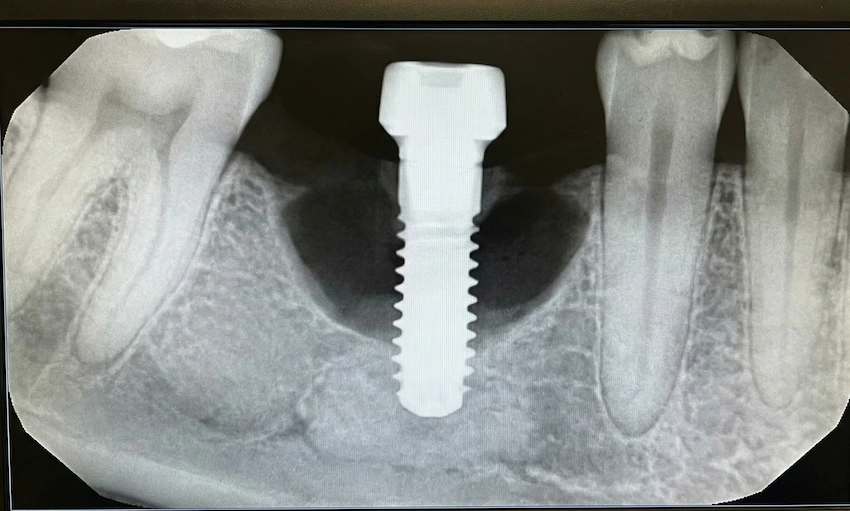
Here goes the difference between a normal recovery and a situation that cannot be left unattended.
| Feature | Healthy Implant | Ailing Implant (Peri-mucositis) | Failed Implant (Peri-implantitis) |
| Sensation | Feels like a natural part of you, no pain | Tenderness and mild hypersensitivity | Sharp pain on biting or a dull, deep ache |
| Mobility | Absolutely no movement | Usually none, but gums may feel soft | Visible movement or looseness |
| Gum Appearance | Firm, pink, stippled texture | Red, swollen, band leeds when brushed | Purple-red, receding, possible pus discharge |
| Bone Level (X-ray) | Bone tightly attached to the implant neck | No bone loss yet; condition is reversible | Crater-like bone loss around the implant |
| Action Required | Routine scheduled check-ups | Thorough cleaning and antibiotic therapy | Surgical intervention or implant removal |
Can a Failed Implant Be Saved?
Dr. Polen Akkılıç with our team of specialists in hygiene frequently rescues cases of peri-mucositis only by means of laser and by putting the patient under a strict hygienic regime.
On the other hand, if the implant is loose (osseointegration failure), you will have to accept the fact that the implant has to be removed, generally. But don’t worry! Most of the time going for an implant removal is less painful than the one the doctor does for an Lema Dental Clinic in Turkey. The process involves getting rid of the broken fixture, cleaning the spot thoroughly, bone grafting (laying down that concrete foundation), and finally, healing. Then, the implantation can be attempted once again.
FAQ
Yes, it can be, but the best choice is not to wait for it to fall on its own. Most of the time, the fact that the implant goes out without any help is just a sign that the bone was so badly damaged that it had become loose. So, if in the future you want to have a long-lasting implant and your jawbone is in good condition, the proper way is to get the implant surgically removed.
Among all the feelings we have in such a situation, fear is the one most frequently heard. Actually, the implants can be removed very fast and even painlessly if the implant is not fused anymore with the bone and you are under local anesthesia. You will be numb as before and the wound will heal even faster than after the first implant surgery.
Body chemistry is completely different from one person to another. Besides smoking, diabetics with no control and bruxism are all risk factors. At times, your bone condition may be the deciding factor. Prof. Dr. Coşkun Yıldız examines each case to the very last detail to find the problem’s root so that such an event is not repeated again.
Definitely. Fixing a bad job with revision surgery in the UK or the US is not only very complicated but also very costly. At Lema Dental Clinic, top-notch surgical titanium materials and expertise are at the disposal of our patients just like at the best clinics in London and New York City. We leverage the lower costs of operations to provide our high-end restoration and renovation surgeries at a fraction of the price with no compromise to safety and efficacy.
It is all about the condition of the infected site at any time. Usually, after the bone has been patched, the patient has to wait for 3 to 6 months for the “foundation” to become solid before new implantation. Patience is the key to a permanent result.
- Derks, J., & Tomasi, C. (2016). Peri-implantitis: Biological complications with dental implants. Journal of Clinical Periodontology, 43(S16), 116–135.
- Heitz-Mayfield, L. J. A. (2008). Peri-implant diseases: Diagnosis and risk indicators. Journal of Clinical Periodontology, 35(8), 292–304.
- Albrektsson, T., & Donos, N. (2012). Implant survival and complications. The Third EAO consensus conference 2012. Clinical Oral Implants Research, 23(s6), 63–65.
- Esposito, M., Grusovin, M. G., & Worthington, H. V. (2012). Treatment of peri-implantitis: What is the evidence?. European Journal of Oral Implantology, 5(Suppl), S21-S28.
- Schwarz, F., Derks, J., Monje, A., & Wang, H. L. (2018). Peri-implantitis. Journal of Periodontology, 89(S1), S267–S290.

