


All-on-4 fits limited bone, while All-on-8 offers higher stability.
All-on-4 and All-on-8 dental implants are two advanced techniques for full-arch rehabilitation that aim to restore the function, comfort, and oral stability of patients who have lost most or all of their teeth. Both techniques use titanium dental implants and fixed prosthetic bridges but differ in the number of implants, the way the biomechanical load is distributed, and the plans for the long-term support.
The study by Dr. Polen Akkılıç and her team suggests that picking one of the two options should not be influenced just by the price and the time factor. Besides bone density, the force of biting, the overall health condition, and the long-term plan of the patient are some of the major considerations that determine which of the two solutions is capable of providing the most secure and reliable results. In a difficult situation, which cases, according to Dr. Coşkun Yıldız, professor and doctor, adding more implants will improve the distribution of forces and thus there will be less mechanical load on each implant over time.
All-on-4 vs All-on-8 Dental Implants
| Clinical Aspect | All-on-4 Dental Implants | All-on-8 Dental Implants |
| Number of implants | 4 | 8 |
| Bone grafting need | Often avoided | May be required |
| Load distribution | Concentrated | Widely distributed |
| Long-term stability | High | Very high |
| Ideal patient profile | Limited bone volume | Adequate bone density |
All-on-4 and All-on-8 Dental Implant Comparison: Differences and Functions
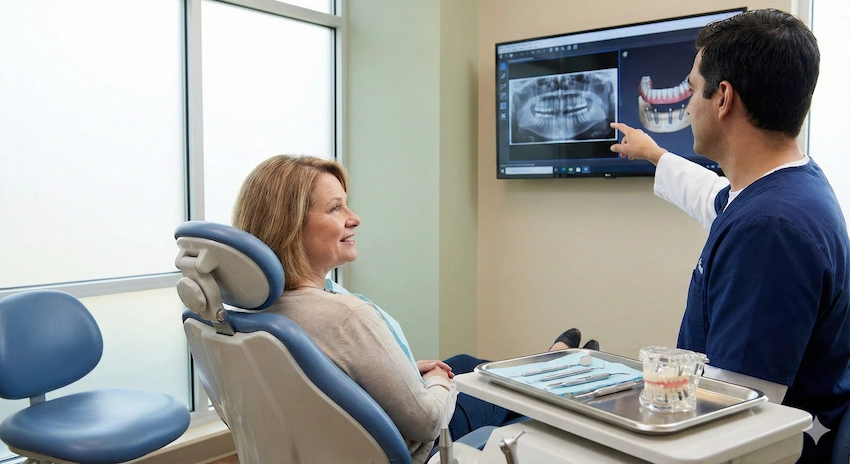
All-on-4 dental implants refer to a method where four implants are positioned in the jawbone. Generally, two implants are placed vertically in the front and two angled implants in the back to avoid anatomical structures like the sinus cavity or mandibular nerve. Hence, the full-arch prosthesis can be effectively supported with this design while making the most of the bone that is available and in many cases, bone grafting is not necessary.
All-on-8 dental implants are a technique where eight implants are placed along the jaw to provide a broader base for the prosthetic arch thereby improving the biomechanical stability of the arch. Additionally, the forces exerted during chewing can be distributed over a greater area. Prof.Dr.Coşkun Yıldız points out that All-on-8 offers patients with strong bite forces or those who have enough bone volume an excellent solution for increased long-term durability.
What to Expect from All-On Dental Solutions?
These days, all-on dental solutions aim to give patients a fixed set of teeth that function and feel the same as natural teeth. Patients will see a notable improvement in the efficiency of their chewing, their ability to speak clearly and the structure of their face due to the restoration of the vertical dimension and continuous bone stimulation.
Clinically, Dentist Polen Akkılıç and her team share that patients are able to enjoy the advantages of digital smile design, three-dimensional imaging, and prosthetic-driven implant placement. All these stages help to make the final prosthesis not only aesthetically pleasing but also in harmony with the jaw mechanics, the health of the soft tissues, and the stability of the oral environment in the long run.
How Does Treatment Work with the All-On Technique?


The complete process of the All-on treatment starts with a thorough clinical assessment of the patient. It also includes cone-beam computed tomography scanning to check the density of the bone, nerve pathways, and the anatomy of the sinuses. This phase of diagnostics safeguards the placement of the implants and therefore keeps the risk of surgery at a minimum level.
Clinical guidelines dictate the outlining of a therapy regimen that would include drugs such as amoxicillin for infection prevention and ibuprofen for the control of inflammation after the placement of an implant. When there is a favorable scenario, a fixed temporary denture is put on the same day and hence the patient gets access to functionality at once while osseointegration is going on. After complete healing, final prosthetics are installed to ensure both the bite balance and implant longevity are at their best.
When Are All-On Dental Solutions Recommended?
All-on dental implants are highly recommended for patients who have lost a large number of teeth, have severe gum disease, or have crowns and bridges that are deteriorating. Additionally, they are great for folks who prefer a fixed restoration over removable dentures and who desire improved oral stability.
If patients have a low bone volume or simply wish to avoid bone grafting, then they could be the perfect fit for All-on-4 dental implants. On the other hand, patients who have good bone density and whose functional needs are higher might, according toProfessor Doctor Coşkun Yıldız, get more benefits from All-on-8 implants during comprehensive treatment planning.
Factors Affecting the Choice Between All-On-8 and All-On-4
- Bone density and the amount of available jawbone are crucial factors that determine how many implants can be placed safely and predictably.
- Jaw anatomy, including sinus location and nerve pathways, is evaluated with three-dimensional radiographic imaging.
- Bite force and chewing habits, as stronger occlusal forces may benefit from more implant support
- The patient’s age and overall health condition, including diabetes or osteoporosis that may affect bone healing
- The patient has a history of periodontal disease or implant failure which could necessitate a more reinforced implant distribution.
- The patient’s long-term prosthetic needs such as durability, load balance, and resistance to mechanical stress
- Oral hygiene skills and willingness for regular follow-up, are major determinants of implant success
- Patient’s choice to avoid bone grafting, which generally supports the use of the All-on-4 technique
- The clinical examination and treatment plan suggestions by Dentist Polen Akkılıç and her team or Professor Doctor Coşkun Yıldız are based on a thorough individual risk assessment.
Frequently Asked Questions About All-on-4 vs All-on-8 Dental Implants
All-on-8 implants can offer better load distribution which may result in less mechanical stress on individual implants. Both techniques are safe if planned and carried out properly.
The essential point is that both techniques are geared towards lasting a long time provided they get proper care. It can be said that All-on-8 is stronger simply because there are more implants and hence there is more support.
A post-surgery regimen may involve taking amoxicillin to prevent infection and ibuprofen to ease inflammation for healing and patient comfort.
Patients will be able to chew normally little by little as the healing phase goes on. A fixed/durable denture will give a stable and efficient chewing function.
Both solutions feel natural but the All-on-8 could be more balanced for those patients with very high chewing demands since the force is distributed better.
- Maló, P., Rangert, B., & Nobre, M. (2003). All-on-4 immediate-function concept with Brånemark system implants for completely edentulous mandibles: A retrospective clinical study. Clinical Implant Dentistry and Related Research, 5(2), 2–9.
- Babbush, C. A., Kanawati, A., & Brokloff, J. (2011). A new approach to the All-on-4 treatment concept using narrow platform NobelActive implants. Journal of Oral Implantology, 37(4), 431–445.
- Papaspyridakos, P., Chen, C. J., Singh, M., Weber, H. P., & Gallucci, G. O. (2012). Success criteria in implant dentistry: A systematic review. Journal of Dental Research, 91(3), 242–248.

