


14K is hardest, 18K is balanced, 22K is softest and richest in color.
When a patient from anywhere in the world sits in our chair here in Istanbul and asks for a gold restoration, they almost certainly aren’t just looking for a functional restoration. They are looking for a statement. However, there usually remains an aesthetic gap between the patient’s ideal and the inherent properties of gold.
A situation like this turns into a problem when we continue to transport pieces in the fading province of sound at Lema Dental Clinic. You may desire that deep, rich yellow glow of high-purity gold (such as 22K or even 24K), but if we talk about your bite force, you, a human, may require something tougher in the first place. It’s a balancing act. Professor Doctor Coşkun Yıldız repeatedly explains to our patients that the mouth is a very unfriendly environment—it is wet, it is acidic, and the pressure of your jaw is sufficient to crack a walnut.
So, how do we make the choice between 14K, 18K, and 22K gold? It is not merely a matter of the price; it is also a matter of the physical properties.
The Alloy Equation: Why “Pure” Isn’t Always Better
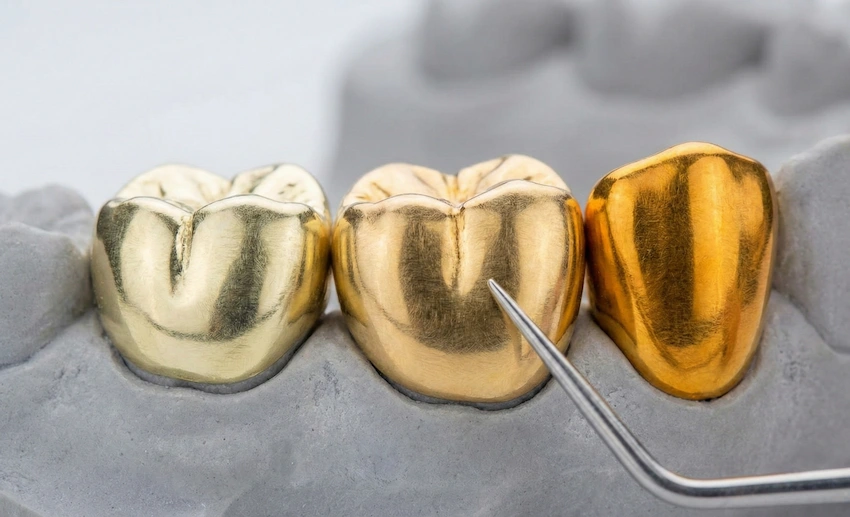
Before we start discussing mechanical properties, the initial point to clarify is that pure gold (24K) is very soft and malleable. Pure gold (24K) is like soft clay. If we put a 24K gold crown on a molar, the patient would be able to chew through it after only a couple of years. It would get deformed, lose its marginal seal, and finally break down. Therefore, the gold that is used in dental procedures is always alloyed with other metals such as copper, silver or zinc.
You may refer to these metal additions as the reinforcement that makes the copper bar stronger. Gold as a metal brings aesthetic beauty and biocompatibility, whereas the other metal additions bring the strength and competitiveness to withstand the wear of chewing that comes every day.
14K Gold: The Structural Tank
- The Composition: approximately 58% gold.
- The Look: A lighter, subtle yellow.
From our clinical work at Lema Dental Clinic, the 14K belongs to the class of dental gold which we would call the backbone. Since it contains a higher percentage of other metals (copper, silver), it is significantly harder than its higher-karat siblings.
Dentist Polen Akkılıç, our director practitioner, with the team, frequently suggests 14K gold to the patients who are bruxers or the teeth at the back that bear the greatest chewing force. It doesn’t have that very deep, sunset-orange color of 22K gold; it’s rather a light, metallic straw color. But the thing is, you lose the color saturation, but you gain the longevity dimension. It remains resistant to wear and tear more than almost any other gold substitute.
18K Gold: The “Sweet Spot.”
- The Composition: 75% gold.
- The Look: A rich, warm yellow.
Indeed, 18K is often the public’s favorite. It allows for mechanical strength sufficient for function and aesthetic richness that people want. Its softness compared to 14K means it will be worn down at a rate similar to human tooth enamel. This is an important detail: a crown made of a material that is too hard (like some dental ceramics) would cause damage to the natural tooth facing it. 18K is thus very “nice” to the opposing natural tooth (antagonist), being it nevertheless strong enough to resist changing its shape.
22K Gold: The Showpiece
- The Composition: ~91.6% gold.
- The Look: Deep, vibrant, almost orange-yellow.
Without a doubt, 22K is intrinsically amazing. It confers a radiance that less-karat materials are just unable to match. Though it is very soft. Hence, we generally do not suggest this to be a molar material for patients with heavy bite force. It is much better suited for anterior (front) teeth or inlays where the biting pressure is less intense. It’s a salon choice, essentially for the aesthetic rather than the mechanical resistance.
Comparing the Options: At a Glance
We use this matrix during the investor breakfast in order to help the patient understand the potential disadvantages and advantages of each material.
| Feature | 14K Gold | 18K Gold | 22K Gold |
| Gold Content | ~58% | ~75% | ~91.6% |
| Color Profile | Pale, light yellow | Rich, warm yellow | Deep, intense yellow-orange |
| Durability | Excellent (Hardest) | Very Good (Balanced) | Fair (Softest) |
| Wear on Opposing Teeth | Can be slightly abrasive | Matches natural enamel | Very gentle |
| Tarnish Resistance | Good | Excellent | Superior |
| Best Use Case | Molars, heavy grinders | All-around use | Front teeth, cosmetic emphasis |
The Clinical Reality: What We See in Turkey
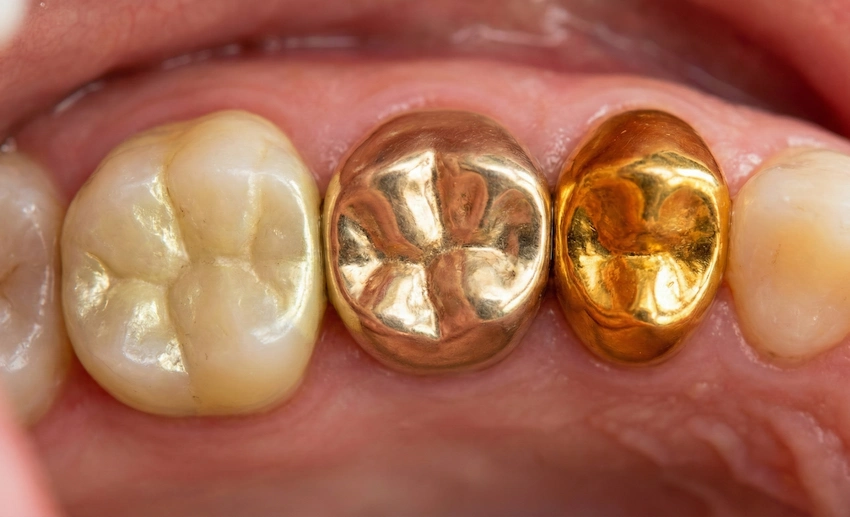
One of the things that Professor Doctor Coşkun Yıldız very much points out is the “margin”—the junction between the crown and the natural tooth. Gold permits what is called a “burnished” adaptation. Since gold is malleable, we can tighten the edges to the tooth so that the seal is close to being bacteria-proof and far better than most other materials can achieve in this respect.
On the other hand, because 22K is very soft, the fit can be perfect, but under pressure, the metal will deform over time. 14K can resist deformation; it is a shape retainer but, at the same time, you cannot burnish it to the extent that would result in the perfect seal. That is why the clinical skill of the dentist matters just as much as the metal. In Lema Dental Clinic we do not base our decision solely on the price, but on your bite anatomy.
FAQ
Not exactly rust like how iron rusts; gold is a noble metal. But since 14K gold alloys have more base metals (such as copper) the color may slightly darken after many years from regular exposure to a highly acidic oral environment. Hence, genuine corrosion is an extremely rare phenomenon in dental high-quality alloys of which we choose verified medical-grade ones to prevent.
Yes. Gold is non-magnetic. Unlike some compositions of old steel, gold crowns won’t fly out during an MRI or get dangerously loose. However, a gold crown can generate the ‘starburst’ artifact on the scan that might hide the part of the tooth adjacent to the crown. For your safety and knowledge, advise your radiologist of the gold crown beforehand.
In case you are a severe bruxer, I would suggest you get a 14K gold crown or maybe even a full zirconia crown. 22K gold is very soft and, with this material, you may expose the biting surface hole in a couple of years. 14K has enough wear resistance to let you continue the use of it as a nightly bite guard.
Material-wise, yes. However, when you look at dental treatment globally, the price difference is not that big. The cost of the treatment involves the clinical expert’s time, the creativity of the lab technician, and the sterilization procedures rather than the sheer weight of metal. We recommend making a decision based on your tooth’s condition rather than a small fluctuation in the gold market.
It’s all about conservativity. In fitting a porcelain crown, the dentist has to remove a great amount of healthy tooth structure so that the ceramic can fit in. Gold, on the contrary, is strong even at very thin layers. Therefore, more of the healthy, natural tooth could be preserved under a gold crown. It can be considered as a conservative and patient-friendly material.
- Knosp, H., Holliday, R. J., & Corti, C. W. (2003). Gold in dentistry: Alloys, uses and performance. Gold Bulletin, 36(3), 93-102.
- Anusavice, K. J., Shen, C., & Rawls, H. R. (2013). Phillips’ Science of Dental Materials (12th ed.). Elsevier Health Sciences.
- Roberts, H. W., Berzins, D. W., & Charlton, D. G. (2009). Hardness of different resin-based composites and gold alloys. Journal of Esthetic and Restorative Dentistry, 21(6), 406-407.
- Wataha, J. C. (2002). Biocompatibility of dental casting alloys: A review. The Journal of Prosthetic Dentistry, 87(2), 205-214.
- Baltag, I., Watanabe, K., & Miyakawa, O. (2005). Elemental release from dental casting alloys into cell-culture medium. Journal of Dental Research, 84(5), 458-462.

