


Gold dental crowns are durable and safe, but not aesthetically discreet.
Why Gold Crowns are Still the “Gold Standard” in 2026
In a society that has the “Hollywood White” coloration as the goal, the discussion about gold dental crowns sounds like an outdated recommendation. An analogy might be that of telling a person who uses Spotify exclusively to listen to a classic vinyl record. It is still somehow vintage, but the quality is often the winner.
Gold Crowns are still the “Gold Standard” in 2026 at Lema Dental Clinic. Patients from all over the world come to Turkey looking for the latest zirconia or E-Max veneers. However, Professor Coşkun Yıldız would pause during the consultation, look at the patient’s X-ray, and suggest gold instead.
Why? Because gold functions like a tooth while porcelain looks like a tooth.
The “Shock Absorber” Effect
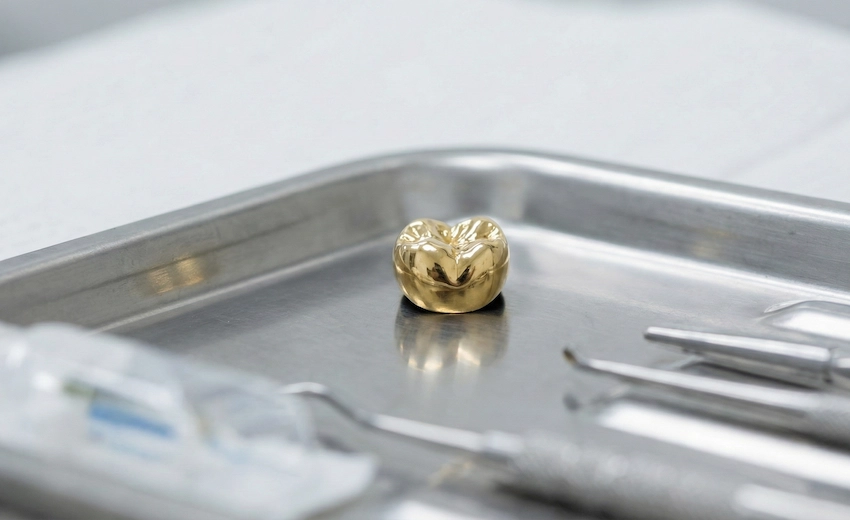
Your mouth, though, is a high-pressure area. The molars of your teeth endure hundreds of pounds of force every time you bite down. Dentist Polen Akkılıç and her staff frequently refer to a gold crown as the “luxury shock absorber” of dentistry.
Due to its rigidity, ceramic will eventually crack under extreme pressure, whereas gold gives a microscopic “slip.” It is a bit malleable. After years, a gold crown gets polished and molded to your bite, which is the case with a high-end leather boot that gets more and more comfy the more you wear it.
The Reality: Why Choose Gold Over Porcelain?
The ultimate question is: If gold has such a conspicuous position, why would anyone opt for it? Here is the scenario we encounter in the clinic daily. A big portion of our patients are “grinders”. If your jaw is sore when you wake up, it means that you are probably putting tremendous stress on your teeth during the night. Porcelain can be very rough on those; it is like a glass plate rubbing against a stone. Finally, the stone (your natural teeth) wears out.
Gold doesn’t do that. It wears at a rate almost identical to human enamel. Here’s a quick look at how it stacks up:
Gold vs. The Alternatives
| Feature | Full Gold Alloy | Zirconia (Ceramic) | PFM (Metal-Ceramic) |
| Survival Rate | Exceptional (30+ years) | Very High | High |
| Tooth “Tax” | Minimal shaving needed | Requires more space | Significant shaving |
| Opposing Tooth Wear | Very Low (Gentle) | High (Abrasive) | Moderate |
| Visual Appeal | Distinctive/Metallic | Natural White | White (with dark edges) |
But Let’s Go Deeper into the Flaws
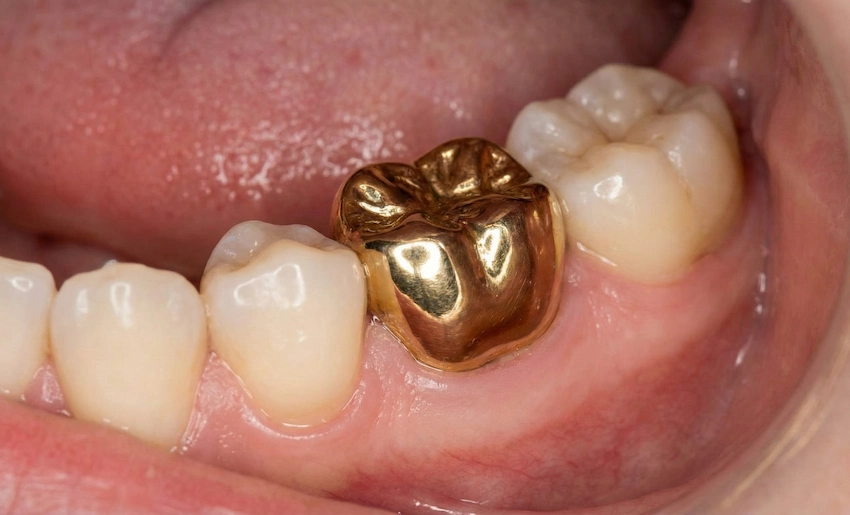
We have to admit—gold isn’t for everybody. To be honest, the greatest obstacle is the “mirror test.” Most people do not want a slight yellow color when they smile. For this reason, in our clinic in Turkey, we mainly use gold for the back molars.
Then, there is the price. Gold is a material. When the price of gold in the world goes up, so does the price of the alloy. But if you consider the fact that a gold crown seldom—if ever—needs to be replaced, the “cost per year” is actually much lower than almost any other dental treatment.
The “Lema” Clinical View
Professor Doctor Coşkun Yıldız frequently remarks that the edge of a gold crown is its greatest secret. Since gold can be molded so thin, the “fit” at the edge of the gums is extremely tight. It is similar to the difference between a ready-made suit and one made on Savile Row. That tight seal is what stops germs from going under and making a fresh cavity.
FAQ: Real Talk from the Dental Chair
No, not at all. The materials we use for our dentures are high-noble alloys. They are bio-inert and once the crown has been cemented, there will be no taste at all.
Metal is indeed a better heat conductor than porcelain. You might for the first weeks get a slight sensitivity to hot and cold drinks but this tooth soon adapts through the process of creating a protective layer of “reparative dentin” inside.
If it were pure 24k gold, it would be just as soft as a candle. We use a “high-noble” mix of metals that has gold, platinum, and palladium in it. This combination makes the material strong enough to withstand even steak dinners without getting bent.
It’s not because the gold is “cheaper”—gold prices are global. The savings at Lema Dental Clinic come from lower laboratory overheads and clinical operating costs in Turkey, allowing us to provide the same high-noble alloys used in London or New York for a fraction of the price.
You can’t “paint” over gold. If you decide later you hate the look, the entire crown has to be replaced. That’s why we spend so much time in the consultation phase making sure you’re 100% comfortable with the choice.
- Anusavice, K. J., Shen, C., & Rawls, H. R. (2012). Phillips’ Science of Dental Materials. Elsevier Health Sciences.
- Donovan, T. E., & Cho, G. C. (2001). Materials for conservative posterior restorations. Journal of the California Dental Association, 29(11), 797-801.
- Kelly, J. R., & Nishimura, I. (2008). Science-based decision making in fixed prosthodontics. Journal of Prosthetic Dentistry, 99(6), 479-496.
- Knosp, H., Holliday, R. J., & Schnorr, W. (2003). Gold in dentistry: Alloys, uses and performance. Gold Bulletin, 36(3), 93-102.
- Pjetursson, B. E., et al. (2015). A systematic review of the survival and complication rates of metal-ceramic and all-ceramic reconstructions. Clinical Oral Implants Research, 26(S11), 17-51.

