


To save space for permanent teeth to grow.
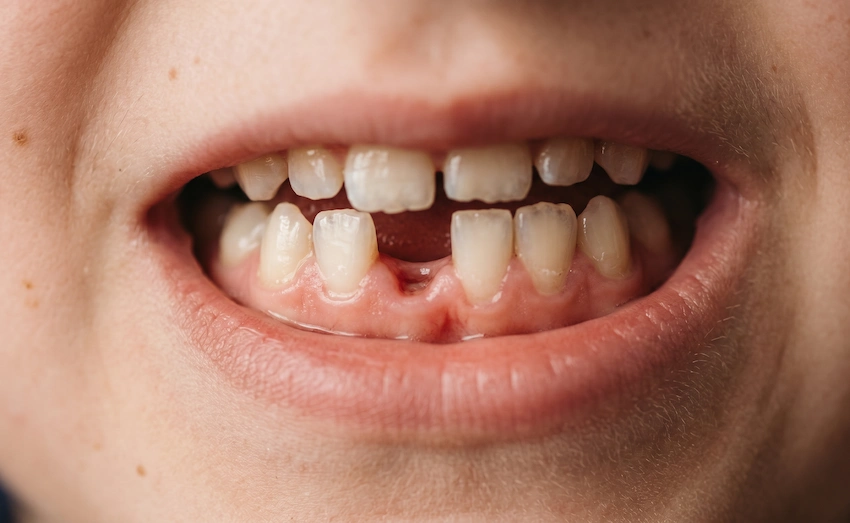
Finally, the troublesome baby tooth that had been bothering you has fallen out. Besides a sense of relief, you might have reassured yourself that this was inevitable.
The fact is, leaving that space is like setting a ticking time bomb.
Baby or primary teeth, aside from being a temporary means of chewing, are also like a model house throughout childhood. They act as the perfect blueprint, giving us the exact layout. Imagine a jawbone in the process of development as a very busy construction site. Every baby tooth is an anchor that pinpoints the position for the adult tooth that has yet to emerge from below the gum line. Suddenly removing that anchor – either by extraction due to very bad decay, or by an accident during playtime – means that the whole plan for the building of the mouth is at risk.
The Domino Effect Inside the Jaw

It is a natural tendency for teeth to exploit the situation. At the same time, they desire a surface to provide support to them.
What happens if a tooth loses its place? Within a short time after the disappearance of a primary molar, the teeth adjacent to it will move into the gap. Firstly, they lean over and then slide forward. Whether it is a few months or half a year, the adult tooth that is enclosed inside the bone is left with no space to erupt. As a result, it does not come out at all (becomes impacted) or it erupts at a bad angle that causes an improper bite.
This is the reality we witness in our practice. Young people who come to see us in their teenage years have to undergo very difficult, painful, and also financially expensive orthodontic treatments. Why? All because a small gap was neglected at the age of six.
At Lema Dental Clinic, we have found that one step at the right time can bring about a total change in a person’s facial growth. During consultations with parents, Professor Doctor Coşkun Yıldız frequently touches upon the point that pediatric dentistry is akin to time travel. We fit a simple preventative device today, so your child will not need a complete realignment structurally tomorrow.
Bridging the Gap: The Role of the Maintainer
What is that one step that we take to maintain a secondary barrier? We turn to the aid of a space maintainer. This device is precisely what its name suggests—a tiny custom-bent security guard typically made of medically approved steel. Its sole function is to remain totally immobile so the other teeth cannot invade the vacant area.
Of course, not all gaps are the same. The exact device is chosen with a lot of factors influencing this decision, being guided by the tooth that has been extracted, the child’s age, and their stage of skeletal growth.
| Appliance Design | Clinical Target | The Upside | The Catch |
| Band-and-Loop | One missing primary molar on one side. | Very strong. Cemented in place so that kids cannot lose it. | Wire forms small plaque traps. Therefore, kids must have excellent brushing habits to prevent buildup. |
| Lower Lingual Arch | Missing molars on both sides of the lower jaw. | Extremely strong stabilization. Prevents collapse of front teeth. | Functional only after the permanent lower front teeth have erupted. |
| Distal Shoe | The primary second molar is extracted before the permanent 6-year molar element is present. | Think of it as a sort of positioning guide rail for the impacted permanent element. | Placing it is not an easy task. The metallic arm must be slightly submerged under the gum. |
| Removable Guard | Several missing teeth, mostly from the front aesthetic area. | Aesthetics are really good; able to hold artificial teeth to hide the gaps. Very convenient for cleaning. | Children can easily take them off. If they don’t wear it, it is ineffective. |
The Pediatric Experience in Turkey
That is a very good question. A six-year-old who is frightened, how is it possible to get him to keep a fixed posture for a long time?
First of all, be assured—this is extremely non-invasive. It does not even come close to removing a layer of natural enamel. It is not necessary to give a local anesthetic or to use needles.
Working at a specialized clinic in Turkey, Dentist Polen Akkılıç and her colleagues encourage children to play the low-stress type of tame. It takes a couple of minutes max to insert a tiny digital scanner inside the oral cavity. Attaching a small metal ring to an anchor tooth takes even less time. We want the child to leave the office with a smile, feeling happy, unaware that they have just received first-class preventative care, saving their future smiles.
Frequently Asked Questions
Honestly, not even a little bit. Probably the most difficult thing for the child would be to keep their mouth open for a few minutes only. We make a fast digital impression and later attach the little metal band to a tooth next to the gap by adhesively bonding it. No drills, no pain.
Simply put, they have to bear it for the entire time that the permanent adult tooth is still under the gum, and we cannot yet see the white part of the crown. After that, the bit of the permanent tooth breaking out of the gum is a sign that the space maintainer has been successful. It is just a matter of unsecuring it in the dentist’s chair afterwards.
Certainly, children are definitely wild and disorderly, and therefore, at times, accidents occur. Actually, we use the strongest dental cement available; however, if the child decides to chew something other than a dental product, the ring might come loose. If it pops off, do not get scared. Take it and put it inside a small plastic container, and give us a call. Provided that the metal wire has not been twisted, we will be able to clean it and glue it back down, usually without any problems.
Indeed. All sticky and chewy types are forbidden. Caramels, gummy bears, and a piece of chewing gum would literally dislodge the cement. We also instruct the children not to press hard down on ice or candy that can break their jaw on that part of the mouth, as excessive force can bend the spacing wire.
Simply, because here we combine sophisticated diagnostic equipment with real, slow human compassion. It is not only teeth we treat, but also dental anxiety that we deal with. By identifying these developmental changes early on in our Istanbul clinic, we also shield your family from the hefty emotional and financial burden of serious orthodontic surgeries in the future.
- American Academy of Pediatric Dentistry. (2022). Management of the developing dentition and occlusion in pediatric dentistry. The Reference Manual of Pediatric Dentistry, 419-434.
- Brothwell, D. J. (1997). Guidelines on the use of space maintainers following premature loss of primary teeth. Journal of the Canadian Dental Association, 63(10), 753-766.
- Laing, E., Ashley, P., Naini, F. B., & Gill, D. S. (2009). Space maintenance. International Journal of Paediatric Dentistry, 19(3), 155-162.
- Qudeimat, M. A., & Fayle, S. A. (1998). The longevity of space maintainers: A retrospective study. Pediatric Dentistry, 20(4), 267-272.
- Setia, V., Pandit, I. K., Srivastava, N., Gugnani, N., & Sekhon, H. K. (2013). Space maintainers in dentistry: Past to present. Journal of Clinical and Diagnostic Research, 7(10), 2402-2405.

