


Intraoral scanners offer superior speed, accuracy, and comfort.
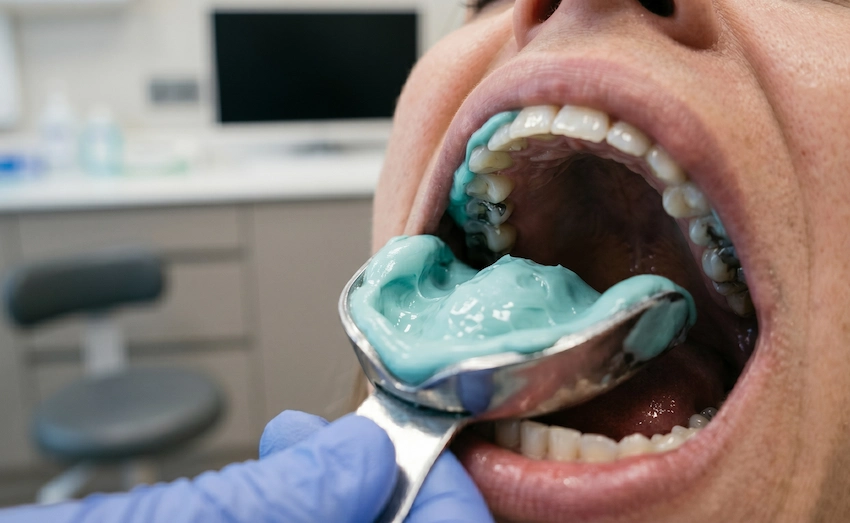
Getting a dental crown or a veneer, for a long time, posed just one main issue: the putty tray. You sit there in the chair. You try to breathe through your nose. A cold, thick paste surrounds your teeth. It’s messy. It really isn’t a fun experience.
The fact is, dental care has progressed far beyond this old method. These days, advanced digital instruments can capture your smile in a matter of seconds. But what really differentiates these two ways? Which one is truly the best one for you?
The Old Way: Traditional Impressions (The Putty)
We need to examine the traditional method if we want to understand the reasons for digital one’s superiority. Traditional impressions require the use of a thick paste that is placed in a mouth tray. The dentist then situates the tray over your teeth, and you wait for the paste to harden like rubber.
It is similar to the process of making a footprint in wet mud, only that the mud dries in your foot’s exact shape. Dental technicians use this mud-like casting to pour plaster and prepare a hard model of the teeth.
This old method can still produce results. However, there are also downsides to it. The paste could induce the gag reflex in some patients. The mold is capable of tearing when it is being taken out. Besides, if one swallows or moves, the mold will be ruined. And of course, the entire messy procedure needs to be repeated in such cases.
The New Way: Intraoral Scanners (The Smart Wand)
The introduction of the intraoral scanner tool helps get rid of the putty mess. This device looks like a small wand fitted with a smart camera and a light. The dental practitioner carefully moves the wand over the teeth. At that very moment, the camera snaps thousands of pictures in a flash. Afterwards, the images are perfectly combined into a 3D image that can be seen on a screen just next to the patient.
Instead of a footprint in mud, a digital scan is like a drone taking exact photos of a mountain range. It sees every tiny bump and valley. Best of all, it never pushes hard on your teeth.
This smart device is the one that Dentist Polen Akkılıç and her team use daily at their clinic in Turkey. Nowadays, the changing times and technology have made the removal of putty an everyday thing. Not only does fast optical scanning imply zero mess, but it also results in the patient spending less time in the chair. Plus, since it is a digital file, the lab gets it directly, and there is no waste of time in transferring the file one more time. A huge advantage of this is that your smile transformation time is greatly shortened.
Side-by-Side Comparison
Look at some of the main points we observe in our clinic when comparing the two options:
| Feature | The Putty Mold | The Digital Scanner |
| Material | Thick paste (Alginate/Silicone) | Safe light and a small camera |
| Comfort | Low (can cause gagging) | High (easy to breathe and swallow) |
| Time Needed | 5 to 15 minutes | 2 to 5 minutes |
| Accuracy | Good, but it can shrink or warp | Perfect 3D map, checked on screen |
| Lab Delivery | Takes days to ship in a box | Sent in seconds via the internet |
Our Clinical Experience at Lema Dental Clinic
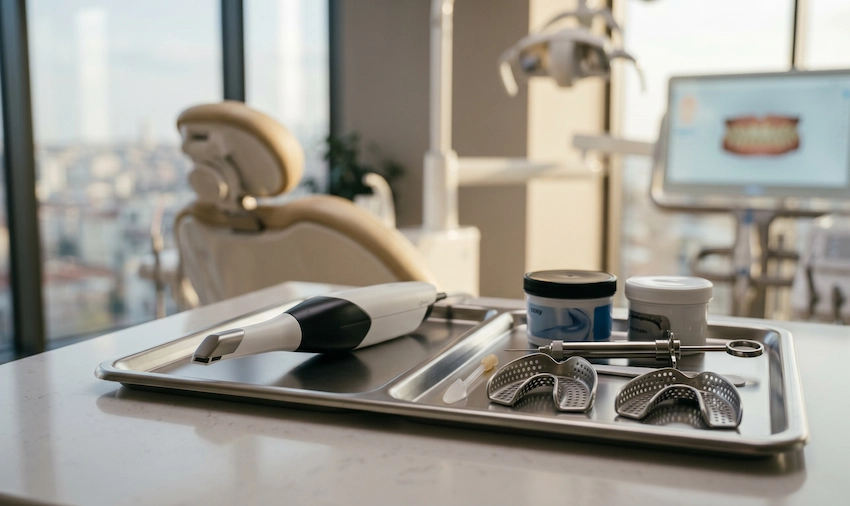
We at Lema Dental Clinic have discovered through clinical experience that making a transition to complete digital has a huge impact on everything. Patients from all over the world who come to Turkey for excellent treatment really desire pinpoint outcomes. There is no room for errors when we are designing a brand-new smile.
Professor Doctor Coşkun Yıldız is a frequent commentator on how the scanner’s real strength lies in safety and delivery of consistent outcomes. A putty mold that is packed in the box may bend. In contrast, a digital file is flawless. The very clinic measurements that we keep go directly into the equipment for fabricating your teeth. Thus, your crowns or veneers will perfectly match the first time.
Are traditional putty impressions done and dusted? They are not, in fact. Certain surgical procedures, such as deep gum surgeries, still require them. However, for the new smile work, digital scanners undoubtedly come out on top each time, giving you ultimate comfort and the best clinical results.
Frequently Asked Questions
Totally safe. The device only shines light on your teeth to take photos. Thus, you are not exposed to radiation, which means that it is safe for everyone.
The exact reason why our patients are quite fond of the scanner. Use of that small wand hardly ever touches the biting edge of your teeth, and you could even breathe through your mouth or nose.
At our facility, we think that advanced technology is the norm rather than an option. A scanner will be used for your treatment without additional costs.
Absolutely! A 3D model of your mouth will be visualized in real-time on the screen. It is quite handy for us to explain to you the situation.
It takes only three to five minutes to scan your entire mouth. You spend less time with the scanner than with the putty that gets hardened in your mouth!
- Ahlholm, P., Sipilä, K., Vallittu, P., Vehkalahti, M., & Mäkilä, E. (2018). Digital versus conventional impressions in fixed prosthodontics: a review. Journal of Prosthodontic Research, 62(1), 40-46.
- Chochlidakis, K. M., Papaspyridakos, P., Geminiani, A., Chen, C. J., Ijams, I. J., & Ercoli, C. (2016). Digital versus conventional impressions for fixed prosthodontics: A systematic review and meta-analysis. The Journal of Prosthetic Dentistry, 116(2), 184-190.
- Joda, T., & Brägger, U. (2015). Patient-centered outcomes comparing digital and conventional implant impression procedures: a randomized crossover trial. Clinical Oral Implants Research, 26(4), 585-589.
- Ting-Shu, S., & Jian, S. (2015). Intraoral digital impression technique: a review. Journal of Prosthodontics, 24(4), 313-321.
- Yuzbasioglu, E., Kurt, H., Turunc, R., & Bilir, H. (2014). Comparison of digital and conventional impression techniques: evaluation of patients’ perception, treatment comfort, effectiveness, and clinical outcomes. BMC Oral Health, 14, 10.

