


Some veneers need minimal preparation, while no-prep veneers need none.
If you have scrolled a bit on social media, chances are you have come across some of the horror stories. Some influencers who’ve had their teeth turned into tiny, jagged pegs are posting videos that say “getting my veneers done.” That alone would make anyone cancel their flight to Turkey!
However, at Lema Dental Clinic, the reality we witness every day is quite different: what you see in these viral videos is hardly ever veneer preparation. Most of the time it’s a crown preparation.
The biggest issue for patients is the fear that they will “lose their teeth” when gaining a beautiful smile. It is a legitimate concern since nobody wants to compromise their dental health to get a brighter and symmetrical smile. So, is it necessary to “cut” teeth? In short: YES, teeth are usually prepared but rarely cut as drastically as you might imagine.
Storage aside, let us look at some clinical facts.
The Contact Lens Analogy: Understanding Preparation
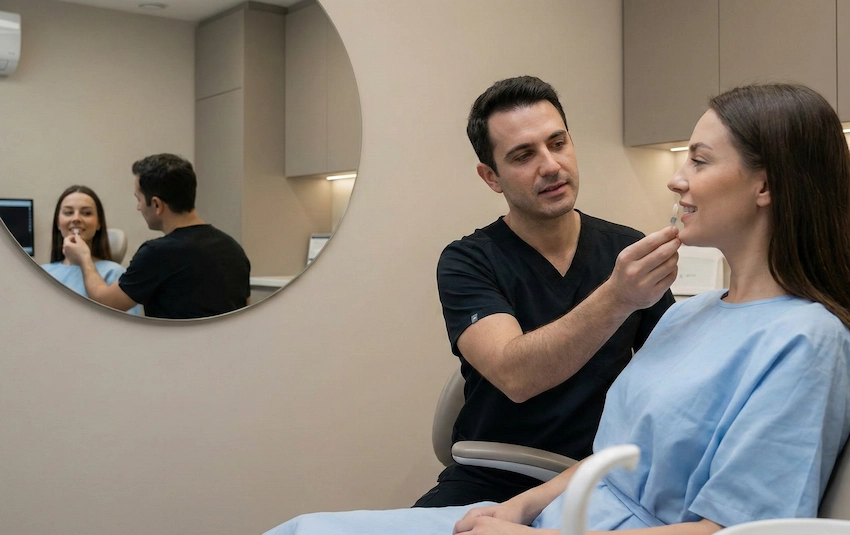
Imagine if your tooth were just like a nail on your finger. Now, if you glue a very high-quality acrylic nail over your natural nail without preparing the surface, what would be the result? The nail would look bulkier, it would catch on things, and the nail wouldn’t look natural since it would sit on top of the cuticle instead of the nail bed. The same goes for veneers.
If you want the porcelain veneers to look so natural that they appear to have grown out of your gum line, then you will have to allow some space for them. No, this definitely doesn’t mean you have to cut your teeth structurally; it’s actually more to do with the micro-contouring. Dentist Polen Akkılıç and team are well-versed with the term “Minimally Invasive Dentistry.” Usually, for a standard laminate veneer, the amount of enamel removed can be 0.3mm to 0.5mm.
Just to give you an idea, it is about the thickness of a contact lens. So, instead of tearing down your house, think of it as if we are only doing a light sanding to make the paint look nice and smooth.
Why Some Preparation is Non-Negotiable
People often say, “Is It Possible To Get No-Prep Veneers?”
The question is absolutely good. The reality is that although there are ‘No-Prep’ options available, they are by no means the answer for everyone. Say your teeth are already sticking out or even slightly bucked, then overlaying a base of porcelain – even if it’s thin – will give you a ‘horsey’ or bulky look.
Clinically speaking, Preparation is what grants the technician the ability to add layers of translucent porcelain. Without that small depth, the veneer ends up looking dull and unreflective like a natural tooth.
Based on our clinical experience at Lema Dental Clinic in Turkey, we have found light preparation to be preferred almost always, and that is by the majority of patients:
- Truly Seamless Fit: It makes sure that there won’t be any “ledge” near the gum line where bacteria can hide.
- Bonding Strength: Porcelain bonds much more strongly to a slightly roughened enamel as opposed to a smooth, unprepared glaze.
- Natural Aesthetics: It gives us leverage to fix alignment issues without making the teeth look thick.
The Lema Approach: Precision Over Force
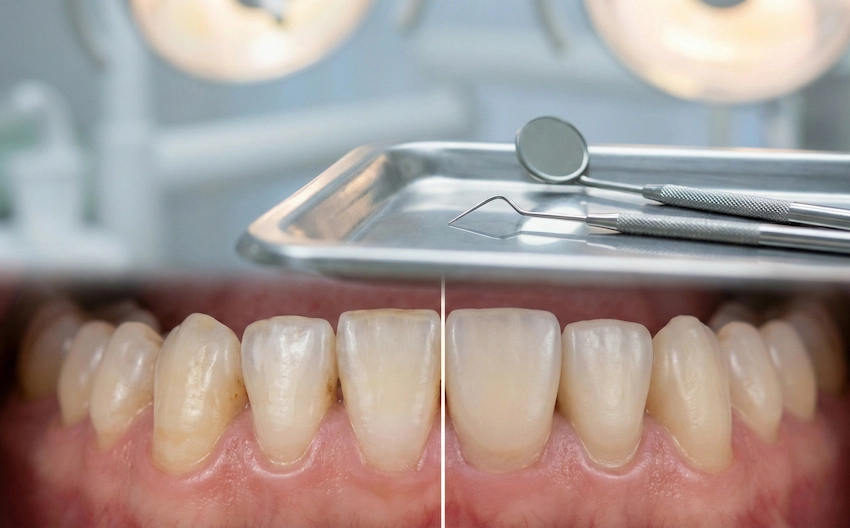
It is the point where the skill of the medical team plays a major role. It is a very subtle difference between preparation and aggression.
Professor Doctor Coşkun Yıldız quite often stresses that the jaw and teeth are an interconnected system. White aesthetics are not the only thing to consider; you have to be aware of biology as well. In an extreme case, if a clinic cuts down healthy teeth to stubs just because of a simple aesthetic issue, they are really treating those teeth in a non-standard care manner.
Using the digital smile design technique even before picking up a handpiece is what we do at Lema. We go through the process of modelling the smile to exactly determine how much or how little the amount of enamel is to be affected.
Here is a breakdown of how different treatments impact your natural tooth structure:
| Treatment Type | Enamel Removal | Purpose | Reversibility |
| No-Prep Veneers (Lumineers) | 0–0.1 mm | Adding volume to small teeth | Mostly reversible |
| Laminate Veneers (Standard) | 0.3–0.5 mm | Color change and minor shape correction | Not reversible |
| Dental Crowns (Full Veneers) | 1.5–2.0 mm | Restoring damaged or decayed teeth | Not reversible |
| Composite Bonding | Minimal etching | Repairing chips or minor gaps | Reversible |
The “Shark Tooth” Myth
Let’s face it, those little finger-like sharp shark teeth are always the prep of the crowns (dental caps) and not the veneers. So, what are crowns? They are dental caps that cover the entire 360 degrees of a tooth – used when the tooth is very decayed, a root canal done or weakened.
However, if the teeth are healthy but the color and the shape need to be changed and the dentist suggests shaving them down to pegs, do get a second opinion.
At Lema Dental Clinic, we believe in fighting for your natural enamel. Polen Akkılıç, our dentist, insists on the motto: “As little as possible, as much as necessary.”
FAQs: A Doctor-to-Patient Conversation
Not in the way you may be picturing. Since the work is done only on the enamel (which is a nerve-less layer), many patients even report experiencing no pain or very little pain. Anyway, we do use local anesthetics so that the patient is at complete ease. You may hear some noise or feel a bit of vibration, but pain? No.
You must absolutely realise that with regular veneers, the procedure is irreversible. Once the enamel layer of 0.5mm has been taken off, it will be lost for good. That goes to say the teeth will be permanently dependent on veneers or any other form of protective covering.
The reason for the “Turkey Teeth” stigma is mostly because unlicensed clinics use aggressive crown preps and call them veneers. A clinic like Lema that is hallmarked by authority, the price difference comes from operational costs and currency exchange rates and definitely not from lack of technology. Basically, we use the same premium porcelain (E.max) and adhesives as advanced clinics in London or New York do.
It’s hard to say how much tooth sensitivity you will experience after your enamel is removed After the temporary veneers have been placed, you might notice your teeth being sensitive to hot and cold for just a few days or at most a couple of weeks. That is simply the tooth’s reaction when it gets used to the new environment. We provide you with the correct desensitizing agents to simplify the process for you.
Well, if the teeth are basically healthy but it is just the crookedness and stains that are bothering you, then the solution is veneers (minimal prep). On the other hand, when you have heavily filled teeth, broken teeth, or teeth with root canals, crowns (more prep) are the only option for structural support. Also, to save time, we will never recommend getting crowns for healthy teeth.
- Magne, P., & Belser, U. (2022). Bonded Porcelain Restorations in the Anterior Dentition: A Biomimetic Approach. Quintessence Publishing.
- Layton, D. M., & Walton, T. R. (2012). The up to 21-year clinical outcome and survival of feldspathic porcelain veneers: Is there any influence of existing dentition?. The International Journal of Prosthodontics, 25(6), 584–591.
- Gurel, G. (2003). The Science and Art of Porcelain Laminate Veneers. Quintessence Publishing.
- Peumans, M., Van Meerbeek, B., Lambrechts, P., & Vanherle, G. (2000). Porcelain veneers: a review of the literature. Journal of Dentistry, 28(3), 163-177.
- Edelhoff, D., & Sorensen, J. A. (2002). Tooth structure removal associated with various preparation designs for anterior teeth. The Journal of Prosthetic Dentistry, 87(5), 503-509.

