


Gold teeth don’t damage gums.
There is a certain undeniable charm about gold in the dental field. Over the years, it has always been regarded as a status symbol and a sign of style and robustness. Here at Lema Dental Clinic, Turkey, we very often get patients who travel to us from all over the world, just for that unique golden look. Yet, underneath the glow, the question concerning one’s health comes up quite frequently at our consultations: Are these permanent golden teeth going to damage my natural gums?
As clinical partners to surgeons like Professor Doctor Coşkun Yıldız, we have to move past the aesthetic trends and look at the biological reality. The short answer to whether gold damages gums is complicated—it’s rarely a simple “yes” or “no.” It is almost always a question of quality, fit, and biology.
The reality is that gold itself is not the villain in this story. The actual culprits are usually lesser metals hidden in alloys, or poorly executed dentistry that turns a beautiful restoration into a bacterial trap.
The Biocompatibility Paradox: Not All Gold Is Created Equal
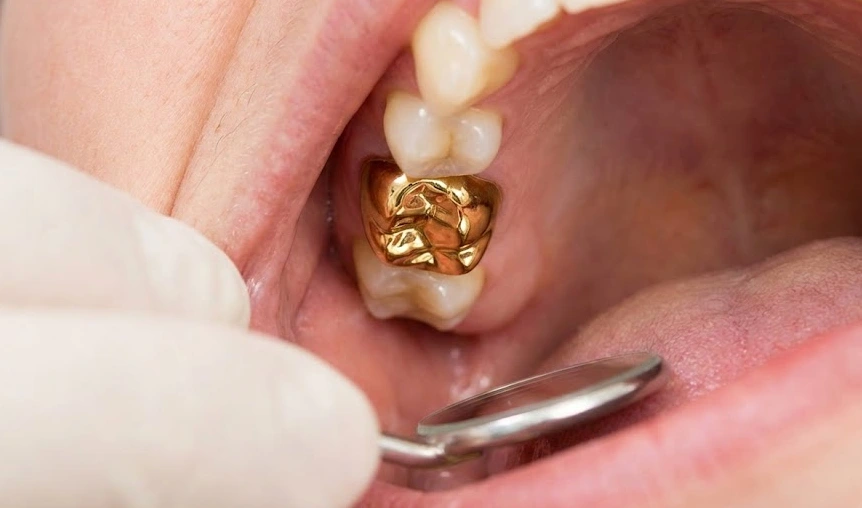
It is a known fact that pure gold (24 karat) is too soft to be used in permanent crowns or bridges that have to endure the heavy force of chewing. Hence, gold has to be alloyed for strength with other metals.
This is the point where troubles typically arise.
Say your “gold tooth” is fabricated with a cheap base metal alloy containing high levels of nickel, beryllium, or copper. Then, most probably, your gums will have an adverse reaction to such metals. These non-precious metals, when exposed to the moisture in the mouth, break down to some extent and the ions released thereby chemically interact with the tissue surrounding them. Being fussy biological defenders, your gums recognize these foreign elements and react by becoming inflamed. Apart from redness and swelling, you may even notice that infamous dark line at the gumline.
Conversely, high-noble gold alloys (usually over 60% gold mixed with platinum or palladium) are arguably the most biocompatible materials in dentistry.
Think of your gum tissue like highly sensitive skin. A cheap, nickel-based earring might cause an infection in an earlobe within hours. But a high-karat gold earring can stay in indefinitely with no issue. Your mouth works the same way. High-quality gold is inert; it doesn’t fight with your body.
The Real Culprit: The “Ledge” At The Gumline
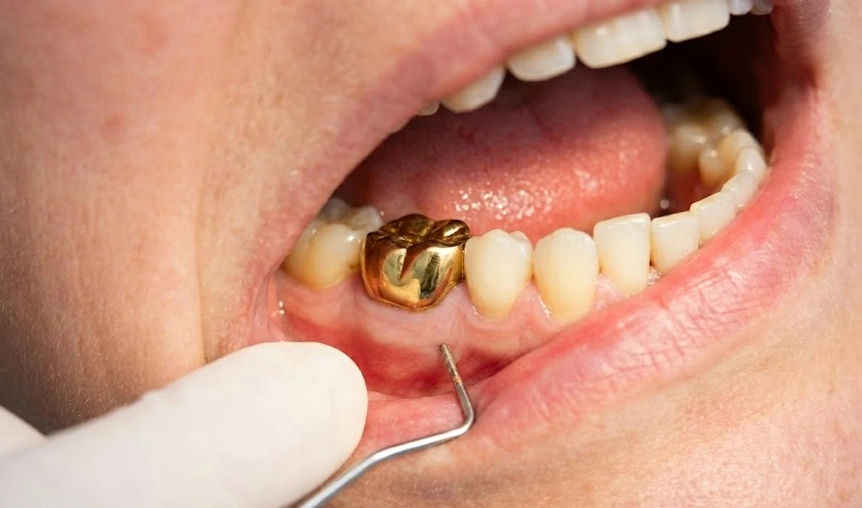
Just imagine you have bought the best quality gold alloy. Are you still able to get gum problems? Yes, certainly.
At Lema Dental Clinic, Dentist Polen Akkılıç, along with her team devote most of their time in repairing the work of other dentists where the material was okay but the mechanics were totally out of the question.
The most crucial element of any crown—gold, zirconia, or porcelain—is the margin. This refers to the very tiny line at which the artificial crown meets your natural tooth structure, usually at or just below the gumline.
If the dentist fails to prepare the tooth properly or the dental technician fails to provide a flawless fitting, a microscopic ledge or gap will be formed.
It looks good to the naked eye. However, to bacteria, that gap is as grand as the Grand Canyon. It turns into a haven for plaque that the toothbrush and floss cannot reach. Eventually, the bacterial colony that has been building up here causes the gums to be inflamed (gingivitis) and finally the bone to be destroyed (periodontitis) around the gold tooth. The gold itself is not causing the gums to hurt; it is the bacteria that are trapped under the gold’s imperfect edge.
Permanent Crowns vs. Removable “Grills”
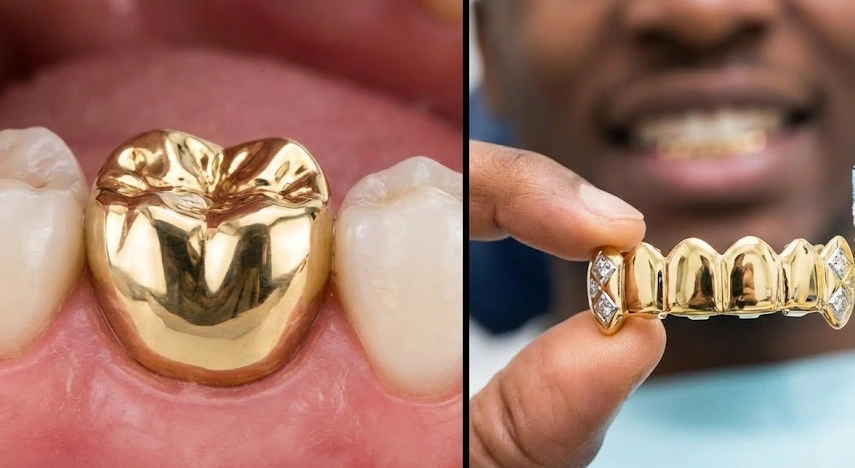
We must also draw a hard line between permanent restorative dentistry and removable cosmetic appliances, often called “grills.”
Removable appliances, if worn continuously, are notoriously bad for gum health. They cover the natural self-cleansing mechanisms of the teeth and saliva, creating an incubator for bacteria across the entire gumline. We generally advise strong caution regarding long-term use of removable pieces.
Permanent crowns, when done correctly here in Turkey under medical protocols, become part of your anatomy.
Here is what we see clinically regarding the two options:
| Feature | Permanent Gold Crown (High Noble) | Removable Gold “Grill” |
| Fit Type | Cemented permanently onto prepared tooth structure. | Snaps over existing teeth; removable by patient. |
| Gum Interaction | Margin meets the gumline precisely; allows for cleaning. | Covers the gumline, trapping saliva and bacteria. |
| Biocompatibility | High (if high-noble alloy is used). | Varies wildly; often lower quality metals used. |
| Hygiene Requirement | Normal brushing and flossing (flossing is crucial). | Must be removed to clean natural teeth underneath. |
| Long-Term Gum Risk | Low (if fit is perfect and hygiene is good). | High (due to plaque trapping and irritation). |
The Lema Dental Clinic Approach in Turkey
When patients come to us in Turkey specifically requesting gold restorations, our approach is medically driven first, aesthetically driven second. Professor Doctor Coşkun Yıldız emphasizes that the foundation—the bone and gum tissue—must be healthy before we build anything on top of it.
We ensure that any gold restoration uses certified high-noble alloys to ensure biocompatibility. Furthermore, our digital scanning tools and in-house lab technicians ensure the margin fit is accurate down to microns. We don’t want any “ledges” for bacteria to hide under.
If you treat a high-quality, well-fitted permanent gold crown with the same hygiene respect you give your natural teeth, your gums should remain healthy for decades.
Your Questions About Gold Teeth and Gum Health
If you choose a high-noble gold alloy, no. The dreaded “black line” at the gum surface is usually caused by two things: either corrosion from cheap base metals in a poor-quality alloy leaching into the tissue, or the metal edge of a porcelain-fused-to-metal crown showing through thin gum tissue. Pure, high-quality gold does not corrode and cause this tattooing effect.
Biologically, high-karat gold is arguably the most gum-friendly material we have. It is incredibly smooth, making it hard for plaque to stick to it, and it’s non-reactive. However, modern, highly polished zirconia is also excellent. The “best” material often depends on the specific location in the mouth and your bite forces, which Dentist Polen Akkılıç assesses during examination.
It depends heavily on what metal you are allergic to. Most metal allergies are to nickel (common in cheap jewelry). If you have a known nickel allergy, you absolutely must avoid base-metal alloys. You would likely be perfectly fine with a high-noble gold alloy that is nickel-free. We always review medical history carefully before selecting materials.
The technique is the same—brushing twice daily and flossing—but the diligence must be higher. Because there is a seam where the gold meets your tooth, you cannot skip flossing. Bacterial plaque doesn’t care how expensive your gold crown was; if you leave it at the gumline, it will cause disease.
The procedure is identical to receiving a standard porcelain or zirconia crown. It is done under local anesthesia, so the preparation phase is painless. You may have some minor sensitivity in the gums for a day or two after the final cementation as the tissue settles around the new structure, but it should not be painful.
- Anusavice, K. J., Shen, C., & Rawls, H. R. (2012). Phillips’ Science of Dental Materials (12th ed.). Elsevier Health Sciences. (Provides foundational knowledge on dental alloy compositions and properties).
- Wataha, J. C. (2000). Biocompatibility of dental casting alloys: A review. The Journal of Prosthetic Dentistry, 83(2), 223-234.
- Goodacre, C. J., Bernal, G., Rungcharassaeng, K., & Kan, J. Y. (2003). Clinical complications in fixed prosthodontics. The Journal of Prosthetic Dentistry, 90(1), 31-41. (Discusses periodontal responses to crown margins).
- Reitemeier, B., Hänsel, K., Kastner, C., Weber, A., & Walter, M. H. (2013). A prospective 10-year study of metal ceramic single crowns and fixed dental prosthesis retainers in private practice settings. The Journal of Prosthetic Dentistry, 109(3), 149-155.
- Al-Hiyasat, A. S., & Darmani, H. (2005). In vivo effects of dental casting alloys on gingival tissues. Journal of Oral Rehabilitation, 32(3), 192-198.

