


Yes, panoramic X-rays are safe for kids due to their very low radiation dose.
It begins with an instinct to protect. We are quite familiar with this instinct. A parent enters our Istanbul office holding their child’s hand, all is well until we mention the word “X-ray“. The atmosphere changes instantly. The thoughts start to run: Is it really necessary? Is it safe? How much radiation can a growing body tolerate?
These questions are not only justified; they are the proper questions to ask.
At Lema Dental Clinic in Turkey, we are not only dealing with teeth; we are dealing with families. One of the family treatments is also being very honest with the use of our tools. The truth is that dental diagnostics have undergone a very significant transformation over the last ten years. The frightening, high-radiation machines of the past are basically museum pieces now. But let’s go more in-depth into what’s actually happening when we scan your child and hear from Professor Doctor Coşkun Yıldız who specifies particular imaging procedures for our kids.
Radiation Exposure: The Big Fear
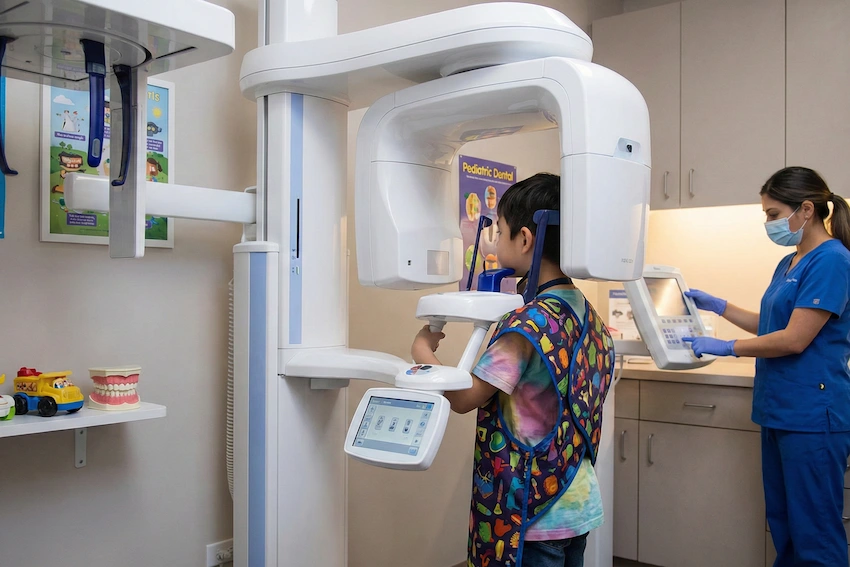
We should not be distracted from the main topic – the big elephant in the room. Indeed, a panoramic X-ray is a source of radiation . But the matter needs to be looked at in its entirety.
In medicine, radiation is measured in microsieverts (µSv). For comparison, we are all exposed to some level of radiation every day—it is radiation from the earth, from the sun, and to some extent even from the food we consume.
You can think about radiation exposure in the same way that you think about filling a bucket with water. Just going about your daily life on earth gradually fills your “daily bucket.” One routine dental panoramic X-ray contributes just 10 to 20 microsieverts to the total that is in your bucket.
Here is the surprising fact: a flight from London to Turkey results in a radiation dose of around 40 to 80 microsieverts due to the high altitude. That is to say, the vacation trip exposes your child to more radiation than the dental scan used to check if their adult teeth are coming in properly.
The “Landscape” Analogy
How come we choose panoramic scans in particular?
Imagine you need to inspect a house. A standard dental X-ray (bitewing) would be akin to a zoomed photo of one window. It can show you perfectly the tiny details of that window, for example, the cavities between the back teeth.
But a panoramic X-ray gives you the whole house in one wide-angle shot, showing the entire property. Therefore, for a child who has a mouth that is literally a construction site with rapidly changing anatomy, we have to get that landscape to be able to tell if there are missing teeth, extra teeth, or bone problems before they develop into serious issues.
The Lema Standard: Digital Accuracy
Dr. Polen Akkılıç and her team have brought the clinic in Turkey up to the highest standards through complete digital radiography which is not simply a nice term but a safety feature. Because digital sensors are so sensitive, they require much lower doses of radiation compared to traditional film X-rays.
Our practice is fully compliant with the ALARA Principle: As Low As Reasonably Achievable. We won’t just take a scan when there is no real reason. Every shot is done for a specific purpose which is closely balanced with the minimum risk involved.
Looking at the Data: Quantifying Risk
It is really quite easy to get stuck with the scientific stuff, so let’s have a look at the tangible data. This table demonstrates the radiation dose from a dental panoramic X-ray together with the doses from familiar everyday activities.
| Radiation Source | Approximate Effective Dose (µSv) | Equivalent “Time” of Background Radiation |
| Eating a Banana (Potassium-40) | 0.1 µSv | A few minutes |
| Daily Natural Background (Sun/Soil) | 8–10 µSv | 1 day |
| Digital Panoramic X-Ray (Child) | 10–15 µSv | ~1.5 days |
| Flight (London to Istanbul) | 60–80 µSv | ~8 days |
| Chest X-Ray (Medical) | 100 µSv | ~10 days |
| Living in a Brick House (Annual) | 70 µSv | ~7 days |
So exposure is next to nothing, practically you could say it is the same as spending an hour and a half or so playing somewhere outdoors in the sun.
Reasons Why It Can Be More Dangerous to Skip X-Rays
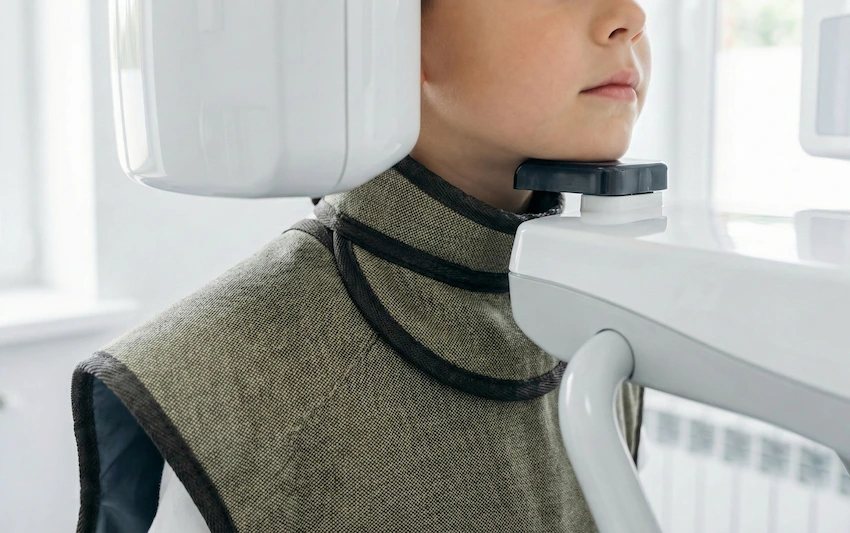
Choosing not to have an X-ray because of fear can much more often be a costly mistake than the scan itself. Without that panoramic view of your child’s jaw we cannot see what links the entire chain.
Sometimes we come across stories of parents who for years refused X-rays and then only after several years do they find out that their child’s canine tooth had been impacted and the neighboring healthy tooth roots were being destroyed without anyone knowing. What could have been a simple orthodontic correction on the spot with early diagnosis turned into a condition requiring surgery.
Professor Doctor Coşkun Yıldız makes the point time and again that “The worst dental issue is the one that you can’t see with your eyes.” Once it becomes noticeable decay, cysts in the bone, or tumors are already advanced. Hence a panoramic scan serves as our screening tool that gives us early indications of these problems.
Frequently Asked Questions (FAQ)
The chance is so tiny that you could hardly tell it’s nonzero. Present research shows that the radiation dose of a brand new digital panoramic X-ray is so low that it barely adds to the already existing natural background radiation your child is exposed to just by living on Earth. Hence, it is still much more crucial to detect a severe infection or growth at an early stage rather than worry about this minuscule hypothetical risk.
We do not have a generic timetable. Usually, an X-ray is taken around the time that the first adult teeth appear—6 or 7 years old—and possibly another at the beginning of the teenage years to assess the situation with wisdom teeth. It is only when medically advisable that we take them, never as a regular yearly practice.
I’m glad you thought of this! Today, it looks like specialists are divided on this matter. Studies suggest that lead protection might disrupt digital X-rays and, therefore, require retakes which, ironically, give patients more radiation. But here at the Lema Dental Clinic, we always put our patients’ comfort first. If the protective cover doesn’t cover any part of the image, certainly, we can still use it for your reassurance as long as it doesn’t reduce the image quality.
Panoramic X-rays are without a doubt one of the dental procedures that even very sensitive kids have no problem with! For intraoral X-rays, the sensor needs to be put in the mouth a bit (which is a common reason for the gag reflex); however, the panoramic device only rotates around the head. So, the mouth is not really opened. The procedure time is less than 15 seconds, and all that the patient has to do is keep still.
Besides giving you more money in your pocket, a clinic like Lema employs the same top-notch German and American imaging technology as in Western Europe. This way you get diagnostic safety standards at the highest level, under the watchful eyes of experts like Dr. Polen Akkılıç, plus a warm atmosphere that makes anxious children feel at ease.
- American Dental Association Council on Scientific Affairs. (2012). Dental Radiographic Examinations: Recommendations for Patient Selection and Limiting Radiation Exposure. The Journal of the American Dental Association, 143(11), 1197-1200.
- Ludlow, J. B., Davies-Ludlow, L. E., & White, S. C. (2008). Patient Risk Related to Common Dental Radiographic Examinations. The Journal of the American Dental Association, 139(9), 1237-1243.
- White, S. C., & Pharoah, M. J. (2014). Oral Radiology: Principles and Interpretation. Elsevier Health Sciences.
- European Commission. (2012). Radiation Protection No. 172: Cone Beam CT for Dental and Maxillofacial Radiology (Evidence-Based Guidelines). Directorate-General for Energy.
- International Commission on Radiological Protection (ICRP). (2007). The 2007 Recommendations of the International Commission on Radiological Protection. ICRP Publication 103. Annals of the ICRP, 37(2-4).

