


Both have high success rates, with delayed implants being more predictable.
You’ve decided to fix your smile and that’s the major step. The tricky part that confuses most of our patients is: when exactly the implant is placed?
Timing matters a great deal in the field of dental restoration. Some patients simply step into our clinic in Turkey and get a new tooth on the spot. Others need to be prepared for a few months before the final placement. It isn’t only about quickness—it’s about biology. At Lema Dental Clinic, after witnessing extremely large number of cases, we find that the choice between immediate and delayed implantation frequently decides the overall duration of your smile.
Let’s skip the noise and see what clinical data and our own experiences confirm about success rates.
Immediate vs. Delayed Implants: Should You Choose Speed or Safety?
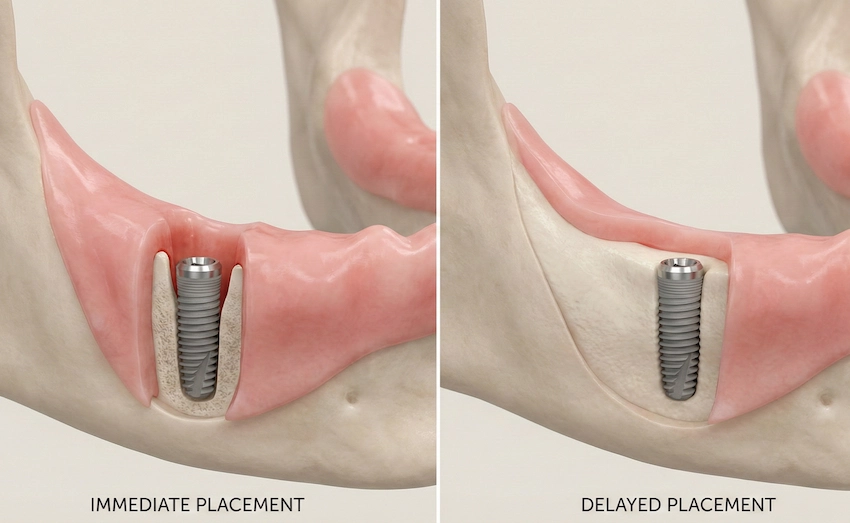
- Picture your jawbone as the soil of a garden.
- Immediate Implantation is similar to planting a tree sapling directly into a fresh hole where an old tree was removed. The ground is already disturbed, but you make use of the existing space.
- Delayed Implantation is like waiting for that soil to settle, get its nutrients back, and become firmer before you plant.
- You can say that both methods share a common goal: the healthiest, most beautiful tooth. However, the path towards that goal differs quite a bit.
1. Immediate Implantation (The “Same-Day” Method)
This is probably the first thing patients demand. The advantage is clear—fewer surgical interventions, less time at the dentist, and faster healing.
- Process: We pull the tooth that is beyond repair and then insert the titanium implant right in the same spot during the same procedure.
- Reality: It is very selective. When there is an infection or the bone is so thin that it is impossible to hang a heavy picture on the wall without a stud, this method is prone to failure.
Dentist Polen Akkılıç and her team keep saying that although we are efficient, stability is never compromised for speed. Immediate implants have high success rates (approximately 94-98% in healthy patients according to some studies; however, the margin for error is quite small.
2. Delayed Implantation (The “Wait-and-See” Method)
That’s the standard procedure. Of course, it will take more time; however, it is generally safer for complicated cases.
- Process: We extract the tooth and let the socket heal for 3-6 months. Once the bone has grown and filled the space, the implant is installed.
- Reality: It is a reason this is called the gold standard. It essentially allows the body to restart the healing process. In case of a large infection or cyst, delayed placement guarantees that the foundation for new treatment is completely clean and free of disease.
Looking at the Data: A Clinical Overview
Professor Doctor Coşkun Yıldız often reminds us that success isn’t only about how long the implant survives, but also about the aesthetic result. A delayed implant may provide better soft tissue (gum) recovery, which is very important for natural appearance, especially for front teeth.
Here is a comparison of these two methods based on our clinical experience:
| Feature | Immediate Implantation | Delayed Implantation |
| Primary Benefit | Less treatment time; fewer surgical sessions | Safer and more predictable outcomes, ideal for infected sites |
| Bone Requirements | Very high; sufficient existing bone is mandatory | Moderate; bone grafting can be added if needed |
| Risk of Infection | Slightly higher ifthe existing infection is not fully eliminated | Minimal; infection can be completely resolved before placement |
| Aesthetic Risk | Higher risk of gum recession if not managed precisely | More predictable and stable gum contours |
| Success Rate | ~94%–98% (highly case-dependent) | ~95%–99% (very consistent across cases) |
Which One Is The Best?
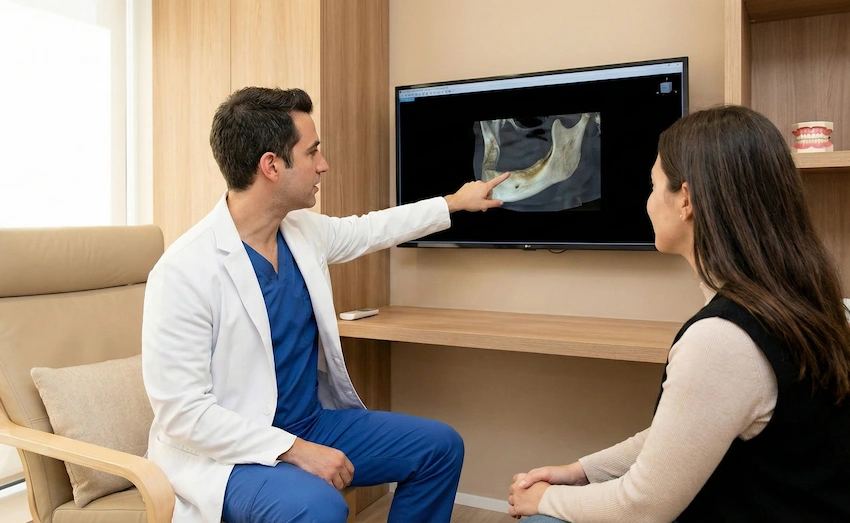
The final decision is all about your anatomy.
If your jawbone is thick and healthy and you just broke your tooth due to an accident, immediate implant placement is absolutely great. You skip the months of healing. However, if you have periodontitis and your jawbone is thin and fragile, then rushing will be a disaster.
Here at Lema Dental Clinic, we don’t make guesses. We use 3D CBCT scans to get your bone density measurements to the millimeter. We are looking for “primary stability” which is a mechanical grip that the implant has on the bone at the very moment it gets screwed in. When the grip is not tight enough (imagine a screw spinning loosely in the wood), we pause.
Frequently Asked Questions
Definitely not. The smile is the last thing we allow a patient to lose. If we have to wait for the implant, we will give you a temporary tooth or bridge that is just as good as the real thing. Your look and function won’t be affected much while the bone is healing underneath.
You may be surprised, but sometimes the patients with immediate implants experience a less painful period of recovery since only one surgery is involved. In delayed implants, two procedures are done separately (first extraction, then implant placement; however, with modern anesthesia and the methods used by Dentist Polen Akkılıç, experiencing discomfort is very uncommon for both.
The price of an implant remains almost the same. But most likely delayed cases require bone grafting or membrane placement in order to rebuild the site, which can increase the overall cost. We take great care to fully inform you of any costs upfront during your consultation so that there will be no surprises later.
Blood vessels constrict when a person smokes and this limits the blood supply which is vital for healing. Although it is not impossible, smoking raises the implant failure rate significantly. We very often suggest the delayed method to smokers so that their bones have the best chance of integrating before we stress them.
The point is the volume of cases and expertise. In Turkey, the same complex reconstruction cases that other clinics can only see once a month we see and handledailys. Professor Doctor Coşkun Yıldız is a top expert in maxillofacial surgery. That means our work goes beyond merely “placing teeth”—we re-establish the functional anatomy of your face.
- Esposito, M., Grusovin, M. G., Polyzos, I. P., Felice, P., & Worthington, H. V. (2010). Timing of implant placement after tooth extraction: immediate, immediate-delayed or delayed implants? A Cochrane systematic review. European Journal of Oral Implantology, 3(3), 189–205.
- Chen, S. T., & Buser, D. (2014). Esthetic outcomes following immediate and early implant placement in the anterior maxilla—a systematic review. The International Journal of Oral & Maxillofacial Implants, 29(Suppl), 186–215.
- Gallucci, G. O., Hamilton, A., Zhou, W., Buser, D., & Chen, S. (2018). Implant placement and loading protocols in partially edentulous patients: A systematic review. Clinical Oral Implants Research, 29(Suppl 16), 106–134.
- Lang, N. P., Pun, L., Lau, K. Y., Li, K. Y., & Wong, M. C. (2012). A systematic review on survival and success rates of implants placed immediately into fresh extraction sockets after at least 1 year. Clinical Oral Implants Research, 23(Suppl 5), 39–66.
- Cosyn, J., De Rouck, T., Collys, K., & Bruselaers, N. (2019). The efficacy of immediate implant placement in the anterior maxilla: A systematic review and meta-analysis. Journal of Clinical Periodontology, 46(S21), 245–262.

