


Brush gently, soak daily, rinse.
Our patients often tell us that when they get a new set of aligners, they have a special sensation with it. They feel the aligners are tight and crisp, and they have that freshly cleaned feeling. Now, think about day seven of the same tray. If you don’t clean your aligners, that clear plastic is going to be a nasty trap for bacteria that is cloudy and stinks.
At Lema Dental Clinic, each year, we have thousands of international patients coming to Turkey, and we can see how hygiene makes such a significant difference. Apart from the visual aspect, a clean tray is also about the effectiveness of the treatment. Dirty trays can, in fact, limit the tooth movement.
Imagine your aligners are similar to contact lenses for your teeth. Just as you wouldn’t use a dirty lens and put it in your eye, likewise, you shouldn’t place a dirty tray onto your enamel. It leads to a “greenhouse effect,” where acid and bacteria are compressed right against the tooth surface, letting the decay progress faster than you may think.
The “No-Toothpaste” Rule
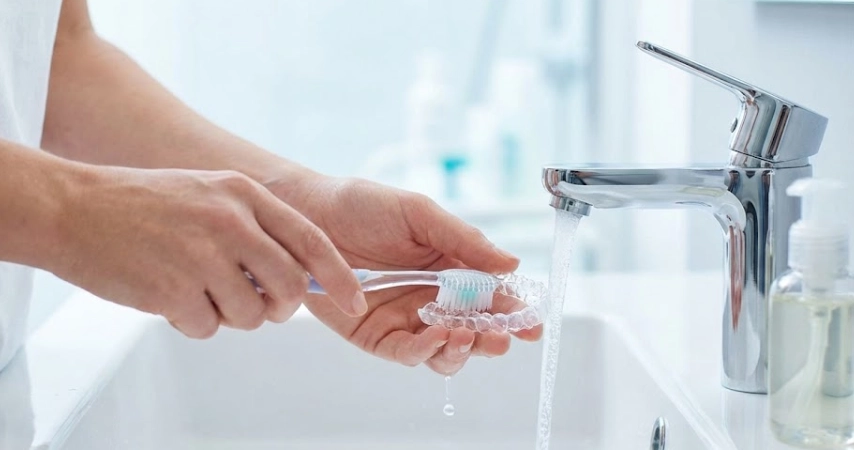
Most patients are shocked when they learn this. Dentist Polen Akkılıç is often in the situation of having to change this misconception at follow-up visits. Your instinct is to think that if toothpaste is beneficial to your teeth, it should also be good for the trays.
It is contrary to what people think. Toothpaste is abrasive; it has micro-particles that remove enamel, which is the hardest substance found in the human body. On the other hand, your aligners are medical-grade thermoplastic.
By using a toothbrush with toothpaste it’s like applying sandpaper on a window. Microscopic scratches will be made on the surface. They cause the aligners to look foggy (thus, the “invisible” aspect is destroyed) and serve as bacterial homes since bacteria hide and multiply in those tiny canyons.
The Lema Dental Daily Protocol
To keep the look of your aligners “invisible” and not destroy your oral microbiome, Professor Doctor Coşkun Yıldız is a strict advocate of a simple, yet effective routine. To prevent any warping or staining, we recommend following the very same method:
- The Morning Rinse: Overnight, you will have bacteria accumulating on your aligners. So as soon as you open your eyes in the morning, take off your aligners and rinse them thoroughly with cold water. Do not ever use hot water as it can deform the plastic and destroy the fit.
- The Soft Brush Technique: Get a soft-bristled, narrow toothbrush just for cleaning trays. Don’t use the one for your teeth. Take a small amount of transparent, liquid antibacterial detergent. Clean the inside and the outside surfaces of the injectable trays very carefully.
- The Soak Strategy: Take advantage of meal times for a final cleaning session if you can only do it once a day. You can use denture cleaning crystals or specific aligner cleaning tablets. This chemical cleaning breaks down the biofilm that brushing misses.
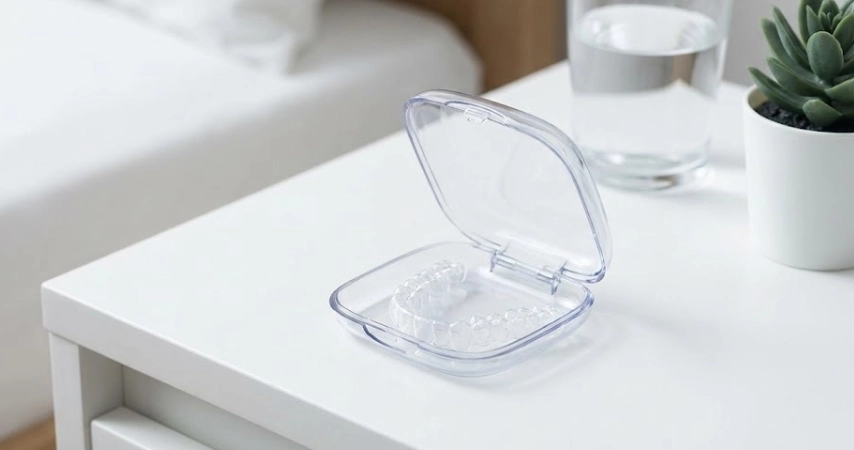
- The “Case” Habit: In case you are not wearing your aligners, then put them in the case. The number one reason why patients lose their aligners in restaurants is that they have wrapped them in a napkin.
Chemical Warfare: What Works vs. What Damages
Patients often confuse which cleansers are the best and the safe for their appliances. They usually want to try a DIY method that they have seen on the internet, which causes them to get their appliances damaged. In line with what is safe and what is not, we have prepared a clinical benchmark based on the material safety data.
| Cleaning Agent | Effectiveness | Risk of Damage | Recommended Frequency |
| Clear Liquid Soap | Moderate (removes debris) | Low (Safe for daily use) | Every time you brush |
| Invisalign Crystals | High (kills bacteria) | Low (Designed for polymer) | Daily or every other day |
| Toothpaste | Low (doesn’t kill bacteria) | High (Causes micro-scratches) | NEVER |
| Mouthwash (Colored) | Moderate | High (Causes staining/tinting) | Avoid (unless clear) |
| Hydrogen Peroxide (Diluted) | High (kills bacteria) | Moderate (Can degrade plastic over time) | Weekly only |
| Vinegar Solution | Moderate (removes calcification) | Moderate (Sour taste/smell risk) | Only for hard tartar |
Essential Queries on Aligner Maintenance
If your trays smell, it usually means biofilm has hardened into the plastic’s texture. Saliva contains bacteria that produce sulfur compounds—the same stuff responsible for morning breath. If you are only rinsing with water, you aren’t killing the colony; you are just bathing it. We recommend soaking them in a specialized cleaning solution for 15 minutes to neutralize the odor-causing bacteria chemically.
We strongly advise against this. Heat is the enemy of thermoplastic. Even with a straw, hot coffee can warp the precise shape of the tray, meaning it will no longer apply the correct force to move your teeth. Furthermore, liquid seeps inside the tray and sits against your teeth for hours. This acidic bath is a recipe for rapid cavities. Take them out, enjoy your Turkish coffee, rinse your mouth, and then put them back in.
Generally, yes, but read the label. Some denture cleaners are designed for porcelain and acrylic, which are much tougher than clear aligner plastic. If the cleaner is too harsh or significantly colored (like deep blue tablets), it might leave a slight tint on your clear trays. Stick to brands that specifically mention “retainers” or “aligners,” or use the cleaning crystals provided in your starter kit.
Yellowing is almost always caused by smoking or eating with the trays in. Spices like turmeric and saffron are notorious for instantly staining the plastic. Unfortunately, once the plastic is dyed, it is very difficult to reverse. If you are near the end of your two-week cycle, it might be time to switch to the next tray a day early (consult your dentist first). If you have just started a tray, a soak in a 50/50 mix of water and hydrogen peroxide might lighten the stain, but it likely won’t remove it entirely.
You should treat your aligner brush just like your regular toothbrush. Over time, the bristles fray and harbor bacteria themselves. In our clinic, we suggest replacing this brush every 3 to 4 months. Using an old, frayed brush is ineffective at getting into the deep crevices of the aligner where plaque likes to settle.
- Levrini, L., Mangano, A., Montanari, P., Margherini, S., Caprioglio, A., & Abbate, G. M. (2020). Periodontal health status in patients treated with the Invisalign® system and fixed orthodontic appliances: A 3 months clinical investigation. European Journal of Dentistry.
- Tarter, L. (2021). The physical properties of thermoplastic aligner materials after exposure to various cleaning agents. Journal of Clinical Orthodontics.
- Schiffman, E. (2022). Biofilm formation on thermoplastic orthodontic appliances: A comparison of cleaning methods. American Journal of Orthodontics and Dentofacial Orthopedics.
- Womack, W. R. (2023). Material compatibility of clear aligners with common household cleaning agents. The Angle Orthodontist.
- Ribeiro, I. M., & DeVizio, W. (2021). Micro-abrasion effects of toothpaste on polymethyl methacrylate aligner surfaces. Journal of Prosthetic Dentistry.

