


Crooked teeth trap plaque and bacteria, increasing the risk of cavities and gum disease.
During many of our appointments, we hear patients say, “I’ve always had my crooked teeth; they even give me character.” We are for loving yourself, and we also must acknowledge a biological reality.
Misalignment in good layman’s terms is the same as malocclusion in medical jargon; this is rarely only a cosmetic concern. It carries a functional risk as well.
Think of your teeth as books arranged on a shelf. If the books are all in a neat row and evenly spaced, it will be very easy to clean between them. But if you have crammed the books in, made some of them overlap, and even twisted some, the dust trapped in the places a cloth cannot reach will be very little. In your mouth, the “dust” is plaque and the shelf is your jaw.
At Lema Dental Clinic in Turkey, we see every day the long-term biological consequences of neglecting such problems. A beautiful smile is definitely not the only thing at risk; it is a matter of breaking a chain reaction of dental health problems.
The Anatomy of a Cavity Trap
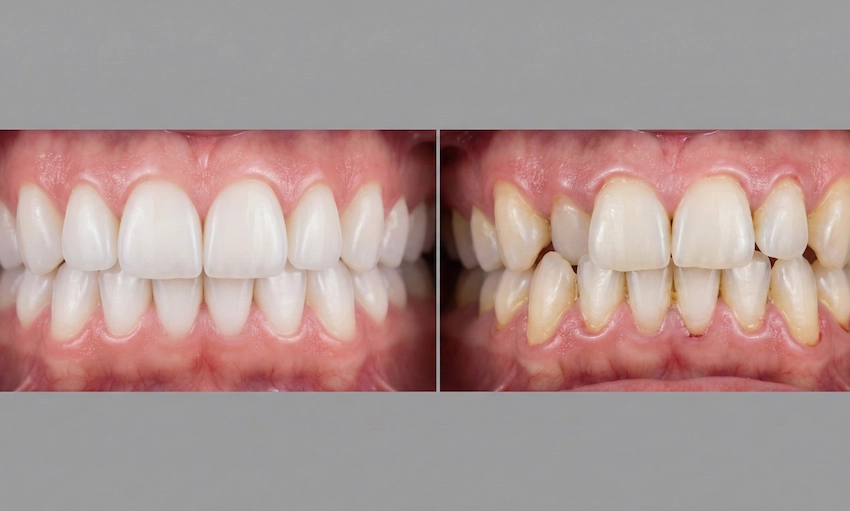
The mechanism which is simple and yet devastating is such that when you have crowded or twisted teeth, you get “blind spots”—very close spaces where toothbrush bristles and floss simply do not reach.
Dentist Polen Akkılıç and her team find interproximal cavities frequently in patients with severe crowding. These patients usually have very good hygiene practices. They brush their teeth twice a day. They floss. But still, they get cavities. Why?
Because, after all, “you can’t clean what you can’t get to.”
When two teeth overlap, a small area is created where the bacteria can live. These bacteria feed on sugars and they make acids as their waste. The saliva removes most of the acid naturally in the case of straight teeth. In the case of crowding, the acid stays because the saliva can’t reach it and acid slowly eats the enamel; this is a very familiar analogy of rust slowly eating a car fender.
The Silent Killer: Periodontal (Gum) Disease
Even though tooth decay is something that hurts and can be seen, it is gum disease that is the silent killer and causes the most damage.
Gums that are in good condition wrap around the neck of a tooth similarly to how a tightly stretched rubber seal on a jar keeps it fresh. This seal blocks bacterial deep penetration into the bone. On the other hand, teeth that are not straight pull and twist the gum tissue. This is the evidence we most of the time find in the clinic: Whenever a tooth is displaced too far either in the front or back, the gum tissue gets stretched and thus becomes very thin. Infection sets in easily (gingivitis) as the plaque accumulates at the gumline.
Eventually, the irritation will become so severe that it will damage the seal. The gums are receding, thus, the pockets are formed where bacteria can thrive quite well. This is the stage when gingivitis changes into periodontitis. When the bone is being lost, the tooth will have a very weak support from its base. Professor Doctor Coşkun Yıldız among the many experts, finds it absurd to try to cure gums without fixing the teeth first. It is like mopping the floor while the faucet is still running. The structure problem is solved and not only is it saved.
Uneven Forces: The Cracking Point
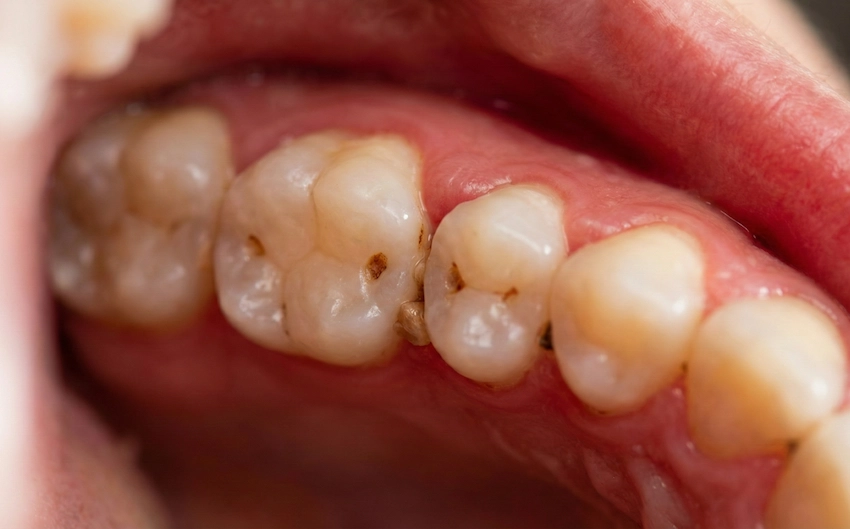
The problem is not just about bacteria; it is a matter of physics, too.
However, whenever the teeth are clenched, the jaw muscles may generate a very strong force. An aligned set of teeth will equally spread the force like a load-bearing wall that supports the weight of a roof. Misaligned teeth get attacked by the force in a way they are not prepared for. The occlusal surfaces become micro-cracked from being hit so hard. The cracks turn into gateways for bacteria to enter the interior of the tooth.
Comparing the Risks: Straight vs. Crooked Teeth
So that you can get a better grasp of the risks, here is a simplified side-by-side of what we have observed clinically in Turkey:
| Feature | Straight / Aligned Teeth | Crooked / Crowded Teeth |
| Cleaning Efficiency | High. Flossing reaches the gumline easily. | Low. Floss breaks or cannot reach contact points. |
| Plaque Accumulation | Minimal. Saliva cleans smooth surfaces effectively. | High. Overlapping areas create plaque traps. |
| Gum Health | Gums form a tight, healthy seal. | Gums are inflamed, tense, red, or receding. |
| Wear Patterns | Slow and even wear over time. | Fast wear with chipping and micro-fractures. |
| Risk of Decay | Low to Moderate (diet-dependent). | High (structure-dependent). |
Frequently Asked Questions
A water flosser is a great machine and we completely support its use. However, it should not be considered as the only instrument for your oral problems. Moreover, if a person’s teeth are so overlapped that the unthinkable contact area which even pressure water cannot clean, is like washing a car for dirt, if you only spray the dirt, the surface will be dirty, and if you don’t scrub the dirt off the surface, it remains. The only way to be sure of complete cleanability is through realignment that is why it is often realigned.
Well, the simple answer is no if it is only about looking. The health side definitely is more important than appearance. You cannot plaster a case of active periodontitis with veneers; that would be dangerous — it’s like painting over mold. First, your gum problem has to be brought under control. Once the foundation is strong enough, Hollywood Smile will be used to correct the misalignment and prevent the problem from recurring.
It significantly lowers the risk. By eliminating bacteria’s favorite hiding places, you have basically made your home cleaning routine work one more time. Now it is no longer a losing battle.
Really no. Human bone can be reshaped, and teeth can be restored at almost any age, assuming that there is still enough bone density. We see plenty of patients in their 50s and 60s being treated. In some instances, only by correcting the alignment can teeth with a risk of losing to periodontitis be saved in old age.
In the end, it all points to trauma. If a crooked tooth gets hit with a force from the opposing tooth a little too much every time you swallow or chew, it “bruises” the ligament that holds the tooth in the jaw. This continued trauma causes the rate of bone loss to be accelerated. Tooth alignment correction stopped this trauma.
- Bollen, A. M., & Cunha-Cruz, J. (2020). Malocclusion and periodontal disease: Is there a link? American Journal of Orthodontics and Dentofacial Orthopedics, 157(3), 289-291.
- Helm, S., & Petersen, P. E. (2019). Causal relation between malocclusion and caries. Acta Odontologica Scandinavica, 47(4), 217-221.
- Geiger, A. M. (2021). Malocclusion as an etiologic factor in periodontal disease: A retrospective essay. American Journal of Orthodontics, 118(1), 112-116.
- Ngom, P. I., Diagne, F., Dieye, F., & Diop-Ba, K. (2018). Relationship between malocclusion and periodontal disease. Journal of Periodontal Research, 53(2), 145-152.
- Sernetz, F. (2022). The correlation between crowding, oral hygiene and periodontal health. Journal of Orofacial Orthopedics, 83(1), 56-64.

