

Meilleure façon d'appliquer adhésif pour prothèse dentaire inférieure
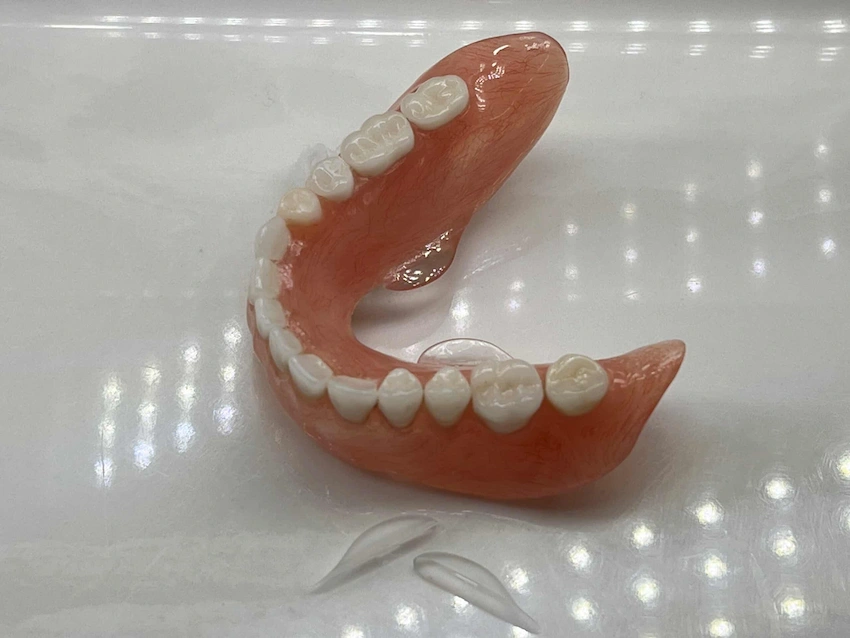
Appliquez de petits points d'adhésif sur une prothèse dentaire inférieure propre et sèche, en évitant les bords.
Vous êtes probablement conscient de la frustration constante que porteurs de prothèses dentaires inférieures rencontrent chaque jour. Contrairement à la prothèse dentaire supérieure, qui dispose d'une zone de palais ample, permettant de créer une sorte de ventouse naturelle entre la gencive et la prothèse, la prothèse inférieure représente un véritable défi. Il s'agit d'un rebord alvéolaire en forme de U très étroit qui bouge constamment. De plus, les muscles de votre langue et de vos joues exercent une pression constante sur ces parties tout au long de la journée. Tenter de fixer la prothèse dentaire inférieure sans la méthode correcte est comparable à une tentative de faire flotter un canoë dans une rivière au courant rapide, ce qui semble de toute façon impossible. Parfois, une prothèse dentaire inférieure bien ajustée a également besoin d'une aide supplémentaire pour rester fixée en permanence. À la clinique dentaire Lema, nous avons découvert qu'utiliser l'adhésif correctement fait des merveilles. Vous retrouvez la confiance que vous désirez. Vous maîtrisez votre élocution. Et surtout, vous devenez celui qui peut passer un bon moment au déjeuner sans aucune anxiété.Un ajustement parfait
La philosophie de la colle : « Moins, c'est plus »
Une erreur courante est d'appliquer une quantité généreuse de pâte, pensant que cela entraînerait une forte adhérence ou du moins un bon résultat. Cependant, c'est le contraire. Vous vous retrouvez avec un énorme désordre, et la prothèse perdrait probablement son ajustement serré. La colle se retrouverait partout sur vos gencives et la prothèse. Voici nos conseils pour obtenir une forte adhérence avec la colle adhésive :- Une petite quantité suffit : Seules quelques gouttes de colle adhésive de la taille d'un petit pois, placées au plus profond de votre prothèse, devraient la maintenir bien fixée.
- Maintenez-la stable : Mordez fermement sur la prothèse. Gardez votre morsure légèrement ouverte, mais pas trop serrée, pour éviter que la colle ne coule dans votre bouche et à l'extérieur de la prothèse.
- La technique de la morsure conjointe : Après avoir mis la colle dans le sillon et placé la prothèse dentaire sur la gencive, mordez doucement et appliquez une pression pendant environ trente secondes. Cela permettrait au matériau de se lier de manière permanente à vos gencives.
Quand l'adhésif perd son adhérence
Vos options comparées
| Méthode de stabilisation | Routine quotidienne | Confort/Variabilité | Protection de la mâchoire | Efficacité à long terme ? |
| Prothèse standard avec adhésif | Très élevée (Vous devez appliquer l'adhésif régulièrement) | Faible à moyenne | Pas de protection de la mâchoire car elle se résorbe constamment | Changer d'option est préférable ! |
| Prothèse amovible sur implants (à clips) | Moyenne (Nettoyer uniquement les attaches à clips) | Sécurisée | Moyenne à élevée | Excellente |
| Arcade complète sur implants (All-on-4) | Très faible (Brossez simplement vos implants comme des dents naturelles) | Fixe (Attachement permanent) - Excellent | Mâchoire entièrement protégée | Excellente |
Foire aux questions
Références académiques
- Carlsson, G. E. (2014). Implant and root supported overdentures – a literature review and some data on bone loss in edentulous jaws. Journal of Advanced Prosthodontics, 6(4), 245-252.
- Felton, D. A. (2009). Edentulism and comorbid factors. Journal of Prosthodontics, 18(2), 88-96.
- Grasso, J. E. (2004). Denture adhesives: changing attitudes. Journal of the American Dental Association, 135(1), 95-96.
- Polyzois, G. L., & Tzoutzas, I. G. (2006). A clinical evaluation of denture adhesives in the stabilization of mandibular complete dentures. International Journal of Prosthodontics, 19(5), 450-452.
- Zarb, G. A., Hobkirk, J. A., Eckert, S., & Jacob, R. (2012). Prosthodontic Treatment for Edentulous Patients: Complete Dentures and Implant-Supported Prostheses (13th ed.). Mosby.
Questions fréquentes
Will my lower denture constantly come loose when I'm eating?
It's your very powerful tongue and cheek muscles that are responsible for it, right? The constant activity of these muscles in chewing food can dislodge the edges of your denture. If the contour of your lower jaw has been flat due to the loss of bone, your lower jaw can hardly support the prosthesis. Those muscles are very strong, and they do lift that little piece of plastic out of its seat easily. In such a case, your prosthesis will definitely be out of place.
Is overuse of glue a possibility?
Yes, absolutely it is. If the adhesive has been spread too much around, it may actually prevent the denture from being in direct contact with the supporting structures. It will work more like a lubricant rather than a bonding agent. You have an example where the denture can actually move freely and cause more problems. So, you'd better do a few tiny dots on the contact surface of the gum with the denture and make them the sole means of support. That will be your best option to hold firmly with the adhesive.
What if I have glue left on my gums? How do I remove it?
Some denture wearers find it very difficult to get rid of glue from the skin, but that's one of those questions with rather complicated answers. Avoid rubbing hard with a stiff brush, since that way is not really helpful. Instead, it is better to use warm water for about a minute to break up the bond that glue is making to the skin. Then, very softly brush your gum with a toothbrush having very soft bristles, or with a warm damp washcloth so any remnants of glue can be wiped away gently.
Is there any recommendation regarding the frequency of adhesive application in a day?
You can do just one single application in the morning and have it work until evening. If you need to reapply it just after a minor lunch and then the main meal, it may point to the fact that your denture has become ill-fitting over time as a result of a shrinking face and jaw, which is not uncommon in the course of years. Such a case deserves your time going to a dentist and being checked if he needs adjustment of the denture, or perhaps the dentist will be able to talk to you about dental implants.
Can I depend on the use of denture adhesive forever?
Only if you keep a so-called denture, which serves as a substitute for the resting jaw. But dentistry these days has brought about some drastic modifications. Just by fixing 2-4 dental implants on the lower jaw i, it becomes possible to snap in the teeth and fix them so strongly that neither pastes nor powders are needed at all.