

Kann man Prothesenhaftmittel mit einer Weichunterfütterung verwenden?
Haftmittel für Zahnprothesen mit einer weichen Unterfütterung nur verwenden, wenn Ihr Zahnarzt dies genehmigt.
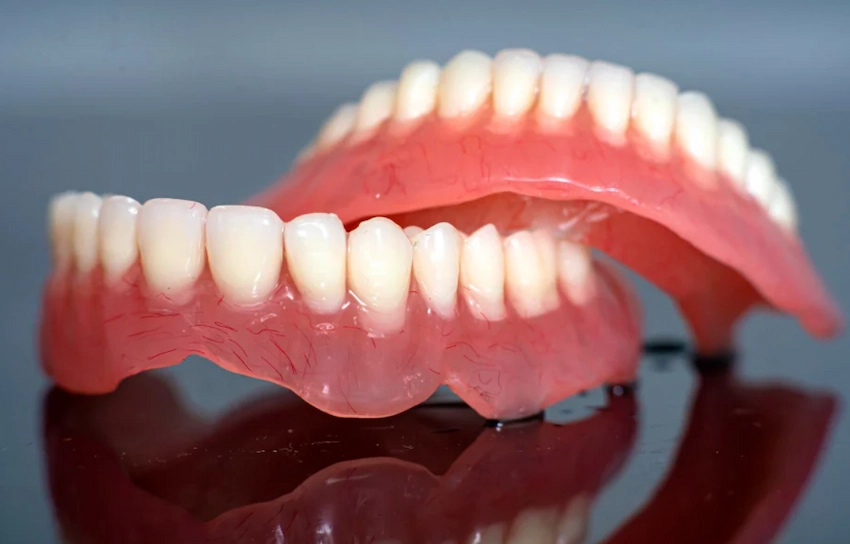
Sie kommen gerade von einer zahnärztlichen Beratung. Ihr Zahnfleisch befindet sich noch in der Heilungsphase. Sie haben eine weiche Unterfütterung für Ihre Zahnprothesen als Komfortmaßnahme erhalten. Beim Zubeißen spüren Sie immer noch, dass die Prothese etwas locker sitzt. Sie fragen sich natürlich: „Kann Haftmittel für Zahnprothesen zusammen mit einer weichen Unterfütterung verwendet werden?“ Tatsächlich wird Zahnprothesenhaftmittel in Kombination mit einer weichen Prothesenunterfütterung Ihre zahnärztliche Arbeit mit ziemlicher Sicherheit beschädigen. Um ein klares Bild davon zu bekommen, wie das passieren wird, könnte es für die Leser nützlich sein, etwas über die Struktur und Funktionsweise von einer weichen Prothesenunterfütterung zu erfahren. Eine weiche Prothesenunterfütterung ist eine biegsame Silikonschicht, die als weiches Polster dient. Ähnlich wie Memory-Schaum-Pads in einem Bett ist sie weich und biegsam. Die Härte einer Standard-Prothesenbasis aus Acryl ist ein solcher Schock für die atrophierten oder empfindlichen Kieferknochen. Daher ist eine weiche Prothesenunterfütterung aus biegsamem, porösem Silikon eine bessere Option als ein Prothesenpolster, das sicher verwendet werden kann, um die Heilung des Zahnfleischgewebes zu erleichtern, in Fällen nach Extraktionen oder Implantatoperationen. Um dies besser zu verstehen, muss man die Materialeigenschaften von Silikon genau betrachten. Eine davon ist die hohe Porosität, die eine Atmung und Feuchtigkeitsaufnahme durch das Material impliziert.Wie eine weiche Prothesenunterfütterung durch die Verwendung von Prothesenkleber zerstört wird
Stabilität von Zahnprothesen: Optionen zur Prothesenstabilität
| Merkmal | Weiche Unterfütterung | Harte Unterfütterung | Prothesenhaftmittel |
| Eigenschaften | Eine temporäre Komfortschicht für Prothesen, die auch das Zahnfleischgewebe heilt. | Bietet langfristigen Halt und strukturelle Stabilität der Prothese für einen besseren Prothesensitz. | Dient nur als temporärer täglicher Halt für harte Acrylprothesen. |
| Durchschnittliche Lebensdauer | Normalerweise 3 - 6 Monate. | Im Allgemeinen 1 bis 2 Jahre. | Nur 12 bis 24 Stunden. |
| Interaktion | Zerstört weiches Material, wenn irgendeine Art von Prothesenkleber aufgetragen wurde. | Sichere Anwendung bei harten Acrylprothesen. | Nicht zutreffend. |
Häufig gestellte Fragen
Akademische Referenzen
- Zarb, G. A., Hobkirk, J., Eckert, S., & Jacob, R. (2013). Prosthodontic Treatment for Edentulous Patients: Complete Dentures and Implant-Supported Prostheses (13. Aufl.). Mosby.
- Murata, H., Hong, G., Hamada, T., & McCabe, J. F. (2008). Dynamic viscoelastic properties of tissue conditioners and soft lining materials. Journal of Prosthetic Dentistry, 99(1), 74-81.
- Kulak-Ozkan, Y., Kazazoglu, E., & Arikan, A. (2003). Clinical evaluation of soft relining materials. European Journal of Prosthodontics and Restorative Dentistry, 11(4), 163-166.
- Chladek, G., Zmudzki, J., & Kasperski, J. (2014). Long-term soft denture lining materials. Materials, 7(8), 5816-5842.
- Garcia, L. T., Bohnenkamp, S. G., & Rudd, K. D. (2014). Kratochvil's Fundamentals of Removable Partial Dentures. Quintessence Publishing.
Häufige Fragen
Why do my dentures feel loose even after a soft reline is done?
When the soft dental reline is placed, it is to care for the gums that are undergoing a shrinking process. The case is such that if you have had a tooth extraction lately, your jaws are undergoing significant morphing, and your jaw will gradually start becoming thinner and shorter. The soft material of the reline is used as a cushion while you have this transition period. Once you start going down without swelling, the gap becomes available again. To address the problem properly, do not simply hide it with your denture glue but take it into professional consideration by visiting your clinic again,n and we’ll do a suitable modification of your reline.
Is it okay to apply powder-type denture adhesive on a soft reline?
Don’t use any kind of adhesive. Though it may appear powder is easier on your teeth than it is, the truth is that it will still transform into a sticky glue when it becomes mixed with your saliva. That sticky glue can easily fill every little pore in a soft reline just as effectively as the super-dry glue will. That glue-like substance will be locked tight there, permanently changing your smooth surface.
How do I clean my soft denture reline without harming it?
You have to be really careful. First of all, brush it with an ultra-soft toothbrush and a denture foam specially formulated for this task. Avoid brushing with ordinary toothpaste, as it contains abrasive ingredients that could damage the silicone. Also, unless your dentist has clearly and specifically approved of the brand, refrain from soaking the denture in effervescent tablets overnight.
When should I consider replacing my soft dental liner with a hard one?
The normal period for changing from a soft denture reline material to the hard one is between 6 months and 6 months. A soft dental reline is only an intermediate solution to the problem. Once your gum tissue has recovered 100% in Turkey after a dental treatment, we can take a new impression to create for you a hard reline of the denture for a permanent fit.
But what if relines and denture paste aren’t working for me anymore?
After a certain period, it’s quite likely that the jawbone will get so weak that a traditional denture won’t even stick. At that stage, the best solution is to get implant-supported dentures. As we insert titanium rods into the jawbone, we can then secure the denture firmly in place, and you’d no longer need any form of denture adhesive.