


No—a night guard does not straighten teeth.
This is something that we at Lema Dental Clinic in Turkey hear almost every week. Patients come in, sit down, and raise their new occlusal splint (night guard) that they hold up in front of their face while asking, “If it fits so tightly, won’t it also move my teeth into a better position?”
It is a reasonable query at that. After all, if you think about it, once wearing a night guard, you have been holding your teeth and the next morning they even get a little sore as if you have moved your teeth. However, the truth is that a regular night guard can not physically move or straighten your teeth.
The difference is all about their separate roles. To realize why we first need to examine the jaw mechanics. This is a matter that Professor Doctor Coşkun Yıldız Camera lining Dialog does emphasize when dealing with the most complex cases. So, let us make an understanding of how a night guard is different from an orthodontic treatment in terms of function and purpose.
The Mechanics: “The Helmet vs. The Architect”
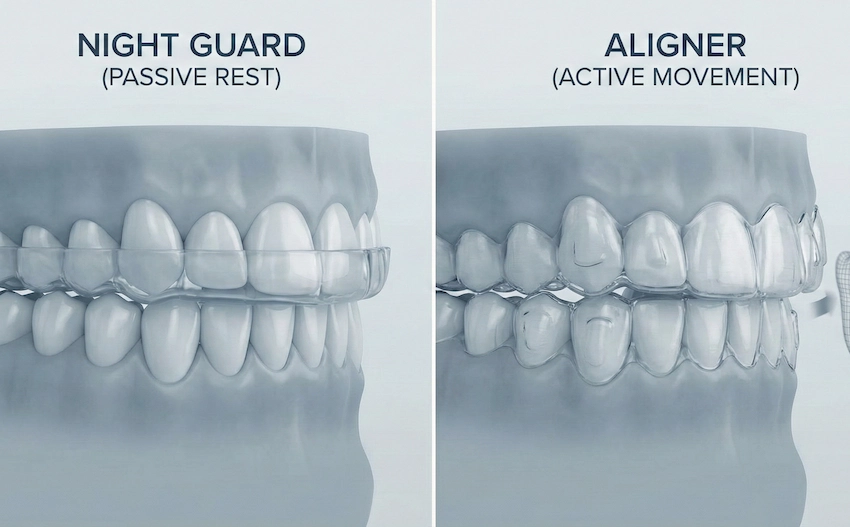
One way to comprehend why a night guard doesn’t work as an orthodontic is the idea of the product’s engineering.
Basically, a night guard is the equivalent of the helmet of your teeth. Its main function is to protect. This is why it does not change what is already there but is only a preventive measure. When Dentist Polen Akkılıç and her colleagues work on a personalized splint, they are basically implementing a barricade between the pressing force of the teeth grinding (bruxism) and the teeth’s surface. The splint’s purpose is to immobilize your teeth and keep them in their original position so that no damage or wear and tear takes place.
In contrast, orthodontics like braces and clear aligners can be compared to an architect who is constantly challenging the status quo by coming up with new structures. They indeed are constantly applying a controlled, calculated pressure on different points to break down the cellular structure and then reconstruct it, thereby literally moving the tooth through the jawbone.
On one hand, a night guard is designed to keep the teeth unchanged; on the other hand, aligners are created so that the teeth can be changed.
Why Does It Feel Like My Teeth Are Moving?
Most of the time this is where the misunderstanding arises. You wake up, remove the night guard, and the occlusion is sensed as “different” or tight.
What we see in Lema Dental Clinic every day is that this phenomenon is usually caused by these two reasons:
- Muscle Relaxation: When the splint keeps the upper and lower jaws apart, compression between the temporomandibular joints is not possible. It is due to this that the pterygoid and masseter muscles (the primary muscles used in mastication) are relieved from the tension, so the jaw presents itself differently in the morning.
- The “Retainer” Effect: As you can hardly experience any tooth movement, the hard acrylic splint might push the teeth that are not completely stable into the position they were when the impression was taken. It is important to know, however, that this is not a straightening of the teeth but only the prevention of further relapse.
Attention: A guard can become a cause of unwanted tooth movement if it does not fit well. Therefore, if you feel that your night guard is constantly pushing and even causing pain in the teeth, it is most likely ill-fitting. There are lots of stories about the open bite problem that is caused by the over-the-counter boil-and-bite guards. The reason for this is that these splints are often not properly adjusted.
The Difference: Night Guards vs. Aligners vs. Retainers
It can be confusing to distinguish between the clear plastic trays. Here is how we break it down for our patients in Turkey.
| Feature | Night Guard | Clear Aligners | Retainer |
| Composition | Hard or soft double-laminated thick layer | Thin, medical-grade thermoplastic | Plastic or metal wire |
| Amount of Pressure | Passive; absorbs pressure without applying force | Active: applies controlled force to move teeth | Passive; maintains current position |
| Can Realign Teeth? | No | Yes | No (only holds alignment) |
| Usage | Primarily worn during sleep | 20–22 hours per day | Depends on type, often at night |
When “Straightening” is the Goal
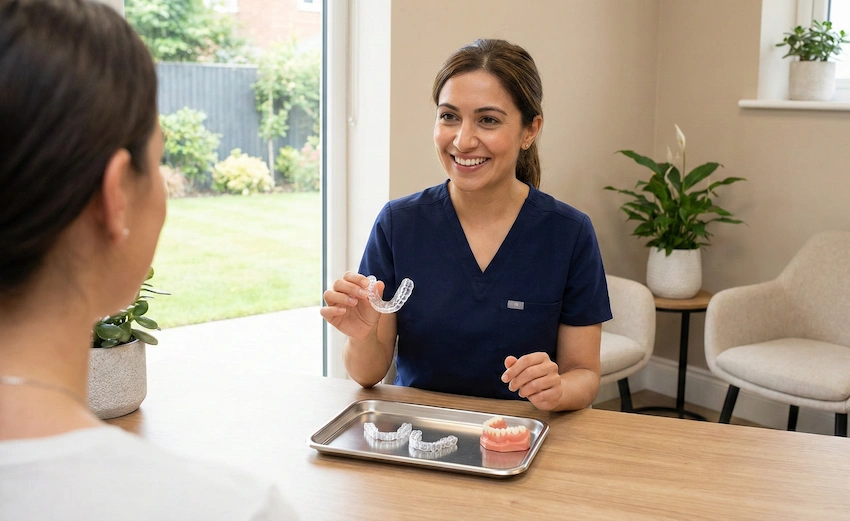
Working with both teeth clenching and misaligned teeth, you cannot generally expect to be able to solve them with only one single-piece plastic application not even initially.
Professor Doctor Coşkun Yıldız frequently advises separation first before proceeding with the second thing. In case the problem of misalignment is quite bad, then we may start with orthodontics. The logic behind this is that, by and large, bruxism is a consequence of bite problems caused by irregularly positioned teeth. Once the teeth are properly arranged and the bite balance restored, the requirement for a night guard may become obsolete.
That being said, patients who are on the way to a Hollywood Smile makeover or getting implants in Turkey usually get their Night Guard after the cosmetic work. It serves as a safeguard for their investment. Even though the porcelain veneers are relatively strong, the human jaw is still the stronger one.
Frequently Asked Questions
Usually, no. Braces are changing the shape of your mouth arch. Hence a night guard can’t be fitted once made after a week. On the other hand, if we try to help you in the worst-case situation where the teeth grinding is severe, the creation of a silicone “loose” protective guard is sometimes possible but it will only be temporary.
It is definitely an option but not as good as a retainer. A hard night guard holds one’s teeth in a certain position, acting somewhat like a retainer. However, if you use a bonded lingual wire (a permanent retainer), the night guard must be made in such a way that it can be worn over the wire.
A guard that you have “formed” yourself is not the one that will fit your jaws. If you buy a “boil-and-bite” type from a drugstore, it will not be customized to your Temporomandibular Joint (TMJ) and may get you into trouble with it. What happens is that an uneven point gets created inside the mouth that will, in turn, have the effect of pushing the jaw into an unnatural position which is highly likely to cause more TMJ pain or even a permanent change of the bite. So, precision matters.
To some degree, yes. Because the plastic teeth cover allows the teeth to wear less. The only problem is that the plastic of an aligner is several times thinner than that of a night guard. If you happen to be a hardcore grinder, your aligner will soon turn into a chewable toy.
Our patients at Lema Dental Clinic normally wear a night guard from 6 months to 5 years with most of it totally dependent on the grinding severity. If you are someone who wears it out quickly, take it as a compliment to the device—it sacrificed itself so your teeth would survive!
- Okeson, J. P. (2019). Management of Temporomandibular Disorders and Occlusion. 8th ed. Elsevier.
- Manfredini, D., et al. (2017). “Bruxism and orthodontics: A systematic review.” Journal of Orofacial Pain, 31(2), 123-132.
- Klasser, G. D., & Greene, C. S. (2009). “The bite plate splint: An effective therapy for temporomandibular disorders?” Journal of the American Dental Association, 140(2), 192-198.
- Ash, M. M., & Ramfjord, S. P. (2005). Occlusion. 4th ed. W.B. Saunders Company.
- Johansson, A., et al. (2018). “Dental wear in a cohort of 18-year-olds in relation to potential risk factors.” European Journal of Orthodontics, 40(4), 374-380.

