


Whitening first ensures even color and stronger bonding.
Whitening Before Tooth Gems: The Critical Rule for a Flawless Smile
At Lema Dental Clinic in Turkey, we frequently face this issue: people expecting to get a tooth gem or gold grill and sparkle immediately but actually finishing with their natural tooth shade being far from optimal.
Simple logic, but chemically the truth is hard. If a gem is placed on a tooth, then tooth whitening is done later, the painted wall analogy is treated here as a wall painting without first painting the spot behind the hanging picture frame. If you ever decide to move that frame—remove the gem in this case—you will be a permanent, discolored ghost of the past.
The canvas must be prepared before the art is applied to have that signature “Hollywood Smile.”
The Chemical Explanation of the “Tan Line”
We can communicate clinical details without overly complicating them with scientific vocabulary. The chief ingredients in tooth whitening products like hydrogen peroxide or carbamide peroxide work by allowing these bleaching agents to penetrate through the enamel rods and break down the stains inside, thus changing the color of the tooth.
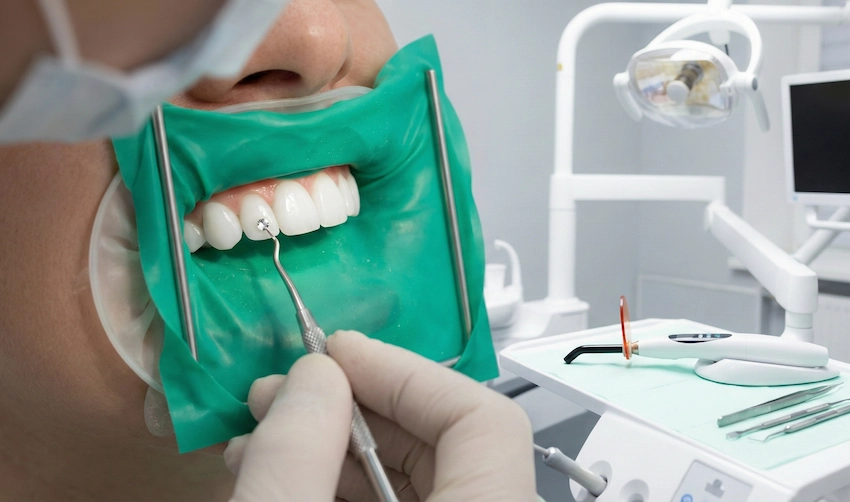
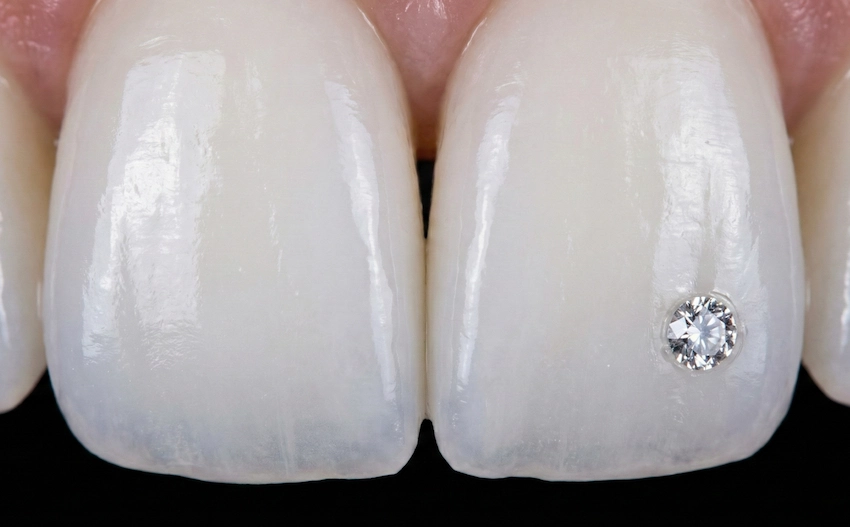
Dental jewelry is attached to the tooth using a flowable composite resin—basically a super good medical glue.
Imagine the whitening gel is not able to penetrate the crystal or the bonding agent if you whiten after a jewel is placed. The exposed portion of your tooth becomes a brilliant white one, whereas the one under the gem remains the original darker shade.
Dt. Polen Akkılıç and her team always say that this is conversely like a “tan line.” When the gem is removed or falls off, the tooth will be yellow in the center and white on the sides. It is not only visible but also very difficult to correct the discoloration after the fact. Besides that, the entire arch will probably have to be re-whitened with the risk of over-processing and damage to the teeth.
The Importance of Bonding Agents: Matching the Invisible
If you think there are bonding agents involved in only two steps, then there is one more important factor here, and it relates to the bonding agent.
At Lema Dental Clinic, based on the clinical experience, and when Dt. Polen Akkılıç places a gem; she carefully chooses the bonding agent that matches the current shade of the tooth to make the “glue” invisible.
If you gem a yellow tooth with a yellow bond and then whiten it, the tooth turns white while the glue remains yellow. After some time, the edges of the gem will appear stained or outlined in gold, thus destroying the neat, clean look you were going for in Turkey.
Clinical Note: Imagine tooth enamel like a sponge. First, we have to clean (whiten) and then dry it before applying a “sealant” (the gem). If a dirty sponge is sealed, the dirt will remain there until the seal is broken.
Timeline: The Waiting Game
In this case, patience is considered a medical necessity. In the morning you cannot whiten your teeth, and in the afternoon, bond a gem.
Whitening opens the pores of the enamel and may cause sensitivity for some time. Meanwhile, for bonding an etching process is required in which the tooth is also slightly dehydrated to get the strongest bond. If these two processes are done consecutively, the patient will experience a sharp, “zinging” nerve pain.
Professor Doctor Coşkun Yıldız advises a certain time for stabilization. Normally, the time between the finishing of whitening and the dental jewelry application is 7 to 14 days. Thus:
- The color of the teeth stabilizes (immediately after the treatment, the teeth often appear chalk-white, but after a few days, they change to a natural brilliance).
- The enamel gets remineralized.
- Sensitivity goes away completely.
Comparison: The Order of Operations
Here is an explanation of the reasons why the order of operations is crucial for the health of your mouth in the long term as well as for your pocket.
| Aspect | Scenario A: Whitening Before Jewelry | Scenario B: Whitening After Jewelry |
| Aesthetics | The entire smile appears bright and uniform. | After gem removal, a yellow spot may remain underneath (“tan line” effect). |
| Bonding Strength | Strong bond aligned with the final tooth color. | Weaker visual harmony; adhesive may appear yellowish against whitened enamel. |
| Enamel Protection | Safer. Time between treatments allows enamel remineralization. | Higher risk. Whitening agents may gradually weaken the gem’s bond. |
| Corrective Measures | Routine maintenance only. | Higher likelihood of gem removal, re-whitening, and re-bonding. |
Most Asked Questions
Of course, you can technically get whitening trays, but we are strongly against this procedure. As mentioned, the part beneath the gem is always left unchanged. The most effective way to raise your tooth shade is to first have us remove the gem, then perform the whitening and put on the new gem two weeks after.
There is no or minimal damage incurred if a professional like Dt. Polen Akkılıç does the procedure. We apply a microscopic etch pattern in the same way orthodontic brackets are positioned. The tooth is not drilled at all. The only problem is when you try to remove the gem by yourself at home, then there is a possibility of chipping the enamel. Always get a professional to remove the gem.
Generally if you get veneers or crowns (Prof. Dr. Coşkun Yıldız’s specialty), there shouldn’t be a need to whiten the teeth that have been veneered or crowned since the ceramics do not stain or whiten. However, if you want to have a jewel applied to a natural tooth together with veneers, the natural teeth should be as bright as the white color of the veneers before the jewel is placed.
Your bite and habits influence this greatly, but in fact, tooth gems last between 6 months and one year on average. They are semi-permanent after all, so the underlying canvas must be perfect.
Putting the gem on is a completely pain-free process and does not involve numbing or drilling at all. Whitening may cause occasional sensitivity but here at the clinic, we use desensitizing agents to keep the patient comfortable.
- Alqahtani, M. Q. (2014). Tooth-bleaching procedures and their controversial effects: A literature review. Saudi Dental Journal, 26(2), 33-46.
- Joiner, A. (2006). The bleaching of teeth: A review of the literature. Journal of Dentistry, 34(7), 412-419.
- Kugel, G., & Ferreira, S. (2005). The art and science of tooth whitening. Journal of the Massachusetts Dental Society, 54(1), 12-15.
- Magne, P., & Belser, U. (2002). Bonded Porcelain Restorations in the Anterior Dentition: A Biomimetic Approach. Quintessence Publishing.
- Van Noort, R. (2013). Introduction to Dental Materials (4th ed.). Mosby Elsevier.

