


Luxury diamonds embedded in crowns
It was once the case that a “sparkling smile” was simply a metaphor. Nowadays, for a certain group of patients traveling to Istanbul, it is very much a reality. Hence the surge in Diamond Implant Teeth—literally tattooing dental prosthetics with precious stones—demand among hip-hop artists, high-fashion models, and social media influencers.
However, from a healthcare perspective, we must contemplate beyond the glamour.
One might say that at Lema Dental Clinic, this is a question that we look at from an engineering perspective rather than merely a beauty issue. Introducing a single piece of diamond to the crown of the tooth or the implant is like bringing an alien element to nature and, therefore, should be an absolute confluence of genius of science, medicine, and engineering. Any slip-up will lead to infection, but a success story will be recognized as an artwork.
Professor Doctor Coşkun Yıldız emphasizes, “The mouth is a very difficult location for medical devices. It’s not just about moisture. Your mouth is a wet, high-pressure battleground where bacteria actively try to compromise dental work. A diamond can stand wear and tear, but the mounting must be able to withstand the same level of wear and tear.”
Understanding the Terminology: What Are We Actually Doing?
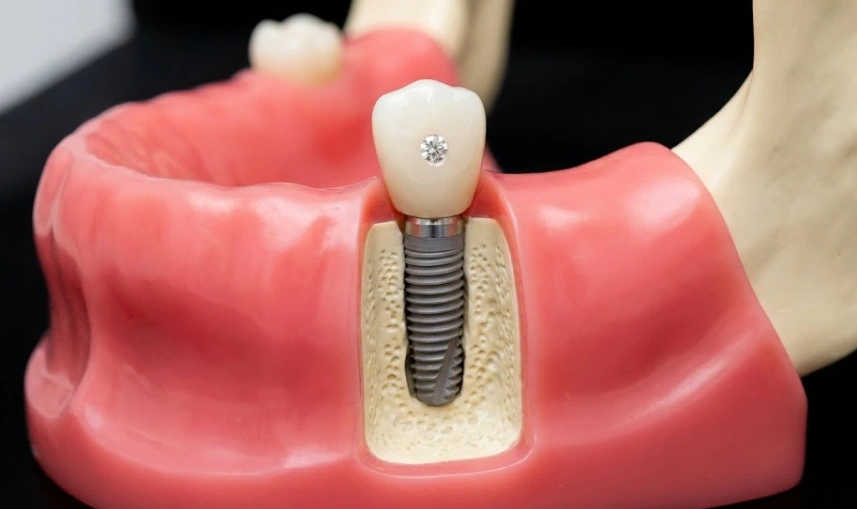
People asking us for “Diamond Implants” usually mean one of the two services we offer. Before making your booking for Turkey, you’d better understand the differences between them.
- When a Tooth is adorned with a Gem (Bonding): This is the lowest level of entry and only option. A crystal/dash of diamond is glued on a natural tooth using orthodontic adhesive. No drilling or any damage is done. And it is a temporal thing.
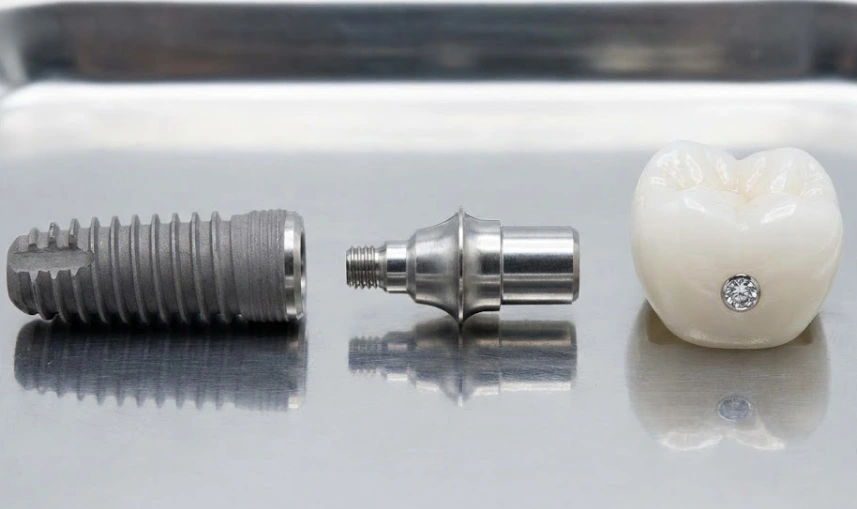
- Embedded Prosthetics (The “Real” Deal): The expression “Diamond Implant Teeth” literally comes from this, plus here. At the office of Dentist Polen Akkılıç, together with her crew, a Zirconia or Porcelain crown is custom-designed (the crown sits on top of a dental implant) with a special socket ready to hold a real diamond. The gem is set level with the surface, just like a diamond in a wedding ring, but covered or sealed to prevent bacteria from entering.
The “Pothole” Analogy: Why Precision Matters
One may ask, why can’t you just glue a diamond onto a crown yourself?
Let’s say that your tooth is like a freshly paved road. It has to be very smooth so that “traffic” (food and bacteria) cannot get a hold of it. However, if you put a diamond on your tooth without having it professionally fitted, you are creating a “pothole” or a bump.
Think of those rough margins as a magnet for food debris; once particles are trapped there, they become nearly impossible to floss away. Bacteria will colonize the gap. A localized area will get exposed to acid from the plaque that will, in turn, cause a cavity in the tooth or an infection of the gums around the implant.
When our team crafts a diamond-embedded crown at Lema Dental Clinic, we employ CAD/CAM technologies allowing us to lay the stone perfectly into the tooth anatomy. We design the shape to be ‘self-cleansing,’ i.e., the natural flow of saliva works to rinse off the gem rather than accumulate dirt around it.
Options for “Bling” in Dentistry
Not all sparkles are created equal. Here is how we categorize the options available for patients seeking this aesthetic.
| Feature | Tooth Gem (Crystal) | Real Diamond (Surface) | Embedded Diamond Crown |
| Material | Swarovski / Glass | Genuine Diamond | Genuine Diamond + Zirconia |
| Placement | Glued on enamel | Glued on enamel | Set inside the porcelain |
| Durability | 1 – 6 Months | 6 – 12 Months | Permanent (Years) |
| Damage to Tooth | None (Reversible) | None | Moderate (Requires crown/veneer) |
| Hygiene Risk | Moderate (Plaque trap) | Moderate | Low (If flush-mounted) |
| Cost | Low | Medium | High (Luxury) |
The Role of the Implant
It is important to clarify: We do not put diamonds in the bone. The “implant” is the titanium screw that acts as the root. The diamond goes into the crown (the visible tooth) that screws onto the implant.
This is actually the safest way to wear dental jewelry. Because the crown is artificial (Zirconia or Porcelain), there is no risk of the crown causing a cavity in that specific tooth. You cannot get tooth decay on a Zirconia crown. However, Professor Doctor Coşkun Yıldız warns that you can still get gum disease (peri-implantitis) if the diamond setting irritates the gumline.
This is why placement is everything. We generally place gems on the upper lateral incisors or canines—teeth that are visible when you smile but don’t take the heavy brunt of chewing as the molars do.
FAQ: Questions from the Chair
Yes, and you must. However, we recommend using an electric toothbrush with a soft head. The vibration helps dislodge bacteria around the setting more effectively than manual scrubbing. If the diamond is raised (not flush), you have to be extra gentle to avoid irritating the inside of your lip.
In a properly embedded crown made in our lab, the risk is very low. The diamond is mechanically locked into the ceramic structure. If it is just a glued-on gem, yes, it can fall off if you bite into a hard apple or sticky candy.
Diamonds are carbon; they are non-magnetic and safe. However, the setting matters. If the diamond is held in place by a gold alloy, it is generally MRI safe but might cause a small “artifact” (blur) on the image. If it is pure Zirconia, it is perfectly fine.
The procedure itself is painless because we are working on the prosthetic crown, not your nerve. If you are getting a new implant and crown, the standard recovery for implant surgery applies, but the addition of the diamond adds no extra pain.
If it is a glued gem, yes, we can pop it off in seconds. If it is an embedded crown, no. The diamond is part of the tooth. To remove it, we would need to replace the entire crown or veneer.
- Underwood, B., & Gurney, J. (2012). Tooth jewelry: A review of the literature and documented case reports. Dental Update, 39(6), 416-420.
- Common, J. (2010). Grills, gems, and gingivitis: The dental implications of mouth jewelry. General Dentistry, 58(2), 120-123.
- Bath-Balogh, M., & Fehrenbach, M. J. (2011). Illustrated Dental Embryology, Histology, and Anatomy. Elsevier Health Sciences.
- Mishra, A., & Pandey, R. K. (2016). Tooth jewellery: A simple way to dazzle. International Journal of Advances in Case Reports, 3(6), 336-338.
- Gupta, N., et al. (2019). Tooth Jewellery: A fashion statement. Journal of Advanced Medical and Dental Sciences Research, 7(5), 65-67.

