


Shifting aesthetics and underlying dental issues
For a long time, gold was the unquestioned king among dental materials. It was the gold standard, literally. In case you needed a dental restoration in the 80s or 90s, a high-karat gold filling was the strongest, most biocompatible option your dentist could offer. It was functional, long-lasting and in numerous cultures, a unique sign of status or style.
However, time passes, and so do the meanings of beauty.
We are witnessing a substantial shift in the field of dentistry today. At Lema Dental Clinic, Turkey, patients come not only to restore their teeth but also to remove the metallic evidence of their previous dental treatments. The question we get most often is not “Is gold safe?” but rather, “Can you make it so that nobody will notice that I had dental treatment?”
Removing gold teeth for one reason is very rare. Usually, it is a mixture of changing appearance, improving medical technology, and, at times, hidden health issues under the metal that prompt the removal of gold teeth.
Aesthetic Revolution: The Wish for “Invisible” Dentistry
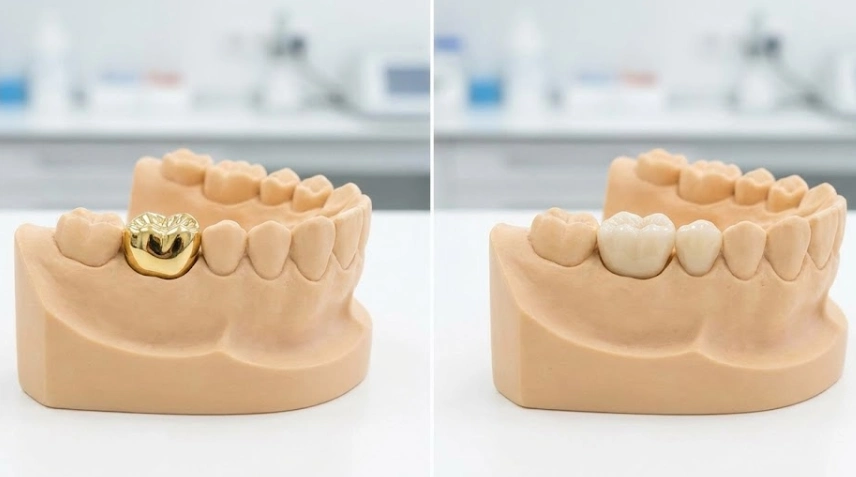
One of the main reasons for removing gold work is a basic change in what society sees as a healthy and attractive smile. With the current visual culture dominated by social media and high-resolution photos, the perfect smile is natural and translucently bright.
In that case, gold is a metal that makes you stand out.
Dentist Polen Akkılıç, who heads the aesthetic team at our clinic in Istanbul, points out that patients are sometimes embarrassed because of the “flash” of dark metal when they laugh or talk. It has been seen that an expensive dental treatment used to be a sign, but now it is perceived as old-fashioned. Imagine it as if you wore a retro outfit to a contemporary corporate meeting; it will definitely attract attention but maybe not the one you have intended.
Dentists are gradually replacing metal restorations with biomimetic materials such as Zirconia and E-max porcelain, which possess the light-reflecting characteristics of natural enamel.
Medical Reality: What Is Under Gold?
It would be wrong to believe that this is completely for the sake of appearance. There exist valid clinical reasons for changing old gold restorations.
Ceramic restorations are more likely to chip or crack than gold, which in itself is a very durable material. Professor Doctor Coşkun Yıldız constantly warns our patients that a crown can only perform as well as the tooth underneath it.
After a period of 15 or 20 years, the thin cement that holds a gold crown could gradually break down and be washed away. Bacteria break through the tiny space between the gold and the natural tooth. Due to the fact that gold prevents X-rays from passing through completely, dentists are very often unable to detect caries that have developed underneath the gold crown until the tooth nerve has been severely damaged.
We sometimes have to take off 20-year-old gold crowns which seem absolutely fine on the outside, only to discover that the natural tooth underneath has collapsed from decay that was not apparent.
The Mixed Metals Issue and Gum Recession
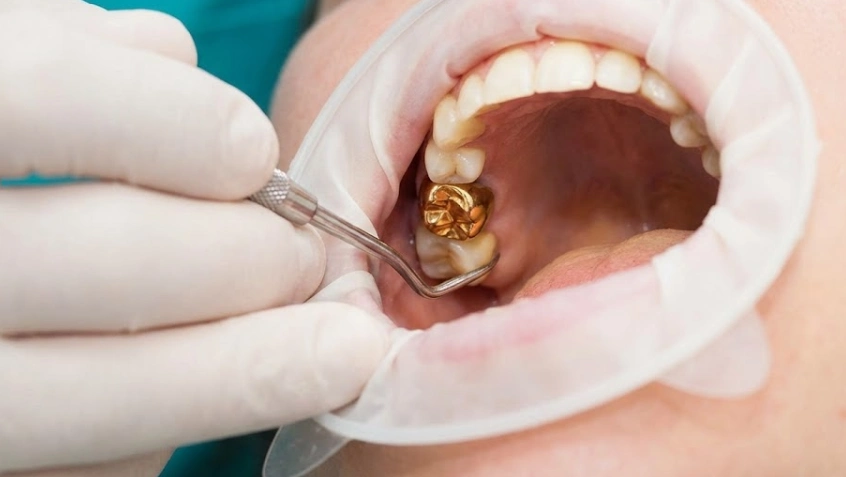
The oral environment is the third component of the clinical aspects we think about at Lema Dental Clinic. Some people have “oral galvanism” – a weak electric current generated when different metals (like a gold crown and old silver amalgam filling) come in contact with saliva. It may cause metallic tastes or minor irritations.
Moreover, as we get older, our gums tend to recede a little which is a natural occurrence. When lips get away from an old gold crown, the dark metal crown base is often exposed at the gum line. This leads to the creation of a “black line” tattoo effect that very few people like to see.
Old Standard vs New Standard
Modernizing their smiles is what brings most patients in Turkey to Lema Dental Clinic. We support them in considering the historical advantages of gold versus the modern alternatives.
| Feature | Traditional Gold Restorations | Modern Zirconia/Porcelain (Lema Standard) |
| Aesthetic Appearance | Highly visible metal; distinct yellow or silver color. | Completely natural; mimics translucency and shade of real enamel. |
| Biocompatibility | Excellent (high-karat gold); rare allergies. | Excellent; Zirconia is highly biocompatible and tissue-friendly. |
| Durability | Extreme; gold does not fracture and wears down similarly to natural teeth. | Very High; modern Zirconia is exceptionally tough, suitable even for molars. |
| X-Ray Visibility | Radio-opaque; blocks X-rays, hiding underlying issues. | Radio-translucent versions exist; allows better monitoring of the tooth underneath. |
| Long-Term Gingival (Gum) Response | Can cause dark lines at the gum margin if recession occurs. | Does not cause dark margins; integrates seamlessly with gum tissue. |
Top Queries on Transitioning from Gold to White Smiles
No more than getting a regular filling. We use robust local anesthesia to completely numb the area. The process involves cutting a slot in the gold crown and gently popping it off the tooth structure. It is usually faster than preparing a tooth for a new crown.
Absolutely. It is your property. Patients are often surprised by the weight of old molar crowns. Depending on the karat and current market prices, the scrap value can be respectable, though rarely enough to cover the cost of the new replacement.
This depends on the tooth’s location. For front teeth where aesthetics are paramount, we often use E-max porcelain for its stunning translucency. For back teeth (molars) that withstand heavy chewing forces, we typically recommend monolithic Zirconia, which offers immense strength while still being tooth-colored.
Only if it is done poorly. The goal of modern aesthetic dentistry in Turkey is “invisible artistry.” Dentist Polen Akkılıç and her team use digital color matching and customized layering techniques to ensure the new restoration blends indistinguishably with your surrounding natural teeth.
Generally, no. High-karat dental gold is one of the safest, least reactive materials ever used in medicine. The reason to remove it is rarely because the gold itself is toxic, but rather because it is outdated, aesthetically displeasing, or hiding issues underneath it due to its age.
- Anusavice, K. J., Shen, C., & Rawls, H. R. (2013). Phillips’ science of dental materials. Elsevier Health Sciences.
- Donovan, T. E. (2007). Longevity of the tooth/restoration complex: a review. Journal of the California Dental Association, 35(9), 635-643.
- Joiner, A. (2004). Tooth colour: a review of the literature. Journal of Dentistry, 32, 3-12.
- Milleding, P. (2000). Crowns and fixed partial dentures: a long-term clinical study. International Journal of Prosthodontics, 13(2).
- Rosenstiel, S. F., Land, M. F., & Fujimoto, J. (2015). Contemporary fixed prosthodontics. Elsevier Health Sciences.

