


Dental implants preserve the jawbone best.
When a patient comes to the Lema Dental Clinic in Turkey and sits in the consultation chair, usually, those who have a gap in their smile first focus on how their teeth look. Their first question is usually, “How quickly can we fix this?”
However, as clinical partners to proficient surgeons, the main thing we consider is biology. The question shouldn’t simply be what looks good right now but also what will keep your mouth healthy at its core in twenty years.
Missing teeth are not just harmless empty spaces. They are like active building sites where the body has started the process of deconstruction. Choosing the most “healthy” replacement is equivalent to choosing the method that will stop the demolition of your mouth.
The Invisible Crisis: The Melting Jawbone
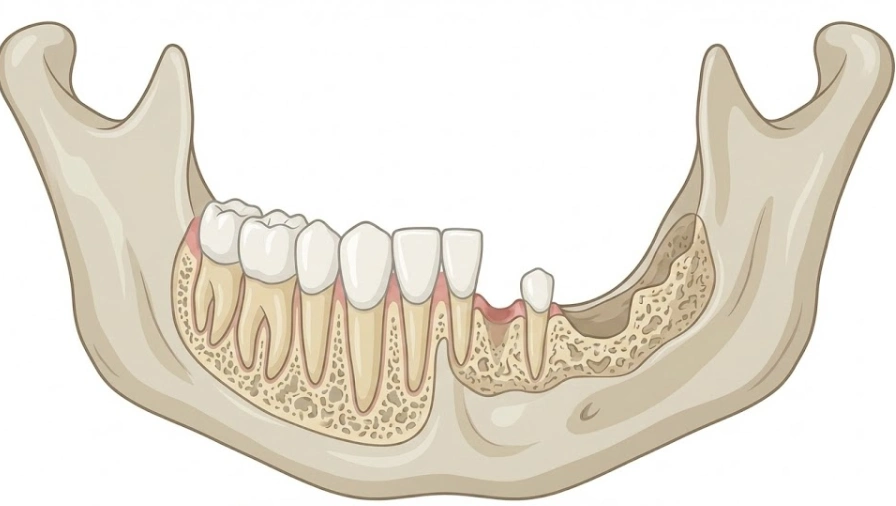
In order to find the healthiest solution, we have to understand the problem first. Your jawbone belongs to a highly efficient group of structures that follow the principle of “use them or lose them“. Alveolar bone (the bone surrounding teeth) only exists because it supports tooth roots.
Therefore, once a tooth is lost, the body recognizes that this piece of “foundation” will not be necessary anymore and, almost immediately, it starts to resorb – or essentially melt – that bone. It is possible to lose up to 25% of the bone width in this particular location in the first year alone.
Think of your jaw as a bookshelf and teeth as heavy books that are tightly packed. If you take out one book, the rest of them may fall eventually. More to the point, the shelf will start to get damaged as the weight distribution is not right anymore.
The healthiest replacement is the one that tells the bookshelf that it still has to be strong.
The Gold Standard: Why the Dental Implant Wins on Health
According to our clinical practice and the literature, the single most biologically optimal method of replacing a lost tooth is a dental implant.
The explanation is clear: it is the only alternative that reinstates the root of the tooth, rather than just the outside part.
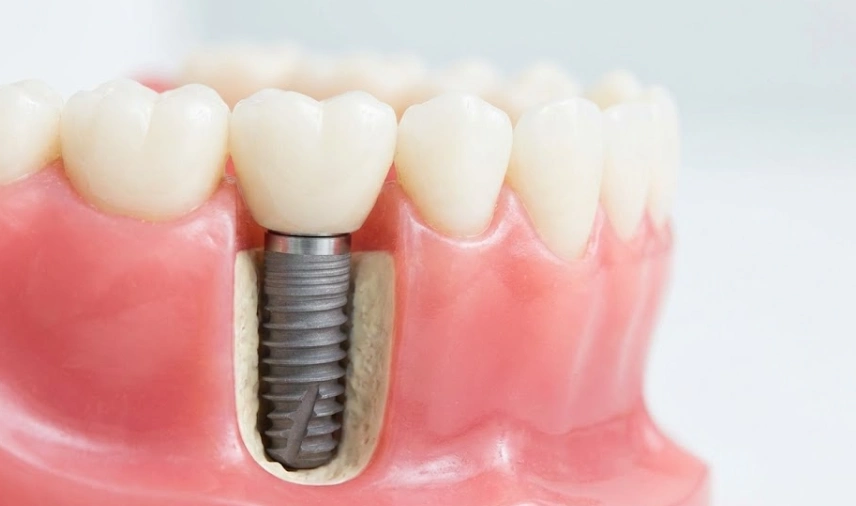
A dental implant is a very small biocompatible titanium screw that is placed tightly into the jawbone under the supervision of a surgeon. Here in Turkey, our surgical leader, Professor Dr. Coşkun Yıldız, talks to his patients about implants in such a way that they understand the implant to be an “artificial root“. After the implant is inserted, an amazing biological phenomenon occurs, which is osseointegration. Bone cells that are alive in the vicinity bind to the titanium, thereby cementing the implant.
The aforementioned impregnation provokes the jawbone to believe that there is a natural tooth in place. The implant sends the chewing forces back to the bone, which is reinforced, so the body gets the message to keep the bone density. No other replacement option can give you this.
After securing the groundwork, Dentist Polen Akkılıç and her clinical team can make the corresponding crown from porcelain. The end product is a perfect tooth that not only exhibits all three characteristics of natural teeth but will also work naturally within your biological system.
The Compromises: Bridges and Dentures
If implants are the healthiest, where do traditional methods fit in?
Bridges and dentures are still part of our arsenal of treatments. In fact, for some cases, they can be the ideal answer. That said, if we were to look at the term “healthiest” through a biological lens, then these two methods are not without their compromises.
The Bridge Dilemma
A fixed bridge is an assembly that imitates a tooth and bridges the gap by using the two adjacent teeth as support. The hidden cost here is that a pretty aggressive approach to the enamel of the neighboring teeth is taken to make the bridge fit.
Let’s take the analogy of a bridge over a river: the only way to build the bridge is to chip off pieces of both sides of the stable mountains to be able to secure it. So, in a way, you are harming two good things to fix one damaged one.
The Denture Downside
Partial and complete removable dentures rest soundlessly on the gums and do not provide bone stimulation. Actually, it can happen that a denture will rub against the gum ridge and thus generate the condition that favors the acceleration of bone loss. So, while they lend a good appearance to the arrangement of the teeth, they do not offer the underlying structure of the jaw any respite from decay.
Comparing the Biological Impact of Your Options
Below is an outline that compares the long-term impact that different tooth replacement modalities have on the overall health of your oral ecosystem.
| Feature | Dental Implant | Traditional Fixed Bridge | Removable Partial Denture |
| Preserves Jawbone Density | Yes (Mimics natural root stimulation) | No (Bone under the gap continues to resorb) | No (Can sometimes accelerate resorption) |
| Impact on Adjacent Teeth | None (A standalone solution) | High (Requires aggressive filing of healthy teeth) | Moderate (Clasps can wear down enamel over time) |
| Bite Force Restoration | 90-100% (Near natural chewing power) | 70-80% (Good, but connected teeth take the load) | 30-50% (Significant reduction in chewing efficiency) |
| Long-Term Health Outlook | Excellent (Often a lifetime solution) | Good (Average lifespan 10-15 years before replacement) | Fair (Often requires relining as bone shrinks) |
Clinical Answers to Your Top Concerns About Restoration Health
Yes, it is a highly predictable, sterile procedure. In the hands of an experienced surgeon like Prof. Dr. Yıldız, the trauma to the tissue is minimal. We utilize advanced 3D imaging at Lema Dental Clinic to map nerves and bone structure before we even begin, ensuring the placement is precise and safe. The body’s acceptance rate of titanium is incredibly high.
Rarely. This is a common concern we see in patients traveling to Turkey who have worn dentures for years. While the bone may have receded, we can often rebuild it using bone grafting or sinus lift techniques before placing the implant. It adds a step to the process, but it restores the foundation needed for long-term health.
Enamel is the hardest substance in the human body, and it does not grow back. Once we remove healthy enamel to place a bridge crown, that tooth becomes more vulnerable to future decay at the gumline and potential nerve damage. We prefer to leave healthy teeth alone whenever possible.
“Non-invasive” doesn’t always mean healthier in the long run. While you avoid surgery initially, the long-term consequence of a denture is progressive jawbone atrophy that changes your facial structure (making you look older) and severely limits what healthy foods you can chew comfortably.
Achieving the “healthiest” result requires precision. It demands a surgeon who understands bone biology and a prosthodontist who understands bite mechanics. At Lema, we don’t just place implants; we engineer complete oral rehabilitation. By coming to Turkey, patients access elite-level surgical expertise and premium materials (like Straumann or Nobel Biocare) at a price point that makes the best health decision accessible.
- Albrektsson, T., Zarb, G., Worthington, P., & Eriksson, A. R. (1986). The long-term efficacy of currently used dental implants: a review and proposed criteria of success. The International journal of oral & maxillofacial implants, 1(1), 11–25.
- Buser, D., Sennerby, L., & De Bruyn, H. (2017). Modern implant dentistry based on osseointegration: 50 years of progress, current trends and open questions. Periodontology 2000, 73(1), 7–21.
- Misch C. E. (2005). Dental implant prosthetics (3rd ed.). Elsevier Mosby.
- Pjetursson, B. E., & Lang, N. P. (2008). Prosthetic treatment planning on the basis of scientific evidence. Journal of oral rehabilitation, 35 Suppl 1, 72–79.
- Tallgren A. (2003). The continuing reduction of the residual alveolar ridges in complete denture wearers: a mixed-longitudinal study covering 25 years. The Journal of prosthetic dentistry, 89(5), 427–435.

