


Sutureless implant treatment places an implant without cuts or stitches for faster healing.
The Reality of Sutureless (Flapless) Implant Treatment
But, what if we informed you that nowadays implantology has come to a point where it no longer requires “opening the gum” for each case?
Sutureless (Flapless) Implant Treatment is the solution that helps the conversation around this issue change. This method is affectionately termed the “keyhole operation” of the teeth. The clinic in Turkey, under the clinical leadership of Professor Doctor Coşkun Yıldız, treats this approach not only as a mere technique but also as a tissue-respecting human method.
What Exactly Is Flapless Implant Surgery?
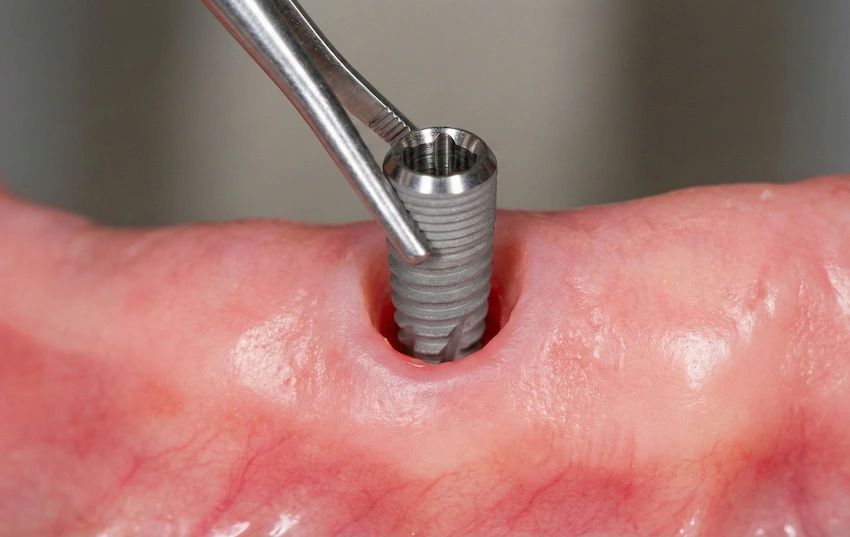
Firstly, think about the traditional placement of the implant to better understand a flapless one. To begin with, a surgeon typically makes a cut in the patient’s gum tissue (called a ”flap”), then folds it away to get to the bone, drills a hole, inserts the implant, and finally, sews the gum back.
Flapless surgery differs in that no gum tissue is peeled back.
Actually, we rely on 3D digital planning to locate the implant position accurately. A minimal and precise access point is created through the gum tissue, which is no bigger than the implant itself.
The “Keyhole” Analogy
This can be compared to the act of hanging a heavy picture on a wall.
- Traditional Surgery: You remove not only the wallpaper but also the drywall to locate the wall studs, fix the anchor, and then you have to repair and repaint the whole wall.
- Flapless Surgery: You use a stud finder (our 3D CT Scans) to find the stud exactly, then you make a single, neat pilot hole right through the wallpaper to install the anchor. The wall is left intact.
The Lema Dental Clinic Protocol: Precision is Non-Negotiable
Many clinics market ”flapless” implants, but this method necessitates a tremendous amount of preparation. Since you can visually determine the bone, you have to ”see” it digitally, in a manner of speaking.
Before you even take a seat in the surgical chair, Dentist Polen Akkılıç and her team at our clinic carry out high-resolution CBCT (Cone Beam Computed Tomography) scans. They accurately map out your nerve pathways, sinus cavities and bone density. This digital map is your surgical roadmap and it allows Professor Doctor Coşkun Yıldız to place an implant with the highest possible level of precision without even seeing the bone in person. The level of confidence here is 100%, because the path is laid down.
Why Patients in Turkey Choose Sutureless Implants?
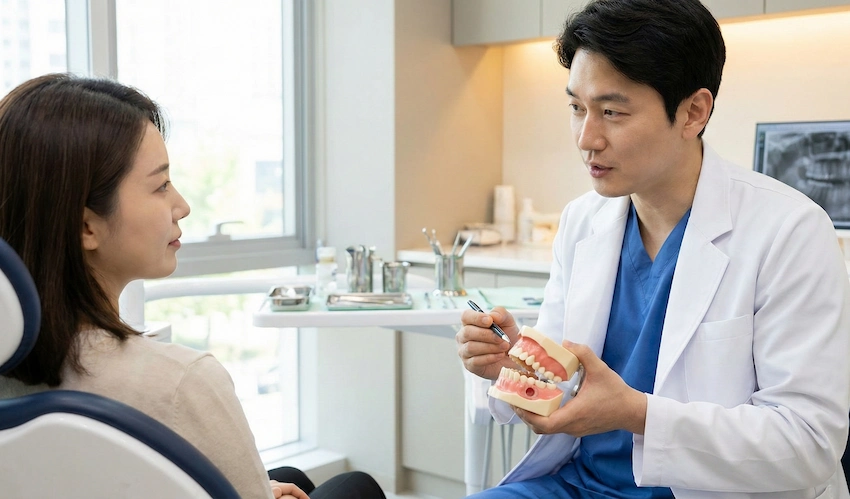
Such great clinical effects of this method hardly need further explanation. When we don’t cut the periosteum (a layer of bone tissue that is vascularized and very rich) to the bone, we only keep the blood flow intact. Hence, healing is quicker, which is what better blood supply results in.
Our clinic observes the following:
- Dramatic decrease in the inflammatory swelling: The body’s inflammatory response is minimal when no major incisions are made.
- Tiny bleeding: The entry point tends to close up on its own.
- Time saving: We can usually complete an implant surgery within 10-15 minutes.
Traditional vs. Flapless: A Clinical Comparison
In order to help them make an informed treatment decision when they come to Istanbul, we sometimes illustrate this comparison to our foreign patients.
| Feature | Traditional Implant Surgery | Sutureless (Flapless) Surgery |
| Incision Type | Large flap (gum peeled back) | Small punch (circular entry) |
| Stitches Required | Yes, multiple sutures | None (zero) |
| Surgical Time | 30–60 minutes per implant | 10–15 minutes per implant |
| Post-Op Pain | Moderate; requires medication | Minimal; often manageable with mild analgesics |
| Gum Recession Risk | Moderate risk during healing | Very low (tissue architecture preserved) |
| Healing Speed | 1–2 weeks for soft tissue | 2–3 days for soft tissue |
Is Everyone a Candidate?
It is the single most important question. Even though we strongly support this method, Professor Doctor Coşkun Yıldız has only one message: nature decides.
Basically, flapless surgery needs to have a large enough “safety zone” of bone that is healthy and attached/grown gum tissue. If one suffers from a large bone defect and has to be grafted, or if he/she has thin and uneven gum tissue, in these cases, we shall opt for the traditional open surgery to tightly fix the graft. Our principle is not to impose a certain technique when it may undermine the future stability of the implant.
FAQ: Your Questions, Answered by Our Surgeons
A partially correct answer is provided here. The ”hole” matches the size of the implant or the healing cap which we put on top of it. It is like a bottle that is corked. The implant takes up the whole space and thus, there is no wound exposed to the mouth. The gum is nearly instantly almost completely closed around this metal sleeve.
It is more of a condition question rather than a yes-or-no one. Sutureless surgery is “blind” to the naked eye. That is why it depends on 3D scans. If the ridge is extremely narrow (knife-edge ridge), we usually decide to open the gum to avoid perforation and see exactly where the drill is going. At the same time, at Lema Dental Clinic, we are able through the use of surgical guides to do flapless even in some borderline situations.
In general, the price of the implant itself is unchanged. However, because flapless surgery almost always implies a 3D guided surgical approach (surgical guides), there probably will be a slight saving for the manufacturing of these guides. Still, based on the shorter recovery period and the reduced number of follow-up appointments, most patients feel that it is well worth the price.
Yes. Actually, it is perfect for the full-arch cases. The trauma is radically lessened since you are doing multiple implants at once, and hence avoiding large incisions all over the jaw. You can usually leave the clinic with temporary teeth on the very same day and with minimal pain.
You won’t be feeling any pain since you are given local anesthesia just as if you are having a filling. Besides that, you are only going to sense pressing and vibration, not sharpness, and of course, no pain at all. Most of the patients are taken aback after we say, “We are done,” since the procedure was much shorter than expected.
- Joda, T., & Brägger, U. (2015). Patient-centered outcomes comparing digital and conventional implant impression procedures: A randomized crossover trial. Clinical Oral Implants Research, 26(12), 1-6.
- Moraes, P. H., et al. (2020). Flapless versus Open Flap Implant Surgery: A Systematic Review and Meta-Analysis. International Journal of Oral and Maxillofacial Surgery, 49, 100-108.
- Vercruyssen, M., et al. (2014). Depth and lateral deviations in guided implant surgery: An RCT comparing guided surgery with mental navigation or the use of a pilot-drill template. Clinical Oral Implants Research, 25(11), 1315-1329.
- Cai, H., et al. (2015). Flapless surgical technique versus conventional open-flap technique in single-stage dental implant surgery: A retrospective study. International Journal of Oral Science, 7, 258–262.
- Esposito, M., et al. (2016). Interventions for replacing missing teeth: hyperbaric oxygen therapy for irradiated patients who require dental implants. Cochrane Database of Systematic Reviews, (12). (Focus on minimally invasive protocols).

