


Yes, bruising is expected to heal.
Imagine that you had a surgical procedure done in Istanbul, and the next day, when you get up and go to the mirror in your hotel room, the reflection of your face stops you cold. The side of the face that you look at resembles more the story of a person who got punched at a boxing match than someone who had a dental procedure. You start feeling panic inside. Is the situation out of control? Are the implants failing?
We see this type of situation with patients coming to Lema Dental Clinic quite often. Actually, this is the exact moment when lots of our patients send a help message to our support team.
It is absolutely understandable that, if someone does not see a familiar face and, on top of that, that face is visually bruised, the person might be afraid. Still, it is good to be reminded that, based on the actual statistics, bruising is an indication that the body is using its self-healing mechanisms. Prof. Dr. Coşkun Yıldız frequently compares a surgical site with a construction site; a house cannot be renovated without some dust being created, it is the same situation with bone and gum tissues that cannot be rebuilt without a temporary biological “debris”.
The Anatomy of a Bruise (Ecchymosis)
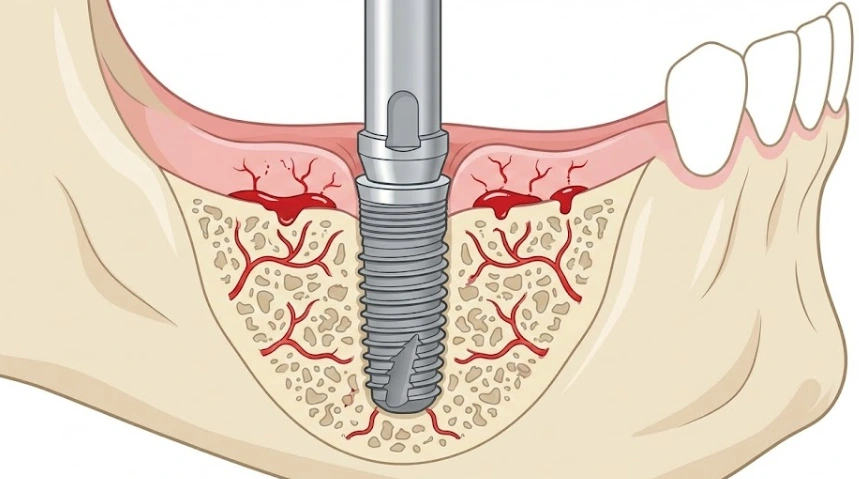
Simply put, a bruise appears when blood from small vessels leaks into the tissues beneath the skin, but if we want to know exactly why the skin changes its color, then we need to understand it from a perspective deeper than the surface.
It couldn’t be imagined that a dental implant surgery, even with the ultra-advanced and non-invasive techniques that we use here in Turkey, would not require some sort of soft tissues and bone manipulation.
During the procedure, although the capillaries (extremely small blood vessels) in the gum tissue and muscle fibers are only very slightly, if at all, broken and bleeding is almost negligible, some blood does seep out from these capillaries and penetrate the neighboring tissues – underneath the skin and inside the muscle. Since the skin is not broken, this blood is trapped and remains localized. In fact, this blood is doing the work of the internal bandage. The blood is the vehicle for platelets and healing factors that are necessary for clotting and wound repair. The bruise you have thus is simply the iron from your blood cells being disintegrated and absorbed by your body.
The “Gravity Effect”: Why Your Neck Might Turn Yellow
Here is the typical scenario in the clinic when a patient asks the doctor a very baffling question:
“Doctor, you did a surgery on my upper jaw, but my neck is bruised. How could that be?”
Gravity is the reason. While you are standing or whenever you are sitting in your hotel room, for example, gravity is pulling down the gel that is trapped there. So, if your face was bruised really badly on day one, by days three to five, it would have lost its “medical” appearance since the colors of the bruise in the neck or even chest area would look quite faded. What can be discouraging to some is that they may think that the wound is spreading; however, what is really going on is that the blood is taking the easiest way to be cleared by your lymphatic system.
Dentist Polen Akkılıç and her team are used to telling patients that this sort of migration phenomenon should be taken positively, as it proves that the fluid is not kept stagnant at the surgical site.
Factors That Amplify the “Technicolor” Effect
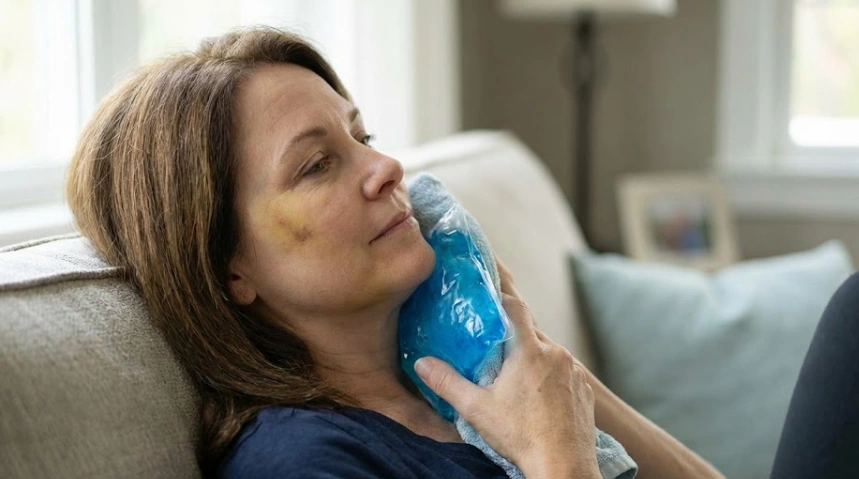
Not only their looks but also the way people’s bodies react to bruises are different. In the case of two patients undergoing the same All-on-4 treatment, the results are likely to be quite different.
- Age and Skin Elasticity: As people get older, their blood vessels also gradually lose their strength along with the skin getting thinner. Aging is usually why patients above a certain age are more prone to show a visible ecchymosis (bruising) after a surgical procedure compared to young patients.”
- Complex Grafting: What if your treatment was a sinus lift or a large-scale bone graft? Then, the way the tissues are handled would be much deeper. The artists will therefore be expected to use more vivid colors.
- Medications: Are aspirin, blood thinners, or even high doses of Vitamin E and fish oil part of your daily regimen? All these substances, which are natural anticoagulants, make it more difficult for those tiny capillaries to heal quickly and, as such, more extensive bruising occurs.
Differentiating Normal Healing from Complications
In case you have troubles in distinguishing a so-called “colorful recovery” from one that deteriorates, below is a guide for you to recognize those symptoms that help you make up your mind.
| Symptom | Normal Post-Op Bruising | Hematoma | Infection |
| Appearance | Flat discoloration (Blue/Purple → Green → Yellow) | A hard, raised, painful lump under the skin | Red, angry, tight skin |
| Pain Level | Tender to touch, but dull | Sharp, pressure-like pain due to trapped blood | Throbbing, increasing pain |
| Temperature | Normal skin temperature | Slightly warm | Hot to the touch |
| Timeline | Appears day 2-3, fades by day 10-14 | Appears immediately or within 24 hours | Appears/worsens day 4-7 |
| Action | Rest, Ice/Heat, Wait | Contact Clinic (May need draining) | Contact Clinic (Antibiotics needed) |
Critical Queries on Facial Discoloration
The timeline is fairly predictable.
Days 1-2: Redness and mild swelling.
Days 3-5: The peak. This is when the bruise turns dark blue, purple, or black.
Days 6-10: The “healing rainbow.” The color shifts to green and then yellow.
Days 10-14: usually, the skin returns to normal. Most of our international patients are well into the yellow/fading stage by the time they fly home.
We generally advise waiting 48 to 72 hours before applying makeup, and never apply it directly over the incision sites or sutures inside the mouth. However, for external facial bruising, Dentist Polen Akkılıç notes that once the initial heat and swelling have subsided (usually after day 3), you can use color-correcting concealers (green cancels out red; yellow cancels out purple) to mask the area if you need to go out.
While there is no magic wand, many of our patients find relief with Arnica Montana (a homeopathic gel or tablet) or Bromelain (an enzyme found in pineapples). These are known to reduce inflammation and accelerate the breakdown of bruising. However, always clear any supplements with Professor Doctor Coşkun Yıldız before taking them, as they can interact with other medications.
This is known as a “sympathetic bruise” or tracking. If you had surgery in the upper jaw (maxilla), specifically near the sinuses or towards the back molars, the tissue connection can allow blood to pool around the orbital rim (eye socket). A “black eye” after dental surgery looks scary, but it is structurally unrelated to your eye health and will fade just like a jaw bruise.
- Misch, C. E. (2014). Contemporary Implant Dentistry. Mosby.
- Adell, R., Lekholm, U., Rockler, B., & Brånemark, P. I. (1981). A 15-year study of osseointegrated implants in the treatment of the edentulous jaw. International Journal of Oral Surgery, 10(6), 387–416.
- Greenstein, G., & Cavallaro, J. (2011). Managing the maxillary sinus for implant restoration: Anatomy, pathology, and surgical techniques. Journal of Periodontology, 82(1), 28-46.
- Chiapasco, M., & Zaniboni, M. (2009). Clinical outcomes of GBR procedures to correct peri-implant dehiscences and fenestrations: A systematic review. Clinical Oral Implants Research, 20(s4), 113-123.
- Bui, C. H., Seldin, E. B., & Dodson, T. B. (2001). Types, frequencies, and risk factors for complications after third molar extraction. Journal of Oral and Maxillofacial Surgery, 59(12), 1376–1383.

