


No, pure gold is too soft
It’s a common scene in our country, Turkey. Someone who maybe likes the style of rap music or the looks of super trendy people comes to our clinic wanting the ultimate sign of success: a dental crown which is made of pure, solid, 24-karat gold and is therefore a permanent fixture in their mouth.
At first glance, it sounds like a very over-the-top extravagance, right? But in fact, jewelry that you wear around the neck is pretty much the opposite of the kind you use to chew your food.
The brief reply would be: In fact, we do not use pure 24k gold for permanent crowns.
But since we are at it, the extended reply is actually super interesting. It’s about the metal composition, bite forces, and the human oral biology. According to our clinical experience at Lema Dental Clinic, discovering the reason why pure gold is a failure helps one to be able to choose the most appropriate restoration for the smile.
The “Butter” Problem: Why Pure Gold Fails
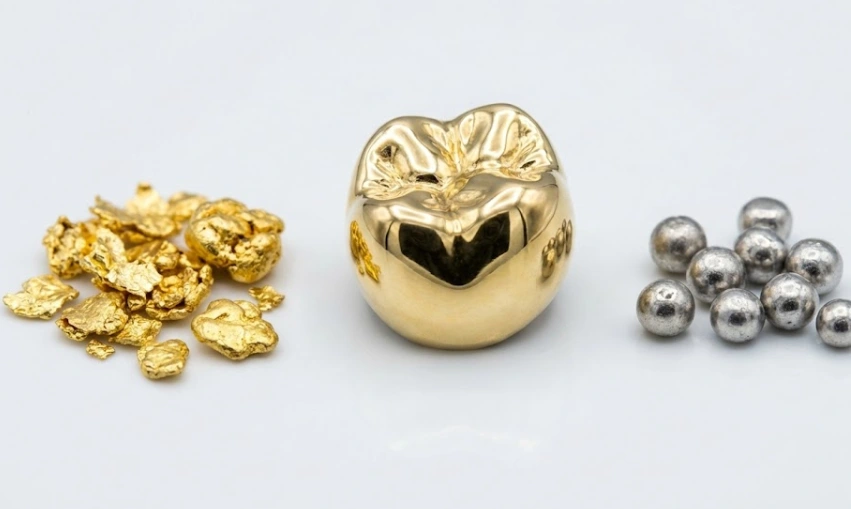
Gold is one of the best metals there is. For instance, it is compatible with the human body, it does not rust, and it also has a very attractive appearance. On the other hand, in its highest purity level (24k), gold is surprisingly soft.
Professor Doctor Coşkun Yıldız is fond of referring to this metaphor when explaining it to the patients: Suppose you are about to make a skyscraper foundation with Play-Doh. The result might be quite pretty and orderly. But as soon as you place some weight on it, the foundation will be crushed.
Without exaggerating, your jaw muscles are extremely strong. The masseter alone can generate more than a hundred pounds of pressure per square inch. If you were to have a pure 24k gold crown fitted on your molar, it wouldn’t surprise me if after a few months of eating a medium-rare steak or grinding your teeth while asleep, that crown would start to show signs of wear and tear. For one, it wouldn’t keep its original shape, plus the edges would get detached allowing bacterial invasion which in turn would lead to the decay of the tooth tissue, the one which we had so painstakingly tried to save.
The Solution: Dental Gold Alloys
Answer me this: when you spot a person who has a golden tooth that looks like it’s been there for 20 years, what material is it really made of?
It is an alloy. The whole idea of gold in dentistry is that it has to be made “durable”. We get pure gold and then blend it with minute quantities of different metals such as platinum, palladium, silver, or copper. Thus, it is what in the industry is referred to as “High Noble Alloy“.
In general, a first-class “gold” crown is in fact somewhere around 16k to 22k gold (roughly 60% to 75% pure gold), with the rest being strengthening metals. This formula ensures that you get the warm, yellow gleam which you are after, but with the toughness of a vehicle.
Gold vs. The Modern Aesthetic
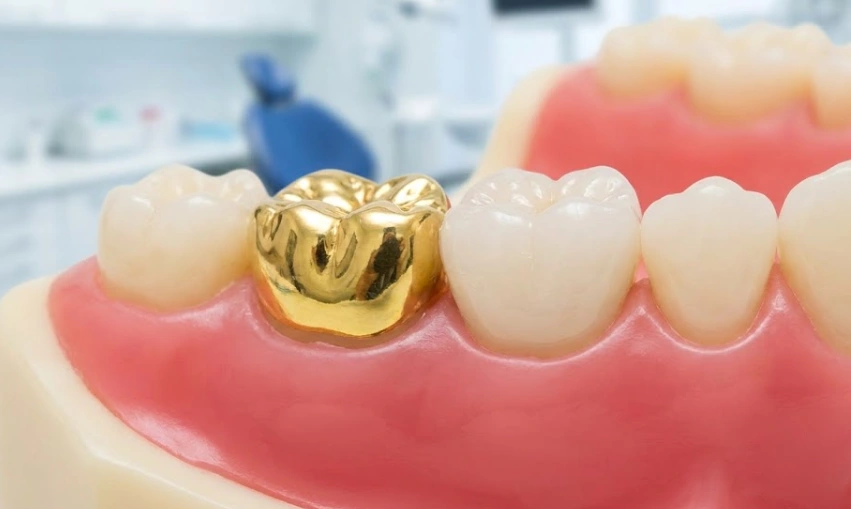
In the past, gold was the gold standard (pun intended) because it was the most durable material we had. Today, the landscape has changed. Dentist Polen Akkılıç and her team usually recommend Zirconia or E-max for most restorations. Why? Because while gold is strong, Zirconia is stronger and looks like a real tooth.
However, gold still has a place. Some patients specifically travel to Turkey for that “retro” aesthetic or because gold is incredibly gentle on the opposing teeth. Unlike porcelain, which can sometimes act like sandpaper against the tooth it bites against, gold is smooth. It wears down at the same rate as natural enamel.
Comparing the Materials
If you are torn between the “bling” of gold and the natural look of porcelain, here is how they stack up in our lab:
| Feature | Pure 24k Gold | Dental Gold Alloy (High Noble) | Zirconia |
| Durability | Very Low (Deforms easily) | High (Lasts decades) | Very High (Virtually unbreakable) |
| Aesthetics | Rich Yellow | Rich Yellow / Silver hue | Natural Tooth Color |
| Bite Resistance | Poor | Excellent | Excellent |
| Wear on Opposing Teeth | Gentle | Gentle | Can be abrasive (if not polished) |
| Primary Use | Jewelry / Removable Grillz | Functional Posterior Crowns | Functional & Aesthetic Crowns |
The Grillz Confusion
This is the source of confusion most of the time. You might spot celebs flaunting 24k gold “teeth,” but those are nearly always removable Grillz.
Grillz are accessories. They are put on top of your teeth, similar to a mouthguard. Since you remove them to eat (or at least that should be the case), they don’t have to be strong enough to withstand biting forces. On the other hand, a permanent crown which is glued into your mouth all the time 24/7 should be made of an alloy.
FAQ: Straight Talk from the Clinic
Yes. High noble alloys with a high percentage of gold (around 75%) have a very deep, rich yellow color that mimics the look of pure gold very closely, but they are hard enough to withstand chewing.
Actually, rarely. The price of gold fluctuates globally. Because a gold crown requires a significant amount of precious metal, it can sometimes be more expensive than a Zirconia crown, depending on the current market price of gold per ounce.
It is very unlikely. High-noble gold alloys are hypoallergenic. However, cheap “base metal” crowns (which contain nickel) can cause allergies. That is why at Lema Dental Clinic, we only use certified, biocompatible materials.
Technically, yes. Biologically, it works fine. But aesthetically, most patients prefer Zirconia for the front teeth to maintain a natural smile. A gold front tooth is a bold fashion statement, not a standard dental recommendation.
We specialize in full mouth makeovers using Digital Smile Design, usually focusing on natural esthetics (Hollywood Smile). However, we treat every patient individually. If you have a specific request for gold alloy work for posterior teeth, we discuss the feasibility during your consultation.
- Anusavice, K. J. (2012). Phillips’ Science of Dental Materials (12th ed.). Elsevier Saunders.
- Knosp, H., & Holliday, R. J. (2003). Gold in dentistry: Alloys, properties and performance. Gold Bulletin, 36(3), 93-102.
- Manappallil, J. J. (2015). Basic Dental Materials. Jaypee Brothers Medical Publishers.
- Wataha, J. C. (2002). Biocompatibility of dental casting alloys: A review. Journal of Prosthetic Dentistry, 87(2), 205-214.
- Donovan, T. E., et al. (2017). Retrospective evaluation of the clinical longevity of gold and porcelain-fused-to-metal crowns. Journal of Esthetic and Restorative Dentistry, 29(3), 201-209.

