


Safe after 24-48 hours.
This is the last stage of your health care plan. The operation in Turkey was successful, you are almost ready with your new smile, but when you are putting your clothes into the suitcase, a sudden fear comes to you. You have just got stitched up inside your mouth. You are going to fly to 35,000 feet.
Will the pressure make them burst? Will I start bleeding right in the aisle?
During an “exit interview” at Lema Dental Clinic, we see this question coming up most often. The simple reply is: Of course, you can fly. However, the detailed explanation concerns the way your body reacts to the fact of being in a pressurized metal tube when it is healing a wound.
Simply stated, flying after oral surgery is a matter of physics and preparation, not chance.
Myth About Pressure: Will My Gums Blow Up?
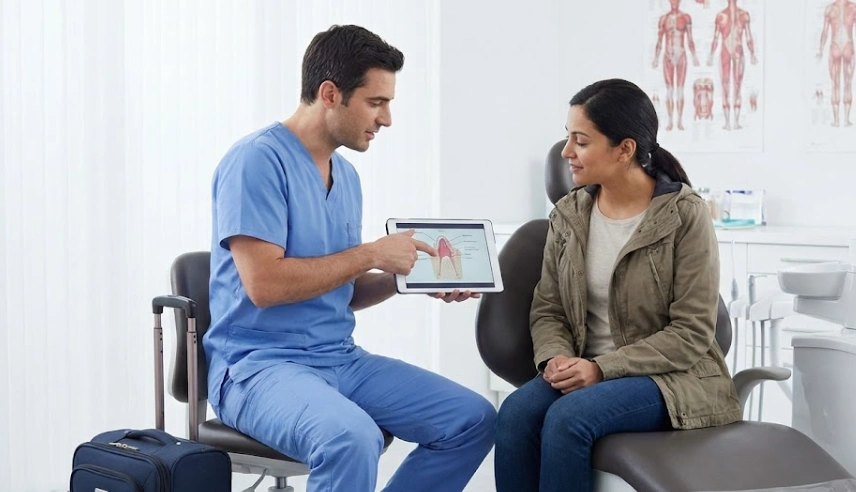
First of all, let’s clear up the biggest dread. Most patients seem to imagine that the cabin pressure will lead to such a violent swelling of their gums or to such a bursting of their stitches that it will resemble an overfilled balloon.
Actually, it is not quite as sensational. Nowadays, airplane cabins are pressurized so as to simulate the altitude of 6,000 to 8,000 feet. Gases do expand slightly (Boyle’s Law), but the gums and the stitches are the two solid areas, rather than one hollow and one filled with gas.
Professor Doctor Coşkun Yıldız quite often refers to this example: “Consider your stitches as a zipper on a jacket. The room air pressure might alter, but the zipper stays mechanically locked. Without trapped air being inside a tooth or sinus, the wound itself is stable.”
Nevertheless, there is an exception. If you have had a Sinus Lift or complicated upper jaw bone grafting, the situation changes. In such cases, the air space in the sinus does get larger. To avoid barotrauma (pressure injury), we require these particular patients to refrain from flying for a specific time period—generally 3 to 7 days.
For the rest of the treatments like standard implants, veneers, or extractions, the time span is significantly reduced.
The One to Blame: Cabin Air
Maybe it’s the pressure that you are obsessed with, but the truth is that dryness is the factor causing this problem. The air inside the plane has only 10-20% humidity, which is a lot drier than even the Sahara Desert.
Dentist Polen Akkılıç points out that oral wounds require moisture for healing. If the dry air dries out the blood clot, the clot will eventually dry up, crumble, and be lost, thus you have become a candidate for “Dry Socket“—an extremely painful condition where the bone is exposed.
During your flight home from Turkey, to stay resilient against this, you may follow the simple regimen we are suggesting:
- Hydrate Intensively: Have a glass of water before and during the flight. Refrain from the consumption of alcohol and tomato juice (too acidic).
- No Suction: Refrain from using straws to drink water. Suction will cause more harm to your stitches than cabin pressure would.
- Nasal Spray: Safeguard your nose from dryness so as avoid mouth breathing, which makes the mouth a wind tunnel.
Flight Safety Windows Comparison
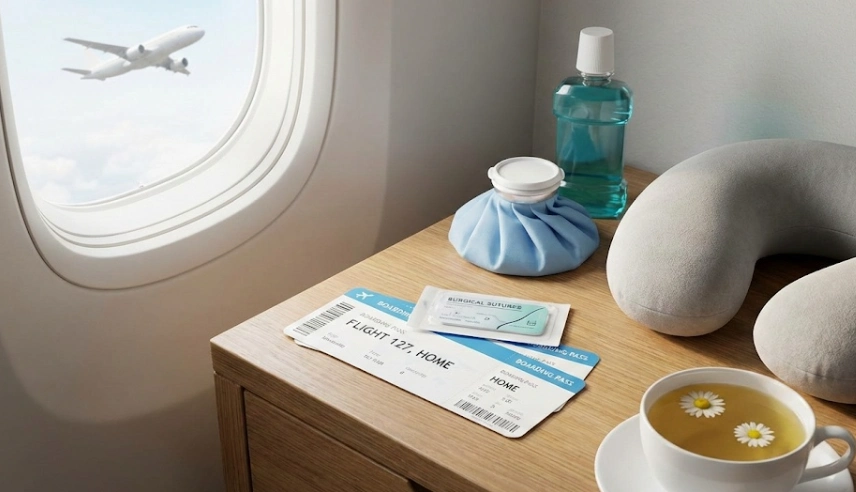
It really matters when to get on the plane. Below is the basic safety protocol employed by Lema Dental Clinic for your various levels of procedural complexity.
| Procedure | Recommended Wait Before Flying | Primary Risk Factor | Key In-Flight Precaution |
| Veneer Prep / Crowns | Same Day (Safe) | Sensitivity to cold air. | Avoid ice in drinks. |
| Simple Extraction | 24 Hours | Bleeding / Dry Socket. | Bite on gauze if needed. |
| Dental Implants (1-3) | 24-48 Hours | Mild swelling. | Keep head elevated. |
| All-on-4 / Full Jaw | 48-72 Hours | Swelling & Comfort. | Use ice packs (ask flight crew). |
| Sinus Lift / Grafting | 3-7 Days | Barotrauma (Sinus Pressure). | Strict adherence to surgeon’s timeline. |
Handling In-Flight Emergencies
Even with perfect preparation, things can happen. If you feel a trickle of blood or a throb of pain over the Atlantic, do not panic.
We pack our patients’ carry-on bags with a “Survival Kit.” If you notice bleeding, it is usually just superficial oozing caused by the increase in heart rate or exertion from walking through the terminal. The solution is mechanical pressure. Take a sterile gauze pad (or a wet black tea bag if you are desperate—the tannins help clotting) and bite down firmly for 30 minutes. Do not check it every 5 minutes. Constant pressure signals the body to seal the leak.
Critical Queries on High-Altitude Healing
No. Surgical sutures (whether silk or dissolvable) are mechanically strong. The tension required to snap a suture is far higher than the subtle tissue expansion caused by altitude. The sensation of “tightness” you might feel is usually due to mild fluid retention (edema), not the stitches failing.
Severe hemorrhage is extremely rare 24 hours post-op. However, if firm pressure with gauze for 45 minutes doesn’t stop it, inform the cabin crew. They have medical kits and can provide ice. Keeping your head elevated above your heart (do not recline fully) will also lower the blood pressure in your head and slow the bleeding.
Absolutely. In fact, we recommend taking a dose of your prescribed anti-inflammatory (NSAID) 30 minutes before boarding. The change in pressure can trigger mild inflammation, and staying ahead of the pain is easier than chasing it. Just ensure you have eaten something small to protect your stomach.
This is a classic worry. Dental implants are made of titanium, which is non-magnetic. You will not set off the metal detector, and the millimeter-wave scanners will not damage the implants or the stitches. You do not need to carry a “medical card” for your teeth.
Be very selective. Airplane bread rolls are notoriously hard/stale, and the snacks are often crunchy. Stick to soft foods (yogurt, pasta, eggs). If the meal is tough, skip it. The mechanical damage from chewing hard food in a cramped seat is a bigger risk to your stitches than the altitude.
- Zadik, Y. (2009). Barodontalgia: what have we learned in the past decade? Oral Surgery, Oral Medicine, Oral Pathology, Oral Radiology, and Endodontology, 107(4), e1-e5.
- Kollmann, W. (1993). Incidence and possible causes of dental pain during simulated high altitude flights. Journal of Endodontics, 19(3), 154-159.
- Lurje, D., et al. (2021). Safety of air travel after oral surgery: A systematic review. International Journal of Oral and Maxillofacial Surgery, 50(9), 1210-1216.
- Robiony, M., et al. (2009). The “airplane” effect on the sinus membrane during sinus lift procedure. Journal of Oral and Maxillofacial Surgery, 67(11), 2561-2562.
- Holtzman, L., et al. (2012). Barodontalgia: The dentist’s role in diagnosis and management. Journal of the Canadian Dental Association, 78, c12.

