


After braces, soreness, poking wires, gum irritation, and loose brackets may occur.
Let’s be frank for a second. You exit the clinic with a brand new purpose and are truly ecstatic about the future of your smile. Yet, some four hours later it happens that the anaesthetic finishes, the reality sinks in and you ponder, “What on earth have I done?”
At Lema Dental Clinic, we treat several thousand patients annually who come to Turkey for smile transformations. Whether it is Dr. Polen Akkılıç and her team making aesthetic adjustments, or you are going through complex orthodontics, biologically the situation is the same. Your body experiences an alien element and it will need some time to get used to it.
Most problems will return to normal after a while, and the great news is that! But it is very important to understand the distinction between “just a little pain” and “a real medical emergency”. This is what happens in our office and the way we handle it.
1. The “Heavy” Sensation and Tooth Mobility
Almost all of our patients first tell us that they experience a very strong pressure sensation in their mouth. A lot of the patients say it to us as if their teeth have gotten “loose” or ”floating”.
Indeed, that is what is happening.
Consider your tooth as a fence post that has been buried in the ground (jawbone). In order to move the post, you would need to loosen the earth around it wiggling it from side to side. In orthodontics, we use the force on the ligament surrounding the tooth by pulling it, as explained above.”I normally point out that this feeling of mobility is a sign that the treatment is going well. It shows that the bone is altering its shape. If the teeth do not become slightly, then it means they are not moving. Usually, this feeling reaches its peak at the 2nd or 3rd day of treatment and then it gets very comfortable after the first week.’, Professor Doctor Coşkun Yıldız remarks.
2. Soft Tissue Trauma: The “Callus” Phase
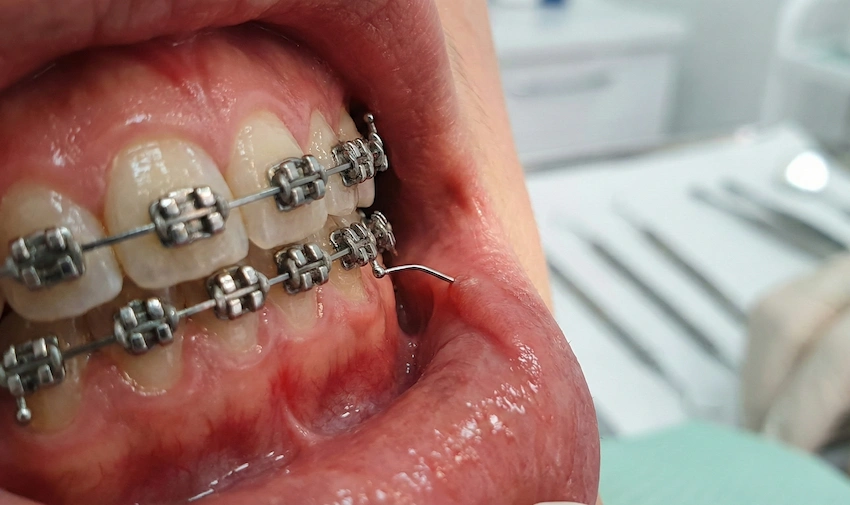
Your cheeks and lips are very sensitive after the treatment. Putting metal or ceramic brackets on there is something the tissues didn’t expect. This is why the inner parts of your cheeks become red, some small cuts here and there" ( ulcers" ) which hardly bother you are formed as the brackets rub the tissue. Here we compare it to playing guitar for the first time. At the beginning, the guitar strings make your fingertips sore, but with time you get used to it and then you don’t even feel the pain because your fingertips have hardened. That is, your mouth will form a callus and have a protective cover after some time.
Here is the instruction in the meantime:
- Orthodontic Wax: What is the use of suffering? Apply a thick layer of wax on the bracket that irritates the inside of your mouth and the discomfort will disappear.
- Salt Water Rinses: Warm salt water is an excellent natural disinfectant. It heals oral mucosal wounds fast.
3. The Hygiene Trap: Demineralization (White Spots)
This matters the most to us. It keeps our heads spinning at night.
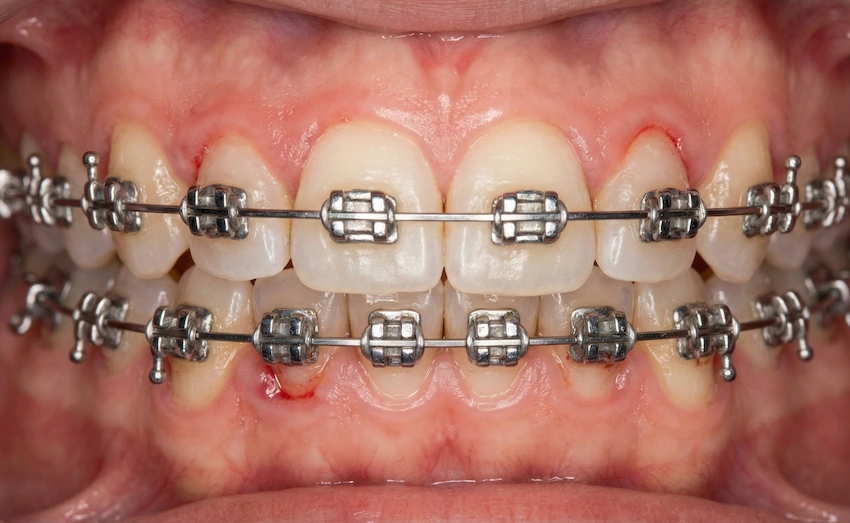
Braces form several tiny spaces, which is why food leftovers tend to stay there. If the plaque is allowed to stay on the bracket for a longer time, the acid it makes will lead to the degradation of enamel. Then, “white spot lesions” or scars will come out on your teeth. The scars remain even when your braces are taken off.
At Lema Dental Clinic we don’t just say that brushing your teeth is no longer a twice-a-day habit, but an event that necessarily follows each meal. In case you ignore this, you will have irresistibly nice teeth but without the necessary structure for them to hinder.
4. Speech Impediments and Excess Saliva
If you find yourself with speech impediments and dew-drooling, it’s because of your brain’s confusion. It treats your braces as if they were new food or some unknown item, and thus it commands the salivary glands to produce more saliva so that the glands “digest” or “flush” it out.
The lisping happens because your tongue, which is a creature of habit, hits the brackets instead of the back of your teeth when you say ‘S’ or ‘T’. This is old muscular memory. If you read a book aloud for 10 minutes daily, your tongue will adjust the positioning within a week.
Quick Guide: Discomfort vs. Emergency
Knowing when to call the clinic is so important. Here is a list of the most common post-installation situations.
| Symptom | Cause | Action Required | Urgency Level |
| General soreness | Teeth shifting / bone remodeling | Soft diet, OTC pain relievers (e.g., ibuprofen) | Low (Normal) |
| Poking wire | Wire shifting or breakage | Apply orthodontic wax; if unavoidable, sterilized nail clippers may be used to cut the wire | Medium |
| Bleeding gums | Gingivitis / poor brushing | Floss thoroughly; improve oral hygiene immediately | Medium |
| Loose bracket | Eating hard foods/bond failure | Keep the bracket safe; contact the clinic to schedule repair | High |
| Severe facial swelling | Infection or allergic reaction | Contact Lema Dental immediately | Emergency |
5. Jaw Pain and Headaches
Since the upper and lower jaws are being forcibly aligned, the muscles that function in chewing (masseter and temporalis muscles) may become tired and spasm. Such a situation can be represented by headaches due to muscle tension or soreness close to the ear.
According to Professor Doctor Coşkun Yıldız this is a neuromuscular adaptation. Your legs get sore after running a long way in the same way your jaw hurts following a day of “hard work” (teeth moving). Heat packs on the jaw area will be quite effective.
FAQ: The Doctor’s Perspective
The very first 72 hours are the most difficult – the time when the inflammatory response reaches the peak. Around day five, you will experience a lowering of the sensitivity to a certain extent. Day 14 is the time when most of the patients momentarily forget that they have a brace on until their next appointment.
No, not really. The first week you should stay away from chewing foods. You can eat mashed potatoes, soups, have smoothies and eat yogurts. If you really want to chew steaks at the moment, you will be sorry very quickly. Consider it as giving a holiday to your periodontal ligaments.
The most effective solution is orthodontic wax. First, completely dry the wire and bracket with a tissue (wax won’t stick to a wet surface). Then, roll a pea-sized piece of wax in your hand and press it onto the affected area. This will create a soft barrier between the wire and your cheek.
Many patients worry about this issue! Seriously, the first time, yes, you will be very aware of the metal. But after a while, just like eating and talking, you get used to it. It hardly ever remains an issue after a couple of weeks.
The answer is Yes. There is no way out. Flossing is quite a difficult task when you have braces on, but if you fail to do so, swollen and bleeding gums will eventually grow over your brackets (hyperplasia). Your best bet is a water flosser if it’s too much trouble to thread the floss manually—it’s a good buy for orthodontic patients.
- Krishnan, V., & Davidovitch, Z. (2009). Biological mechanisms of tooth movement. Wiley-Blackwell.
- Johal, A., Alyaqoobi, I., Patel, R., & Cox, S. (2015). The impact of orthodontic pain on quality of life in adult patients. European Journal of Orthodontics, 37(3), 233-237.
- Ren, Y., Jongsma, M. A., Mei, L., van der Mei, H. C., & Busscher, H. J. (2014). Orthodontic treatment with fixed appliances and biofilm formation—a potential public health threat? Clinical Oral Investigations, 18(7), 1711-1718.
- Brezniak, N., & Wasserstein, A. (2002). Root resorption after orthodontic treatment: Part 1. Literature review. American Journal of Orthodontics and Dentofacial Orthopedics, 103(1), 62-66.
- Proffit, W. R., Fields, H. W., & Sarver, D. M. (2018). Contemporary Orthodontics (6th ed.). Elsevier.

