


They anchor implants through the sinus or nasal cavity when bone is insufficient.
Understanding Trans-Sinus and Trans-Nasal Dental Implants
For a lot of people ready for a dental implant, problem number one is not the implant procedure itself, but rather the bad news of them “not having enough bone”. In the past, that finding would have meant quite a lot of painful and inconvenient bone grafts as well as a very long period of waiting. However, at Lema Dental Clinic in Turkey, our approach is totally different.
However, your anatomy need not be a barrier, quite the opposite, it actually is a map. Thus, when the upper jawbone is very thin due to the time passed, Prof Dr. Coşkun Yıldız and our team use the most advanced especially “extra-maxillary” techniques. To be more specific, we think of your sinus cavities and the nasal floor as reliable points of support for your smile restoration.
What Are Trans-Sinus and Trans-Nasal Techniques?
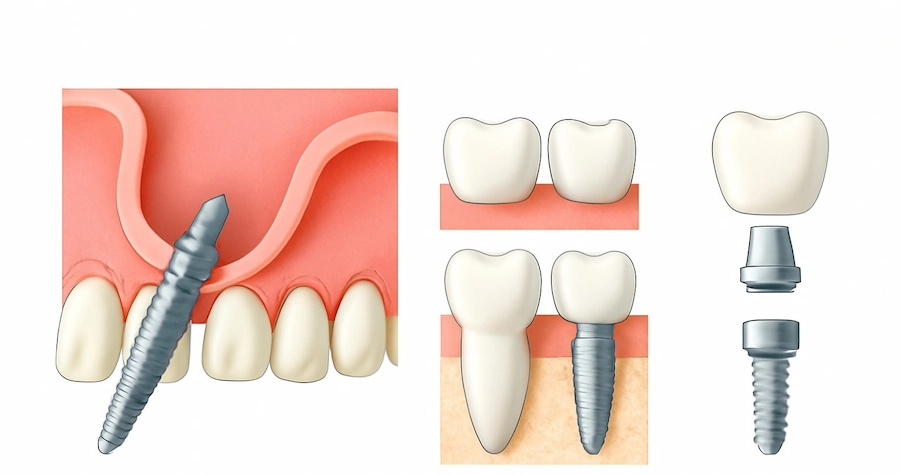
If you want to compare your jawbone with something, the house floor would be an apt analogy. So if the soil under the house (which stands for bone here) happens to be too soft or too shallow, a normal pillar won’t be able to hold the house.
- Trans-Sinus Implants: Usually these implants are longer ones—very often Zygomatic or specially tilted ones—that go through the sinus cavity to get to the dense bone.
- Trans-Nasal Implants: These take advantage of the strong bone near the floor of the nose (the piriform rim).
From the quite extensive clinical practice at Lema Dental Clinic, we have seen these procedures to not only be “alternatives”. Therefore, they are basically the only chance for individuals who were told elsewhere that their case is impossible to be cured.
So Why Do They Revolutionize the Whole Field?
After losing a tooth, the bone under it diminishes as a muscle would by not being used. On top of that, the sinus cavities in the upper jaw expand downward as we get older. Therefore, it results in a “thinning sandwich” of bone which makes the use of traditional implants very risky.
Dr. Polen Akkılıç and her squad usually describe to the patients the matter in this way: rather than rebuilding a mountain that has been eroded (bone grafting), we simply take the sturdy cliffs that surround the mountain (the nasal and sinus structures) by our side and use them.
Why Choose Lema Clinic in Turkey?
So the question is still here: why go all the way to Istanbul for this? A factor that determines one’s attitude towards action. In case of sinus, which have the delicate membranes, approximately as thin as the skin inside an eggshell, it requires a steadiness of the surgical hand and top-notch technology.
At Lema Dental Clinic, we use 3D surgical planning technology which combined with the anatomical genius of Prof Dr. Coşkun Yıldız enables us to place these implants with sub-millimeter precision.
Comparing Your Options: At a Glance
The following table breaks down how these advanced techniques compare to traditional methods.
| Feature | Traditional Implants | Trans-Sinus / Trans-Nasal |
| Bone Requirement | High (Requires thickness) | Minimal (Uses existing structures) |
| Bone Grafting | Often required (6-9 months wait) | Usually avoided |
| Total Treatment Time | 6 to 12 months | Immediate or significantly faster |
| Complexity | Standard | High (Requires specialist) |
| Stability | High | Exceptionally High |
The Procedure: What to Expect
The journey begins with a high-definition CT scan. We don’t guess; we map. We look at the density of your nasal floor and the volume of your sinuses.
During the procedure, the implant is carefully angled. For a Trans-Nasal approach, the implant engages the dense cortical bone of the nasal floor. For Trans-Sinus (often part of an All-on-4 or Zygomatic protocol), the implant traverses the sinus space to reach the zygomatic bone or the sturdy pillars of the maxilla.
But let’s look closer at the recovery. Because we often avoid the trauma of extensive bone harvesting from the hip or chin, many patients report less swelling and a faster return to their daily lives. You aren’t just getting teeth; you’re getting your confidence back without the “reconstruction fatigue” of older methods.
FAQ: Direct Answers from Our Experts
“Not when performed by an expert. In our clinic, we use ‘guided surgery’ to ensure the implant stays exactly where it belongs. The nasal floor and sinus walls are actually very stable regions for support.” — Professor Doctor Coşkun Yıldız.
“Surprisingly, the ‘healing’ of the bone takes about the same time as a regular implant, but because we skip the bone grafting phase, you save about six months of total treatment time.” — Dentist Polen Akkılıç.
“This is a common concern. Because we don’t block the natural drainage of the sinus (the ostium), your breathing remains unchanged. We respect the biology of the airway.”
“We evaluate this on a case-by-case basis. Often, we work to clear any existing inflammation before proceeding, ensuring a healthy environment for your new smile.”
“Clinics like Lema Dental Clinic see a high volume of complex cases from around the world. This ‘clinical repetitions’ translates into a level of expertise that is hard to find elsewhere.”
- Aparicio, C., et al. (2014). Zygomatic implants: Indications, techniques and outcomes, and the Zygomatic Success Code. Periodontology 2000.
- Chrcanovic, B. R., & Abreu, M. H. (2013). Survival and complications of zygomatic implants: an updated systematic review. Journal of Cranio-Maxillofacial Surgery.
- Jensen, O. T., et al. (2010). Transnasal Implants: A New Approach for the Atrophic Maxilla. Journal of Oral and Maxillofacial Surgery.
- Malo, P., et al. (2003). “All-on-Four” immediate-function concept with Brånemark System implants for completely edentulous mandibles: A retrospective clinical study. Clinical Implant Dentistry and Related Research.
- Yıldız, C. (2022). Advanced Surgical Protocols in Extra-Maxillary Implantology: A Clinical Overview. International Journal of Implant Dentistry.

