


Dentists classify tooth decay into six types by location and depth for proper treatment.
Hearing that you have a “cavity” can be very unsettling. The initial thought that most people get is of a small black spot on a molar. However, a dental cavity can be different in each tooth to some extent. It is just like rust on a car. First, it is only a small spot on the surface,e whereas internally it can be much larger.
We at Lema Dental Clinic in Turkey, through our clinical experience,ce have seen that the first step in making a smile beautiful again is to determine the exact nature of the decay. We have to be sure about which parts of the tooth are broken to reconstruct the tooth.
Professor Doctor Coşkun Yıldız points out that dentists ought to have a precise chart for accurately repairing a tooth. Worldwide, dentists have been using a simple method to denote the location and the extent of the decay. This chart guides us in choosing the appropriate instruments and making the decision if the patient requires a small filling or a durable new crown.
Tooth Care Chart: 6 Cavity Types
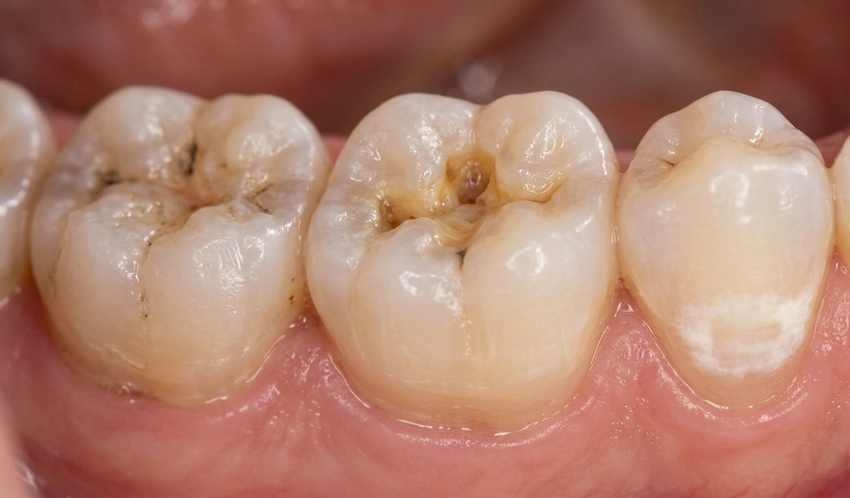
More than a century ago, a dentist,t Dr. G.V. Bla,ck invented a tooth decay chart. It is still in use by the dentists. Below is the breakdown of the most common types we see daily at the clinic in an easy way:
Class I: The Biting Surface
Cave formations can be formed in the tiny cracks and grooves on the chewing surfaces of molars and premolars. The bristles of a toothbrush are generally too thick to reach inside these extremely narrow cracks, which is why it is quite easy for food debris and bacteria to accumulate.
Class II: Between the Back Teeth
This type of decay occurs in the very tight spaces between the back teeth. They can be very deceptive. You cannot see these in a mirror. We can only detect them by taking the dental X-rays. This is the very reason why dental flossing is your weapon against this decay.
Class III & IV: The Front Teeth
These are the cavities of the front teeth. Class III cavities are on the sides, between the teeth. Class IV cavities are larger and incorporate the biting edge of the front tooth. Restoration of these teeth requires a great deal of artistic skill to match the filling to your natural smile.
Class V: At the Gum Line
These cavities develop right where the tooth meets the gum. They are probably caused by frequent consumption of soda and/ or by brushing so hard that the protective outer layer of the tooth is worn away.
Class VI: The Tooth Tips
This type of decay is located on the very tips or points of the teeth. In most cases, it is seen in those who grind their teeth during sleep. Grinding causes the enamel layer to be gradually worn down and provides a gateway for bacteria.
How Deep Is the Cavity?

To know the exact location of the cavity on the surface is only a part of the information. The crucial one is how much depth the decay has reached. Let’s compare your tooth to a building that has three layers to protect the innermost part.
- Enamel (The Outer Wall): This is the white, hard shell covering the tooth. If it is decay in this area, it often appears as a white chalky spot. Interventions with fluoride may stop it from the need for a drill.
- Dentin (The Inner Room): Once bacteria have broken down the enamel, they get to a layer that is softer and yellower called dentin. Here, decay progresses quite rapidly. It is usually the time when the tooth becomes sensitive to cold and sweet.
- The Pulp (The Center): This is when the bacteria have reached the very heart of the tooth, i.e, the nerves and blood vessels. It will result in very intense pain. One cannot get rid of the problem with a simple filling. A root canal will be necessary to remove the infection.
Dentist Polen Akkılıç and her team of professionals rely on cutting-edge 3D scanning tools to get an accurate depth view of the cavity. They make the scans for their international patients even before they arrive for the dental treatment, so they are not surprised.
Quick Guide to Cavity Types
| Cavity Type | Where is it? | Can you see it? | How do we fix it |
| Class I | Top biting grooves | Yes, during a dental check-up | Simple tooth-colored fillings |
| Class II | Between the back teeth | No, requires an X-ray | Fillings or strong custom inlays |
| Class III | Between the front teeth | Sometimes, if it gets big | Highly aesthetic front fillings |
| Class IV | Edges of front teeth | Yes, very easy to see | Bonding, veneers, or crowns |
| Class V | Right at the gumline | Yes, looks like a tiny notch | Gumline fillings and fluoride |
| Class VI | Tips of the teeth | Yes, looks like flat wear | Crowns to protect the tooth |
Frequently Asked Questions
Indeed. Your tooth enamel is a hard and insensitive layer. A cavity may lead to a significant hole in this layer without you experiencing any discomfort at all. There will only be the sensation of pain when the decay reaches the inner, softer layers. This is why dental X-ray examinations are so important.
Unlike a skin wound that normally heals by itself, a tooth usually doesn’t heal on its own. On the other hand, if the tooth has only a minor issue and the surface layer or enamel is not broken, then the tooth could be strengthened,d and the tooth decay could be prevented from spreading further by using fluoride.
If the cavity is very large, the most common type of filling will be insufficient. It is similar to patching a big hole in the wall with a small piece of plastic, er and the result will be the breaking of the wall. A crown is like a robust helmet that surrounds and safeguards the whole tooth.
We aim to be transparent and open with our foreign patients. Knowing the exact type of your cavity will enable us to inform you of the duration of the treatment and the specific price, even before you reserve your plane ticket.
Not necessarily. If the decay is very deep but the pulp has not been affected, it is possible to put a special medicine inside the tooth to soothe the pulp before we do the filling. But when it is the pulp that is infected, root canal treatment is the only option for keeping the tooth.
- Black, G. V. (1908). A Work on Operative Dentistry: The Technical Procedures in Filling Teeth. Medico-Dental Publishing Company.
- Mount, G. J., & Hume, W. R. (1998). A new cavity classification. Australian Dental Journal, 43(3), 153-159.
- Kidd, E. A. (2005). Essentials of Dental Caries: The Disease and Its Management (3rd ed.). Oxford University Press.
- Pitts, N. B. (2004). Modern concepts of caries measurement. Journal of Dental Research, 83(1_suppl), 43-47.
- Ismail, A. I., Sohn, W., Tellez, M., Amaya, A., Sen, A., Hasson, H., & Pitts, N. B. (2007). The International Caries Detection and Assessment System (ICDAS): an integrated system for measuring dental caries. Community Dentistry and Oral Epidemiology, 35(3), 170-178.

