


Titanium dental implants permanently halt jawbone loss by stimulating natural bone growth, whereas traditional dentures do not.
The lack of any natural support for teeth (complete or partial) in the mouth sets off a sequence of events in the body called bone resorption of the alveolar process. In order to prevent this biological degradation, restorative techniques should not only be superficial prosthetic solutions but also consider and manage the biomechanics related to the underlying structure.
The Etiology of Alveolar Ridge Resorption
Wolff’s Law is basically a rule of the human body where the bones get used to the kind of loads or forces that our bodies apply on them which result in their remodeling, or keeping the same density.
When one chewing a food with teeth, periodontal ligament acts as a shock absorber and transmits the forces of mastication to the surrounding alveolar bone as a tensile stress. These kinds of mechanical stresses regularly induce osteoblasts (bone forming cells) to produce bone matrix on a regular basis. Once a tooth has been extracted, such a mechanical stimulus becomes nonexistent. The imbalance results in increased osteoclast activity that ultimately leads to rapid, irreversible deterioration of jawbones in terms of both height and width.

The Biomechanical Deficiencies of Traditional Dentures
We often overlook that the placement of conventional removable dentures merely as dental prostheses cannot only maintain the normal functional condition of the mouth, but the bone will be safeguarded at the same time. Unfortunately, it is the other way around.
Mucosa-borne is an essential characteristic of conventional dentures. The entire weight of the denture is placed on the soft tissues of the gums. There is absolutely no functional loading of the residual bone. However, when a patient bites with conventional dentures, the pressure of a denture is put on the soft tissues of a bone ridge, in a rather unnatural way, causing a severe non-physiologic compressive effect on a jaw. The continuous pressure results in poor blood supply (ischemia) thus bone destruction by osteoclasts increases. With time, the face’s shape will be the consequence of such resorption with the lower area shrinking inward—a condition commonly described as facial premature aging or pseudo-prognathism.
Osteogenesis Through Osseointegration
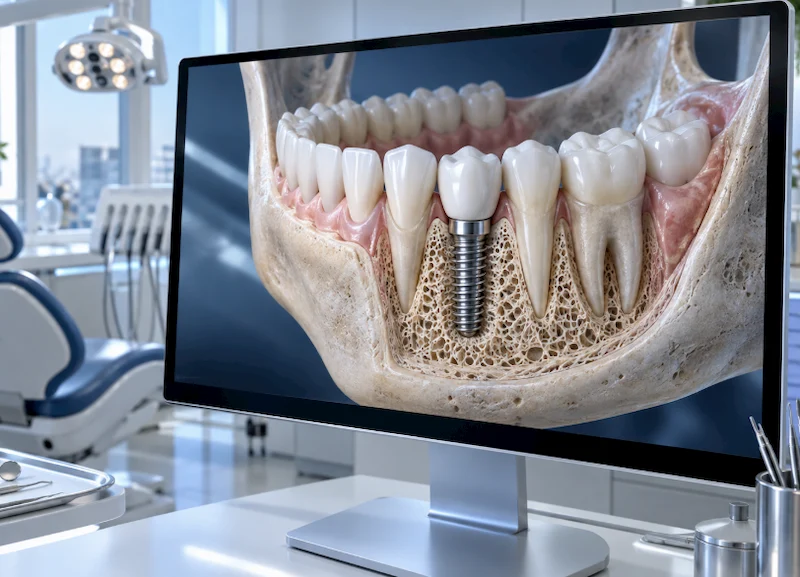
Closing the alveolar bone loss and maintaining it requires the prosthesis to replace the functional and structural properties of the tooth root. Titanium dental implants fulfill these roles by means of a cellular mechanism known as osseointegration that has been thoroughly studied.
The process begins by placing a biocompatible titanium device which is a part of a system of maxilla or mandible, the bone cells multiply and join with the surface having micro-roughness of the implant. Professor Coşkun Yıldız explains that implants placed in a bony framework transmit chewing forces as tension to bones which in turn maintain the bone density through the biological mechanism of bone remodeling.
At Lema Dental Clinic, restoring this biomechanical function requires immense diagnostic precision. Dentist Polen Akkılıç utilizes advanced 3D Cone Beam Computed Tomography (CBCT) to map volumetric bone density before surgery. This ensures that international patients traveling to Turkey receive implant-supported restorations that optimize occlusal force distribution and guarantee long-term maxillofacial stability.
Clinical Efficacy: Mucosa-Borne vs. Implant-Supported
| Biomechanical Metric | Conventional Dentures (Mucosa-Borne) | Dental Implants (Bone-Anchored) |
| Alveolar Bone Preservation | Accelerates resorption due to compressive loading. | Halts resorption via internal tensile stimulation. |
| Masticatory Efficiency | Recovers only 20% to 30% of natural bite force. | Recovers 90% to 100% of maximum bite force. |
| Proprioception & Sensation | Severely blunted due to palatal coverage. | Maintained, allowing for natural bite feedback. |
| Prosthetic Stability | High micromotion; reliant on suction or adhesives. | Absolute rigid fixation within the cortical bone. |
Frequently Asked Questions
1. Why does the jawbone shrink after tooth extraction?
Jawbone density is maintained by the mechanical stimulation provided by tooth roots during chewing. Following an extraction, the loss of this internal stimulation triggers the body to resorb the inactive bone tissue, a physiological process that leads to significant dimensional loss of the alveolar ridge within the first six months.
2. Can dentures be modified to stop bone resorption?
No. Regardless of how well a conventional denture is relined or fitted, it remains a tissue-supported device. Because it sits on top of the gums rather than integrating into the bone, it cannot provide the internal mechanical stress required to prevent osteoclastic bone loss.
3. Is bone grafting necessary if I have worn dentures for years?
Often, yes. Long-term denture wearers typically present with severe alveolar ridge atrophy. To successfully place a titanium implant, a sufficient volume of cortical and cancellous bone is required. Bone grafting or sinus lift procedures are highly effective clinical interventions to regenerate this lost volume prior to implant placement.
4. How do dental implants biologically prevent bone loss?
Titanium implants undergo osseointegration, fusing directly with the surrounding bone matrix at a cellular level. This allows the implant to act as an artificial root, transferring chewing forces deep into the jawbone. This functional loading stimulates osteoblast production, thereby maintaining healthy bone density and preventing structural facial collapse.
Academic References
- Carlsson, G. E. (2014). Responses of jawbone to changing dentition. Clinical Oral Implants Research, 25(S10), 11-15.
- Wolff, J. (1986). The Law of Bone Remodeling. Springer-Verlag. (Original work published 1892).
- Branemark, P. I., Hansson, B. O., Adell, R., Breine, U., Lindstrom, J., Hallen, O., & Ohman, A. (1977). Osseointegrated implants in the treatment of the edentulous jaw. Experience from a 10-year period. Scandinavian Journal of Plastic and Reconstructive Surgery. Supplementum, 16, 1-132.
- Tallgren, A. (1972). The continuing reduction of the residual alveolar ridges in complete denture wearers: A mixed-longitudinal study covering 25 years. The Journal of Prosthetic Dentistry, 27(2), 120-132.

