


A sleep apnea implant helps keep the airway open during sleep.
If you do not get proper sleep, your sleepless days can ruin your daytime work and your energy. Sleep apnea is not merely making you tired. It is actually an ongoing struggle for breath throughout the night. In the past, almost every sleep doctor prescribed a CPAP machine. But let’s get the details right. Many people do not like sleeping with a tight mask on their face.
Lema Dental Clinic, we’ve had lots of patients coming in complaining of fatigue. They have given up on these bulky CPAP machines – one of them wants an invisible and reliable solution that he can have once and for all – in short, a sleep apnea implant. Here we are.
“Professor Doctor Coşkun Yıldız said that ‘sleep apnea is more than just loud or annoying snoring; it is a physical blockage of the airway that needs some kind of surgery.’
Now, let’s have a look at the implant in detail: we will see how this piece of metal solves the problem, and we will also be warned about some consequences or side effects of the implant.
What Is a Sleep Apnea Implant?

Your tongue is a large muscular flap. Imagine a heavy oak door swinging open and shut. The doorway that the airflow normally follows is the airway. When you sleep, your muscles relax, which causes the ‘oak door’ to pull back and obstruct the airway. As a result, you stop breathing. Your brain then recognizes the situation as dangerous and awakens you with a gasp.
A sleep apnea implant is a so-called ‘ pacemaker for your tongue’. It is a totally new technique – a surgically inserted implant that is harmless. It monitors the breathing cycle from inside your body when it detects that you are breathing in. It sends a very tiny electric pulse to the nerve that causes the tongue movement. This gentle stimulation makes the tongue move forward, and the doorway opens again, thus allowing you to continue breathing naturally.
How It Works: The Parts of the Device
In short, the implant comes in three easy pieces:
- The Sensor: It is placed on the chest wall and monitors breathing in and out.
- The Battery: It is placed under the collarbone to power the entire machine.
- The Lead: It is located around the muscle you use to open your jaw and mouth.
All you need to do is turn it on remotely. Once on, it starts waiting for you to fall asleep to start working at night, and then it will help open the airway.
The Surgery Procedure in Turkey
This is how a typical case of sleep apnea is managed at our clinic, i.e., a coordinated effort among a group of doctors. It is Dentist Polen Akkılıç and her dental department team who have worked closely and in synergy with the surgical doctors in Turkey. In fact, we start our analysis with the big picture, like any builder inspecting a house’s foundation. The jawbone, for example, or a narrow palate will change how we develop our treatment plan.
After determining that an implant is a suitable treatment method, the entire surgery takes only one and a half to two hours. You can rest assured that you will be anesthetized throughout the intervention. Even though you get the implant and leave the hospital on the day itself, we still prefer a four-week rest period for your body before we turn on the device.
Side Effects & Risks
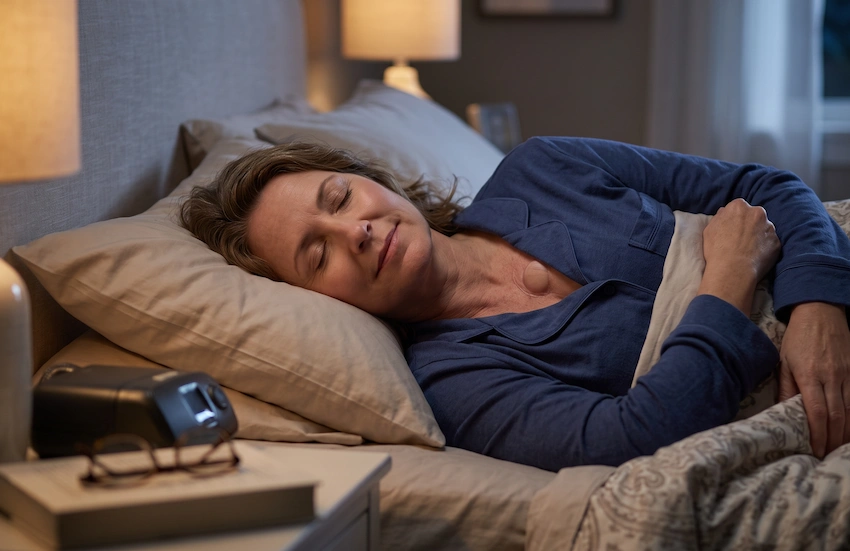
Not all major surgical procedures are without hazards. Now, we raise with patients the possible complications of a surgical procedure. So, is it a safe thing to get a sleep apnea implant?
Absolutely. Based on many clinical trials, it is considered very safe for patients receiving it. However, it is also important to know what risks you are taking by getting the implant.
- Weird Feel: There will come a time when you will notice that your tongue is on the move.
- Brush Your Tongue: Because your tongue can press on the bottom front teeth at night. A custom-made tongue guard by Dentist Polen Akkılıç and her team often protects your lingual tissue from your teeth while you get used to it.
- Ordinary Surgery Side-Effects: There may be minimal swelling or, in rare cases, an infection at the operative sites.
- Battery Renew: Estimated battery life is 11 years. Replacing the battery takes a couple of minutes.
Comparing Your Options
Patients from all walks of life who come into this country and want our attention frequently have inquiries about the implant versus alternative treatments.
| Feature | CPAP Machine | Oral Appliances | Sleep Apnea Implant |
| How It Works | Forced air pressure | Holds jaw forward | Nerve stimulation |
| Everyday Maintenance | Takes a lot of daily work | Reasonably good for daily maintenance | Does not require frequent maintenance |
| Method of Treatment | External to the body | Inside your mouth | Operation |
| Success Rates | Often it fades | Satisfaction is moderate | Very high satisfaction is shown |
| Most Suitable Cases | Every case of sleep apnea is eligible for this treatment | Clients with mild to moderate sleep apnea conditions | Candidates with mild-to-severe sleep apnea are suitable |
Frequently Asked Questions
Does the electrical stimulation from the pulse cause discomfort?
No, in fact, the feeling is rather like a gentle movement. We start with a very low-intensity electrical pulse so you can get the feel before it is powerful enough to awaken.
Can I undergo a scan like an MRI?
Yes, in fact, most current machines are designed not to interfere with MRI scanning. We have been using only state-of-the-art and safe products in our clinic.
Is this a procedure that is generally accepted only, or are there eligibility criteria?
Not at all. First, you need to maintain a BMI below 35. Then, you are expected to be the sort of patient who tried and failed to adjust to using the CPAP machine. First, you will be tested to determine whether your body is compatible with it.
How fast is recovery after the procedure carried out in Turkey?
We consider it very fast, as you can complete light work in a short time. Only remember to refrain from lifting heavy stuff during these initial three weeks, as the wires can get dislodged from the healing area.
Will other persons be able to discern that I have a sleep apnea implant?
There is no way that it could be visible since the wounds are tiny and well concealed in the folds of your skin. Besides that, the battery is deeply covered underneath the skin.
References
- Strollo, P. J., Soose, R. J., Maurer, J. T., de Vries, N., Cornelius, J., Froymovich, O., … & Woodson, B. T. (2014). Upper-airway stimulation for obstructive sleep apnea. New England Journal of Medicine, 370(2), 139-149.
- Woodson, B. T., Strohl, K. P., Soose, R. J., Gillespie, M. B., Maurer, J. T., de Vries, N., … & Strollo, P. J. (2018). Upper airway stimulation for obstructive sleep apnea: 5-year outcomes. Otolaryngology–Head and Neck Surgery, 159(1), 194-202.
- Certal, V. F., Zaghi, S., Riaz, M., Vieira, A. S., Pinheiro, C. T., Kushida, C., … & Camacho, M. (2015). Hypoglossal nerve stimulation in the treatment of obstructive sleep apnea: a systematic review and meta-analysis. The Laryngoscope, 125(5), 1254-1264.
- Heiser, C., Maurer, J. T., Hofauer, B., Sommer, J. U., Seitz, A., & Steffen, A. (2017). Outcomes of upper airway stimulation for obstructive sleep apnea in a multicenter German postmarket study. Otolaryngology–Head and Neck Surgery, 156(2), 378-384.
- Thaler, E., Schwab, R., Maurer, J., Soose, R., Larsen, C., Stevens, S., … & Boon, M. (2019). Results of the ADHERE upper airway stimulation registry and predictors of therapy efficacy. The Laryngoscope, 130(5), 1333-1338.

