


Natural teeth prevent bone loss and facial collapse.
At the moment when a toothache becomes unbearable – that pain that’s so intense and constant that it even wakes you up at night – your brain stops working properly. Basically, all you can think about is how to get rid of the pain. Patients come to us at Lema Dental Clinic, Turkey, and are so vulnerable that they almost want to pull out a tooth themselves. It is the fastest way to end the misery and by far the most straightforward solution that a cortically challenged mind can come up with.
Meanwhile, as clinical partners of surgeons such as Professor Doctor Coşkun Yıldız, we must set aside the present pain and consider the next twenty years of your dental life. Choosing between a root canal and an extraction is not simply deciding if you want to stop the pain of a toothache but the road with totally different impacts, e.g., long-term consequences for your jawbone, facial structure, and bank account.
The truth is that nothing created by humans, not even the best dental implant in the world, can ever quite match the original tooth that nature provided you with.
Going Beneath the Surface of a Root Canal
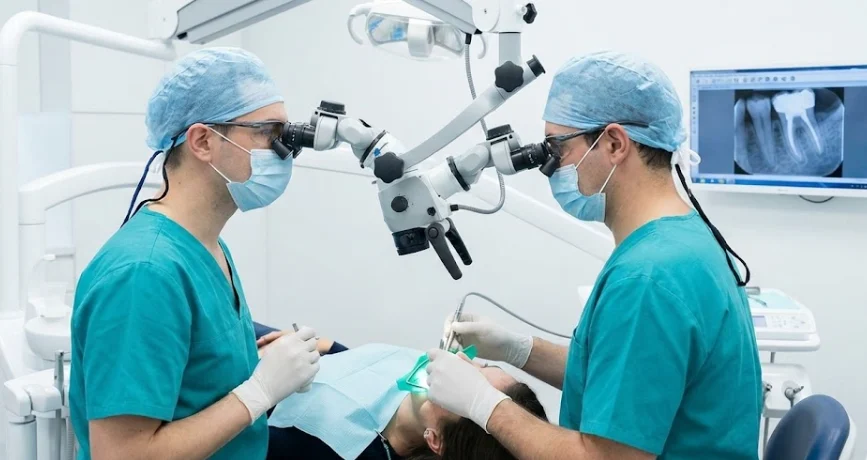
If you listen to the history of the root canal, it has been turned into a villain and here is the reason behind it. However, the opposite of it is true nowadays. In fact, a root canal is the hero in modern medicine.
If a tooth is a house, the very inside parts of it, living there in a hous,e are nerves and blood vessels (pulp). If bacteria manage to get in through a crack or deep decay by the pulp, the pulp can be infected – it is like a fire starting in the living room. That fire alarm which is literally the pain of the tooth is the signal you get when the fire is out of control.
Going for extraction without even considering a root canal is like planning to demolish a whole house just because the fire started in the living room. A root canal done by Dentist Polen Akkılıç and her team, who are experts in the field, is just the procedure where through a tiny opening, the inside is reached and the infected tissue is removed (the fire is put out), the area is sterilized, and it is closed again. The integrity of the house is kept.
Thanks to the use of advanced endodontic equipment and technology here in Turkey, the treatment is hardly ever more painful than having a filling. The treatment goal is pain relief, the pain of treatment itself should be minimal.
But What Really Happens After an Extraction?
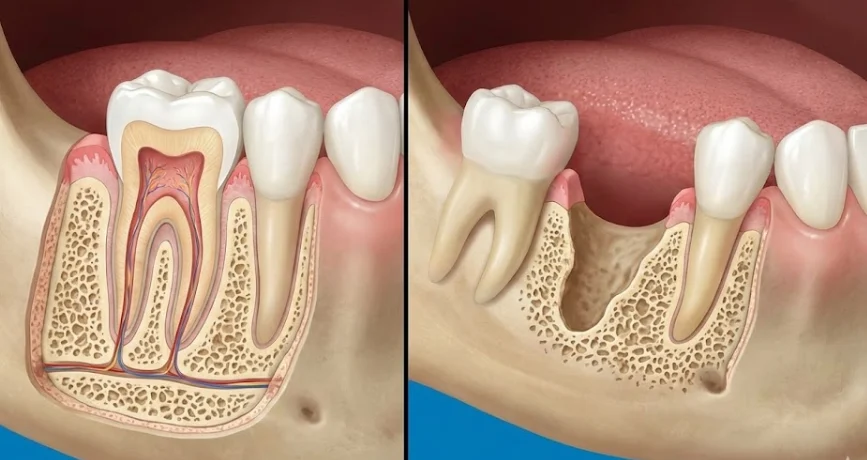
On some occasions, the tooth is so badly broken that there is no other option left than removal. Yet, opting for extraction when the tooth is salvageable is a major mistake as it has several hidden drawbacks.
When a tooth is pulled, what you will lose is more than just the visible white crown. After all, what you will lose is the root that is the mainstay of the jawbone and without the root the rest of the beautiful and functional tooth is worthless.
Jawbone shrinkage due to tooth loss
For the jawbone to retain its density, it needs to be continuously stimulated by the forces of chewing that go down through the root into the bone. Otherwise, it’s simple: if you don’t use a tissue, it dies. From the moment the tooth disappears, the body no longer considers that portion of bone to be necessary.
Like an ice cube on a kitchen countertop, the bone gets resorbed (or “melted away”) gradually. According to Professor Doctor Coşkun Yıldız, the biggest bone loss happens by far in the first 12 months post-extraction, and the amount of bone diminishes to such an extent that placement of dental implants eventually becomes very difficult, or in fact, impossible. Besides this complication, a person can also lose the youthful tightness of the skin due to bone loss that results in the sunken or aged appearance of the face.
The unfavourable consequences of not replacing a lost tooth
Teeth are mainly there to support each other and thus work as a group. When a gap occurs and is left unfilled, it will get closed by the teeth next to it – these teeth will gradually move in the opposite direction of their normal ones, so to try and fill the gap. The tooth that is not in the adjacent area will however, start to come out of its socket in order to be able to be in contact with the drifting teeth. What are the consequences of this? You lose your bite and new decay traps are created.
Comparing Your Options: A Clinical Perspective
We believe in empowering our patients with facts. Here is a breakdown of the immediate and long-term implications of both choices.
| Feature | Root Canal Therapy (Saving the Tooth) | Tooth Extraction (Removing the Tooth) |
| Immediate Outcome | Pain relief; natural tooth remains in place. | Pain relief; a gap is created in the jaw. |
| Impact on Jawbone | Preserves bone density. The root continues to stimulate the jaw. | Accelerates bone loss. The jawbone begins to shrink immediately. |
| Bite Stability | Maintains natural bite alignment and supporting teeth. | Causes adjacent teeth to shift, tilt, and super-erupt. |
| Functionality | Restores near-normal chewing force and sensation. | Chewing ability is compromised unless replaced immediately. |
| Long-Term Cost | Moderate initial cost. Lower lifetime cost if successful. | Lower initial cost. High long-term cost to replace (bridge or implant). |
The Lema Philosophy: Preservation First
At Lema Dental Clinic, our priority is always conservation. We view extraction as a last resort. Why? Because your natural tooth has ligaments that provide a sense of pressure and texture when you chew—something an implant cannot fully replicate.
The question remains: is the tooth structurally sound enough to hold a crown after the root canal? If the answer is yes, we fight to save it. By utilizing microscopes for precision and 3D imaging to navigate complex root systems, our success rates for endodontic therapy in Turkey are incredibly high. We want you to keep your original parts for as long as possible.
FAQ: Straight Answers from the Doctors
This is the biggest myth in dentistry. The pain comes from the infection before the procedure. The root canal treatment itself, done with modern anesthesia, actually relieves that pain immediately. Most patients tell us it was boring, not painful.
It is ‘non-vital’ because the nerves are gone, meaning it can’t feel hot or cold. However, it is still very much a functional part of your body, sitting in living bone and attached by living ligaments. It’s like a preserved biological pillar.
Dental implants are fantastic—they are the best replacement option we have. But they are still a replacement. An implant requires surgery, months of healing time for bone integration, and costs significantly more than saving your natural tooth. We prefer to save the original engineering whenever possible.
With proper restoration (usually a crown) and good oral hygiene, a root-canaled tooth can last a lifetime. However, because it has no internal blood supply, it can become more brittle than a live tooth, so a protective crown is usually essential.
Not necessarily. Modern endodontic techniques are incredibly effective at sterilizing the inside of the tooth. Extraction is actually more traumatic to the body. Unless the tooth is fractured below the gumline or the bone loss is already too severe, cleaning the tooth is usually the safer, less invasive option.
- Iqbal, M. K., & Kim, S. (2007). For teeth requiring endodontic treatment, what are the differences in outcomes of restored endodontically treated teeth compared to implant-supported restorations? International Journal of Oral & Maxillofacial Implants, 22.
- Torabinejad, M., Anderson, P., Bader, J., Brown, L. J., Chen, I. H., Goodacre, C. J., … & White, S. N. (2007). Outcomes of root canal treatment and restoration, implant-supported single crowns, fixed partial dentures, and extraction without replacement: a systematic review. The Journal of Prosthetic Dentistry, 98(4), 285-311.
- Ng, Y. L., Mann, V., & Gulabivala, K. (2010). Tooth survival following non-surgical root canal treatment: a systematic review of the literature. International Endodontic Journal, 43(3), 171-189.
- Tan, W. L., Wong, T. L., & Lang, N. P. (2012). A systematic review of post-extractional alveolar bone resorption in humans. Clinical Oral Implants Research, 23, 1-21.
- Setzer, F. C., & Kim, S. (2014). Comparison of long-term survival of implants and endodontically treated teeth. Journal of Dental Research, 93(1), 19-26.

