


Master Your Daily Brushing Routine
Let’s be honest for a second. We’ve all been told since kindergarten that brushing is the holy grail of health. But in our consultation rooms at Lema Dental Clinic in Turkey, we are seeing a strange trend. Patients arrive with pristine hygiene habits but crumbling dental health. The question remains: is that midday brush—the one you do religiously after lunch—actually a secret enemy?
The reality is that your teeth aren’t just solid blocks of ivory. They are dynamic, living structures. Professor Doctor Coşkun Yıldız often points out to our international patients that enamel is like the finish on a grand piano; it’s incredibly tough, yet if you polish it with the wrong rhythm, you’ll eventually see the wood underneath.
The Midday Mistake: It’s Not the Frequency, It’s the Acid
I want to look closer at what happens right after you eat. Most people think brushing after lunch is a “bonus” for their smile. However, here is what we see in the clinic: patients who brush immediately after a salad or a soda are essentially using their toothbrush to “scrub” acid into their teeth.
However, the science shows something different. After a meal, the pH level in the mouth lowers. The enamel gets briefly softened—its surface becomes porous, like damp chalk. If you start brushing at that precise moment, you don’t simply clear the food. You are actually scraping away a tiny layer of your tooth at a microscopic level.
The 60-Minute Rule
At Lema, Dentist Polen Akkılıç and her team have a strict rule: Wait or Rinse. If you must brush three times a day, your saliva needs at least an hour to “re-mineralize” the surface. It’s like waiting for wet cement to dry before you walk on it.
Frequency vs. Impact: A Reality Check
| Daily Brushes | Verdict | Clinical Observation | The “Lema” Advice |
| 1 Time | Failure | Massive plaque buildup; high decay risk. | Don’t even think about it. |
| 2 Times | The Sweet Spot | Standard for most healthy adults. | Morning and night is the gold standard. |
| 3 Times | High Performance | Great for braces, but high risk for “scrubbers.” | Only if you use an ultra-soft brush. |
| 4+ Times | Dangerous | Often leads to permanent gum recession. | Stop. You are hurting your foundation. |
When “Too Much” Becomes a Problem
The question remains: how do you know if you’ve crossed the line? In our clinical experience at Lema Dental Clinic, the signs are subtle at first.
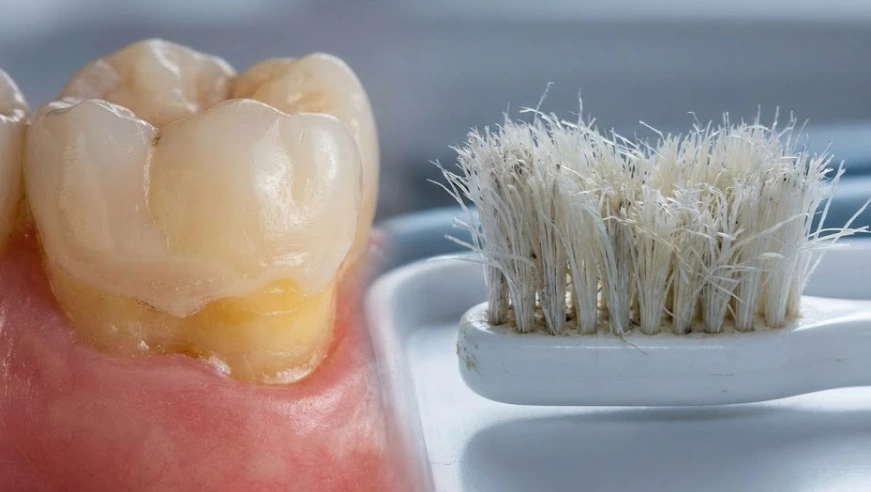
Look in the mirror. Are your teeth starting to look a bit “yellow” near the gums? That might not be a stain. It could be the yellow dentin peeking through because you’ve brushed the white enamel away.
Dentist Polen Akkılıç often sees this in high-achieving, disciplined patients. We have named it “The Perfectionist’s Penalty”. If your gum tissue is shrinking (receding) and your teeth are becoming sensitive to something as simple as a cold glass of water, your thrice-daily routine could be the reason.
Why Turkey for Dental Guidance?
You might wonder why so many people travel to Turkey and specifically to Lema Dental Clinic for these insights. It’s because we don’t just “fix” teeth; we study the lifestyle habits that break them. Whether we are performing a full “Smile Makeover” or a simple cleaning, the goal is longevity, not just a temporary shine.
FAQ: Straight Talk from the Surgeon
No, for you, it’s a necessity. Braces are like “food magnets.” However, you must be even more careful with your technique. Use a specialized orthodontic brush and zero “elbow grease.”
The reality is that a quick rinse with an alcohol-free mouthwash is often better for your midday refresh than a full brush. It balances the pH without the mechanical friction.
Absolutely. If you are brushing three times a day with a “Medium” or “Hard” brush, you are essentially using sandpaper. Switch to an ultra-soft filament immediately.
The question remains: is it plaque or just food? Try “dry brushing” (no paste) very gently, or simply rinse vigorously with water. It usually does the trick.
I strongly advise against this. Whitening pastes are often more abrasive. Using these three times a day is a fast track to tooth sensitivity and enamel thinning.
- Addy, M., & Hunter, M. L. (2003). Can tooth brushing damage your health? Effects on oral and dental tissues. International Dental Journal.
- Lussi, A., & Schaffner, M. (2000). Progression of and risk factors for dental erosion and toothbrush abrasion. Schweizer Monatsschrift fur Zahnmedizin.
- Attin, T., & Hornecker, E. (2005). Tooth brushing and oral health: how frequently and when should brushing be performed? Oral Health & Preventive Dentistry.
- Zhu, L., et al. (2003). Oral health knowledge and behaviour of adults in China. International Dental Journal.
- Amaechi, B. T., & Higham, S. M. (2005). Dental erosion: possible approaches to prevention. Journal of Dentistry.

