


Yes, stitches are usually required.
The word “oral surgery” regularly evokes a certain type of fear. One can think of scalpels, drills, and, of course, needles. Visitors who travel to Istanbul to get treated by Lema Dental Clinic often pose the question that is one of the last before they can sit in the chair: “Will there be stitches in my mouth?“
The brief response is: Most probably yes.
But the question is why. A stitch is more than just a thread; it is the last step in a surgical intervention. It determines how your gum tissue will heal around the new titanium root. From what we’ve seen, patients who are allowed to understand why the stitches are being used usually feel less afraid of the experience.
Understanding a Gum Incision
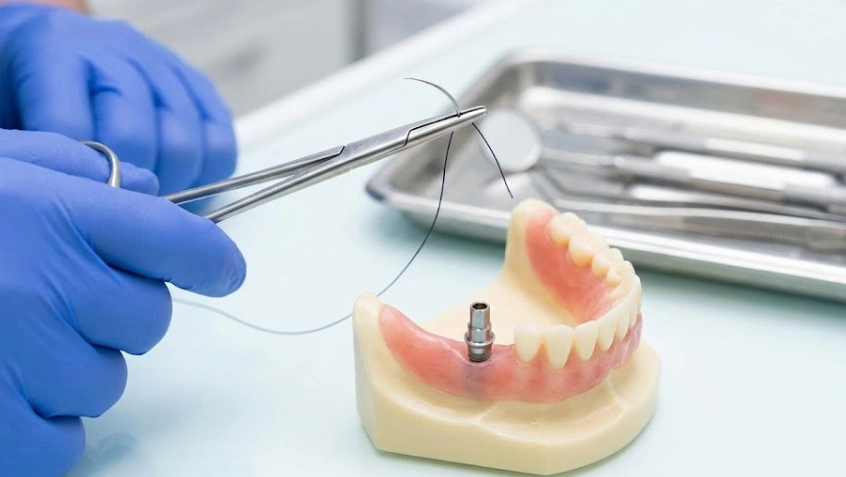
Dental implants are directly fixed on the jawbone. If we do not happen to do a special “flapless” operation (which I will explain shortly), then normally, to get to the bone, we make a small cut in the gum tissue and peel it back, as if you are lifting a corner of a carpet to fix the floorboard underneath.
Once Professor Doctor Coşkun Yıldız has fixed a titanium implant into the bone, the “carpet” (the gum line) has to be put back to its original place.
This is precisely the time when stitches are used. They are not there to hold an implant – the bone does that. The role of the stitches is to hold the gum tissue closed over the area so that new tissue can join rapidly and healing can take place. Think of it less like a wound and more like fine tailoring; we are draping the tissue to ensure the final aesthetic result looks seamless.
The Flapless Surgery Exception
Sometimes we do not use stitches. With high-tech 3D imaging technology available to us in Turkey, we can sometimes perform “flapless” surgery for various cases. In these cases, a tiny hole is made through the gum to be able to insert the implant, thus without any incision, and as a result, without stitches.
However, Dentist Polen Akkılıçand her colleagues will tell you this is not for all. The patient should have perfect bone volume and shape for this method. Most patients who need full restorations or want to close large gaps have to rely on the traditional method with sutures so that we can clearly see the bone and place the implant with absolute precision.
Material Matters: Dissolvable vs. Traditional

For our international patients who are coming to Turkey, whether the type of stitch matters a great deal. We usually divide them into two groups:
- Resorbable (Dissolvable): Is derived from natural materials (such as gut) or synthetic polymers that are broken down safely inside the body. They simply disappear by themselves after about 1 or 2 weeks.
- Non-Resorbable (Silk or Nylon): Are stronger and less inflammatory but have to be cut out.
Here is a breakdown of how we choose one over the other:
| Feature | Resorbable (Dissolvable) | Non-Resorbable (Silk/Nylon) |
| Primary Material | Gut or Polylactic Acid | Silk, Nylon, or Polyester |
| Removal Required? | No (Falls out naturally) | Yes (Requires a quick visit) |
| Retention Time | 5 to 14 days | 7 to 10 days |
| Comfort Level | Can feel slightly stiff initially | Soft, but can trap food plaque |
| Best Use Case | Patients flying home quickly | Complex bone grafts requiring tension |
At Lema Dental Clinic, we usually prefer to use a type of stitching that suits your travel arrangements the most. For instance, if you are to fly back to London or New York pretty soon after your dental operation, we might decide to use absorbable sutures so that you will not have to see a dentist in the area just to have a thread removed.
The “Tongue Test” and Healing
Living with mouth stitches for a week is, in fact, more about the irritations that may come with it than the pain. The tongue is indeed a very strange muscle; it will be eager to check out the new texture over and over again. People often say that the feeling is similar to having a small piece of dental floss caught between your teeth which you are unable to get out.
Our recommendation is always: Do not touch them. Playing around with the area by frequently touching it with your tongue might cause the knot to come undone.
Top Queries on Implant Recovery and Sutures
Surprisingly, no. The gum tissue is resilient but doesn’t have the same type of nerve endings as your skin. While the implant site might feel bruised or tender, the stitches themselves rarely cause pain. If you feel a sharp prick, it’s usually just a stiff end of the knot tickling your cheek, which can be covered with a bit of orthodontic wax.
Don’t panic. If a stitch comes loose after 3 or 4 days, the gum has likely already started to heal. Unless the wound opens up or bleeds significantly, it’s rarely an emergency. Just keep the area clean and let us know during your check-up.
Very gently. You should brush your other teeth normally, but when you get near the surgical site, stop. We usually prescribe a chlorhexidine mouthwash to keep that specific area clean without the mechanical scrubbing of a toothbrush, which could snag the knot.
We strongly advise against it. Smoking constricts blood vessels and drastically slows down gum healing. It creates a “dry” environment that can cause the incision line to fail or, worse, lead to implant failure.
If we use non-resorbable silk sutures, we typically remove them 7 to 10 days post-surgery. The process is painless—literally a “snip and pull” that takes less than 30 seconds.
- Burkhardt, R., & Lang, N. P. (2005). Coverage of localized gingival recessions: comparison of micro-and macrosurgical techniques. Journal of Clinical Periodontology, 32(3), 287-293.
- Greenstein, G., & Cavallaro, J. (2011). Flapless implant surgery: an overview of the literature. Compendium of Continuing Education in Dentistry, 32(9).
- Misch, C. E. (2007). Contemporary Implant Dentistry. Mosby Elsevier.
- Silverstein, L. H. (2005). Suturing techniques in oral surgery. Quintessence Publishing.
- Veltri, M., et al. (2016). Influence of suture material on the success of dental implants: A systematic review. International Journal of Oral & Maxillofacial Implants, 31(2).

