


Prevent decay under your crowns.
It is quite a common error in restorative dental procedures that a crowned tooth is seen as a powerful tooth. Patients generally think that since porcelain doesn’t rot, the tooth underneath it is safe forever.
At Lema Dental Clinic in Istanbul keep hearing patients talk about the “shield myth“. Although a crown is resistant to bacteria, the natural tooth that supports it can be infected. The fact is the weakest point of a crowned tooth is the margin, the very tiny line where the crown meets your natural gum and tooth.
When bacteria leak through this margin, “secondary caries” can occur (decay under the crown). As the decay lies under a ceramic shell, it often cannot be detected by the naked eye until it has become quite a large lesion. Professor Doctor Coşkun Yıldız has pointed out that this can only be prevented by changing one’s mindset from “protecting the porcelain” to “protecting the interface”.
What Happens inside the Micro-Leakage
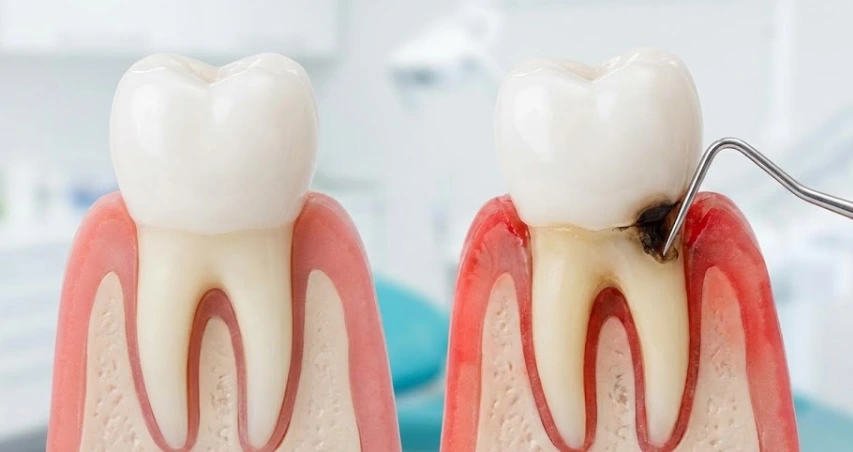
Decay under the crown is a slow process, not instant. First, it starts with micro-leakage – a leakage of a few molecules. It can mean the breakdown of the medical cement which we put at our clinic in Turkey or simply the gums receding, which then exposes the natural tooth root.
The limiting value for dental enamel is a pH of 5.5. When the place at the crown margin remains acidic because of the food or plaque that is trapped there, the minerals of your natural tooth are gradually dissolved. As the crown is hiding the tooth, you may not sense a cavity until it reaches the nerve.
The Clinical Risk Factors vs. Preventive Solutions
| Risk Factor | Biological Impact | The Clinical Solution |
| Gingival Recession | Exposes the vulnerable root surface below the crown. | Gentle brushing and professional cleaning twice a year. |
| Plaque Accumulation | Lowers pH at the margin, causing demineralization. | Interproximal cleaning (flossing or water flosser). |
| High Sugar Diet | Feeds Streptococcus mutans bacteria at the crown edge. | Rinse with water after meals and reduce sugar intake. |
| Margin Precision | Poorly fitted crowns leave gaps for bacteria. | Digital 3D scanning for “zero-gap” fit at Lema Dental Clinic. |
The “Lema Protocol”: 4 Rules for Crown Longevity
Dentist Polen Akkılıç and her team have a special hygiene protocol that helps to keep your investment in Turkey for decades. This protocol goes beyond regular brushing.
- Target the Sulcus: The bristles should be angled 45° towards the gum line while brushing. The main aim is not the cleaning of porcelain but to break the biofilm at the point where the crown and gum meet.
- The “Water Flosser” Advantage: Traditional floss is good, but a water flosser can flush out bacteria from the tiny “pockets” around a crown that string floss might miss.
- pH Neutralization: If you consume acidic foods, do not brush immediately. This can wear down the exposed natural tooth at the margin. Instead, rinse with water or a fluoride mouthwash to neutralize the acid first.
- Regular Radiographs: Because we cannot see under the crown, X-rays are mandatory. At Lema Dental Clinic, we use digital radiography to check the “integrity of the seal” once a year.
The Role of Precision in Turkey
Why does the quality of the initial fit matter so much? Professor Doctor Coşkun Yıldız explains: “A crown that is even 50 microns off-center creates a shelf where plaque can hide. This is why we use CAD/CAM technology. The tighter the seal, the lower the risk of decay.”
When you receive treatment in Turkey, the focus isn’t just on how white the teeth are, but how accurately they transition into the gum line. An “overhanging” crown is a trap for decay; a “flush” crown is a lifetime solution.
FAQ: Protecting Your Investment
Sensitivity to cold or a persistent bad taste/odor near the tooth are early warnings,” says Dentist Polen Akkılıç. “However, often there are zero symptoms. That is why professional check-ups are non-negotiable.
Rarely,” notes the team. “To properly remove the decay and ensure the tooth is structurally sound, we usually have to remove the old crown, clean the tooth, and manufacture a new one.
Absolutely. Using a high-fluoride toothpaste helps remineralize the natural tooth structure at the margin, making it more resistant to the acid produced by bacteria.
- Libman, W. J., & Nicholls, J. I. (1995). Load fatigue of teeth restored with cast post and cores and complete crowns. International Journal of Prosthodontics.
- Felton, D., et al. (1991). Effect of crown margin finish and shape on periodontal health. Journal of Prosthetic Dentistry.
- Valderhaug, J. (1991). A 15-year clinical evaluation of fixed prosthodontics. Acta Odontologica Scandinavica.
- Sailer, I., et al. (2015). A systematic review of the survival and complication rates of all-ceramic crowns. Clinical Oral Implants Research.

